Two critical flaws in NGINX, the web server software behind more than 225 million websites, can let an attacker run code on a server without logging in, and researchers say artificial intelligence helped find them. Wiz Research disclosed the vulnerabilities on November 18, 2026, in a coordinated release with F5, the company behind NGINX, and patches are already available.
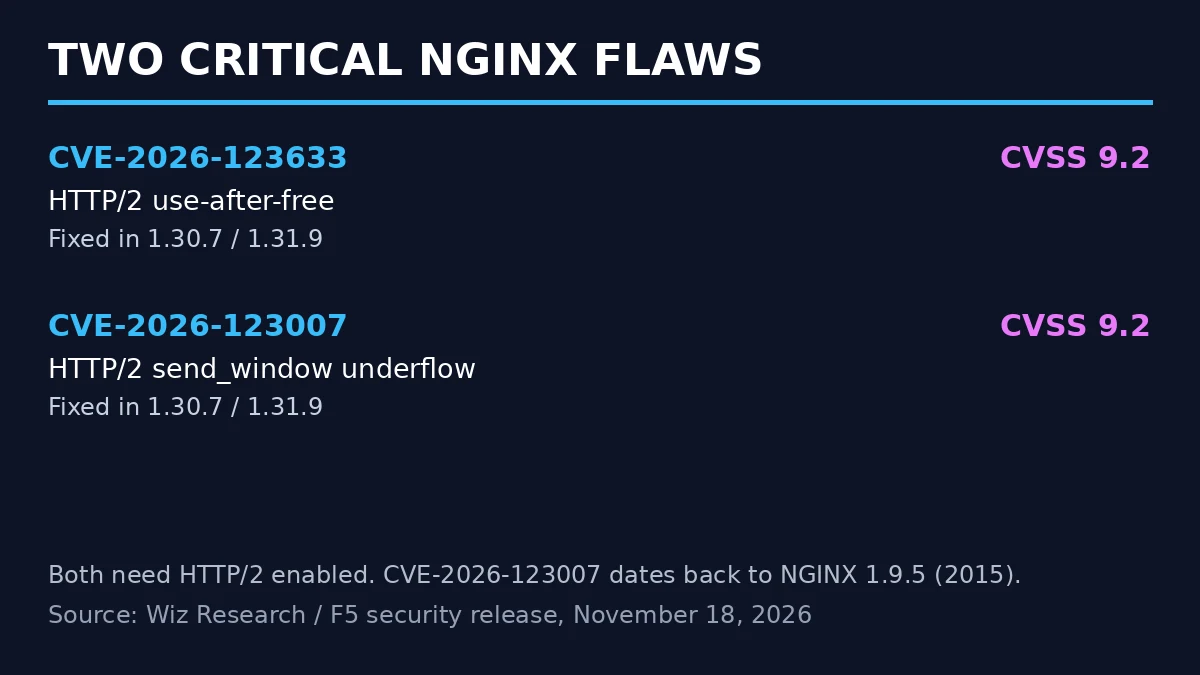
The NGINX RCE flaws, tracked as CVE-2026-123633 and CVE-2026-123007, both carry a CVSS 4.0 score of 9.2, the critical range. Both are memory safety problems in how NGINX handles HTTP/2 traffic, and both require HTTP/2 to be enabled on the affected server. Because the flaws sit in NGINX itself, websites and APIs behind it can be exposed even when their own application code is secure.
What Are the Two Flaws?
CVE-2026-123633 is a use-after-free flaw in NGINX’s HTTP/2 connection handling. A connection can be marked as reusable while it is still processing a request, so NGINX can close it and free its memory while the request is still running. The request then keeps using memory that has already been freed, which an attacker can turn into unauthenticated remote code execution. Wiz says the flaw had been present for nearly six years and mainly affects NGINX configured as a reverse proxy.
CVE-2026-123007 is an integer underflow in HTTP/2 flow control. A refund of unused flow control credit can push a counter past its maximum, and an unsigned arithmetic wrap then defeats a bounds check, eventually producing an out-of-bounds memory copy. Wiz demonstrated code execution on a server serving ordinary static files, with no backend application or third-party module involved. The flaw dates back to NGINX 1.9.5, released in 2015, so it sat in the code for more than a decade.
Wiz confirmed remote code execution with an ASLR bypass on official NGINX 1.31.7 and 1.31.8 builds. The team built proof-of-concept exploits in its lab but said it will not release them.

Image: Wiz Research
How AI Found the Flaws
Wiz Research used its Wiz Atlas harness, which powers its AI code scanning product, to discover both vulnerabilities, then used Gemini 4 Carbon and ChatGPT 5.6 Sol to validate that each one could allow an unauthenticated attacker to execute code. The discovery was not a one-team effort: Ikotas Labs, Metnir, Rapid7 and Xint independently found the same flaws and reported them to F5.
Forbes reported that Xint found the flaws using OpenAI’s GPT 6.1 Sol and GPT-6 Luna. Xint has separately described a set of five NGINX vulnerabilities under the name NGINX2Root, covering HTTP/2, HTTP/3, the resolver and the mail proxy, all rated 9.2, and says the HTTP/2 flaw can be chained with a separate Linux kernel flaw to reach host root.
The pattern is now familiar. Wiz notes that the same AI-assisted approach produced the PHP2Shell flaws last month, and the Java4Shell flaw in OpenJDK disclosed on November 17. Wiz put it plainly in its writeup: “AI is fundamentally dissolving that barrier.” The team added: “The flaws were already there; AI helped us find them.”
Who Is Affected and What to Do
CVE-2026-123633 affects NGINX Open Source from version 1.19.7 and NGINX Plus from R33 and 37.0.0. CVE-2026-123007 affects NGINX Open Source from 1.9.5 and the same NGINX Plus branches. F5 fixed both flaws in NGINX Open Source 1.30.7 (stable) and 1.31.9 (mainline), with matching NGINX Plus releases. Wiz recommends identifying affected deployments with HTTP/2 enabled and upgrading as soon as possible.
If an upgrade cannot happen immediately, the workaround is to temporarily disable HTTP/2 on affected instances. Wiz also notes that CDNs and web application firewalls that terminate HTTP/2 may block parts of an attack, since exploitation requires the attacker to communicate directly with the affected NGINX server. No exploitation in the wild has been confirmed, according to coverage of the disclosure.
Graphic: GPTOnline, using figures from Wiz Research and F5
Why It Matters
NGINX is the front door for a huge share of the web, handling HTTPS and routing traffic to the applications behind it. A single NGINX deployment often serves several applications, so one compromised server can put multiple websites and APIs at risk. These flaws show that even software reviewed for years can hide critical bugs, and that AI is now good enough at tracing complex memory interactions to find them.
That cuts both ways. The same capability that helps defenders uncover flaws can help attackers investigate them, and faster discovery shortens the window between disclosure and exploitation. Wiz argues the answer is to make this kind of work routine: find the flaws in the software organizations depend on and fix them with the maintainers. For now, the practical advice is simple. Check whether your NGINX servers run HTTP/2, and patch them.
Sources
- Wiz Research, “Unauthenticated Remote Code Execution in NGINX: CVE-2026-123633 and CVE-2026-123007”
- SecurityOnline.info, “NGINX2Root (CVE-2026-123007): NGINX RCE Explained”
- CybersecurityNews, “NGINX HTTP/2 Flaws Could Allow Memory Corruption and Remote Code Execution on Web Servers”
- Forbes, “Cybersecurity company Xint says it found RCE vulnerabilities in Nginx using GPT 6.1 Sol and GPT-6 Luna”