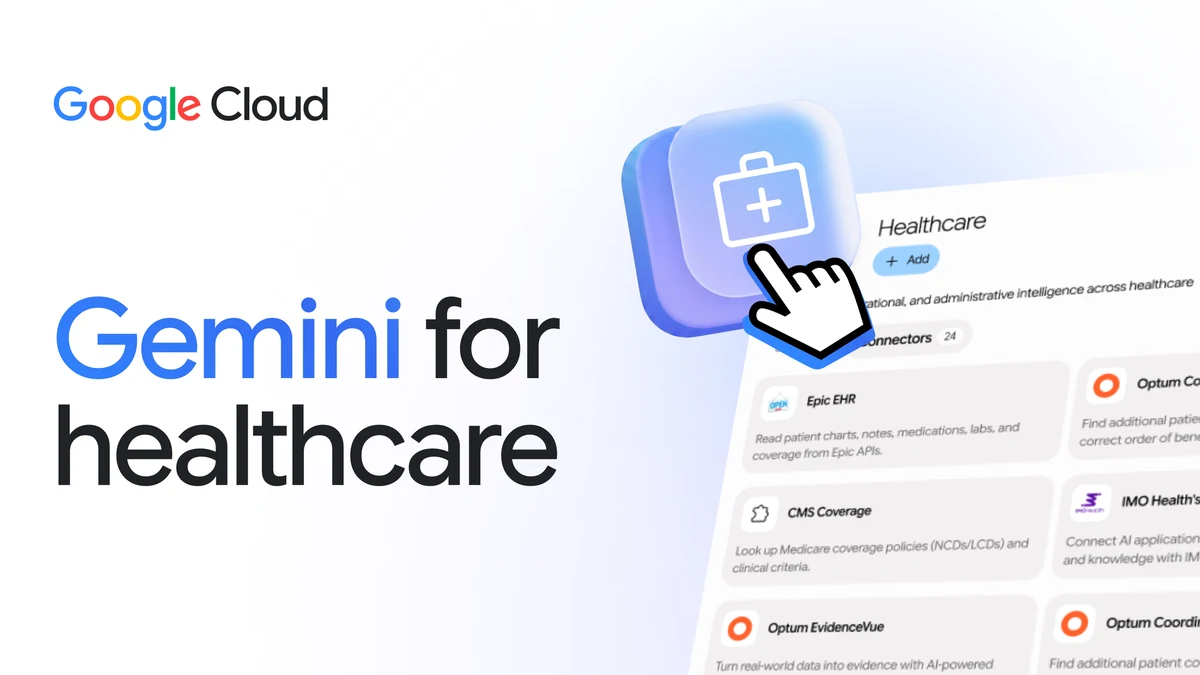
Google Cloud on Tuesday launched Gemini for healthcare in preview in the United States, bringing its Gemini agent to hospitals and health plans with 27 connectors to the clinical and administrative systems they already run. The announcement, published Nov. 10 by Google Cloud CEO Thomas Kurian, targets the paperwork that Google says eats nearly 28 hours a week of clinician time.
The launch extends the universal Gemini agent Google introduced last month at Gemini at Work, and it joins Google Cloud’s industry-specific agent solutions for legal, financial services and government. It serves both sides of the health system: providers that need patient context assembled from scattered records, and payers that need coverage requests checked against medical policy.
What Gemini for Healthcare Does
Gemini for healthcare is not a standalone chatbot. It is a purpose-built industry solution that extends the Gemini agent, which Google describes as a single, always-on agent where employees delegate an objective and the agent plans the steps, retains organizational context and routes across the best models to deliver finished outcomes inside the tools teams already use.
For providers, the agent pulls together a patient’s history across care settings, prepares charts before a visit and assembles authorization packets against payer policy before submission, so fewer claims come back denied. For health plans and payers, it checks requests against medical policy, organizes findings for the clinical reviewer and explains benefits and costs to members from their own plan documents.
“Healthcare organizations need a single, secure, governed orchestration layer that coordinates work across the systems they already run, assembling verifiable evidence and taking multi-step workflows through to completion with human oversight,” Google Cloud wrote in the announcement. The platform is built to support HIPAA compliance, with enterprise-grade access controls, end-to-end audit logging and verifiable citations so reviewers can check where each answer came from.
Four Building Blocks
Google Cloud says Gemini for healthcare was developed alongside clinical and health plan leaders and provides an integrated, fully governed environment with four core components:
- Skills for healthcare work: reusable instructions and context, written by domain experts, that teach Gemini to run tasks such as medical records synthesis, pre-appointment preparation and coverage review. Teams can also build custom skills for their own workflows.
- Connectors to clinical, financial and operational systems: a library of connectors links Gemini directly to the electronic health record, claims, care management and administrative systems organizations already run, while preserving existing identity and role-based access controls.
- An open healthcare partner ecosystem: health systems integrators and digital health partners help organizations extend Gemini with specialized solutions and connect it to what they already run, without lock-in.
- A secure, governed platform with open model choice: clinical, security and IT leaders get one place to set and enforce policies that govern every agent interaction, and organizations can pair frontier models from Google and partners for complex clinical reasoning with faster, cheaper models for routine administrative steps.
27 Connectors, With Read-Only EHR Access
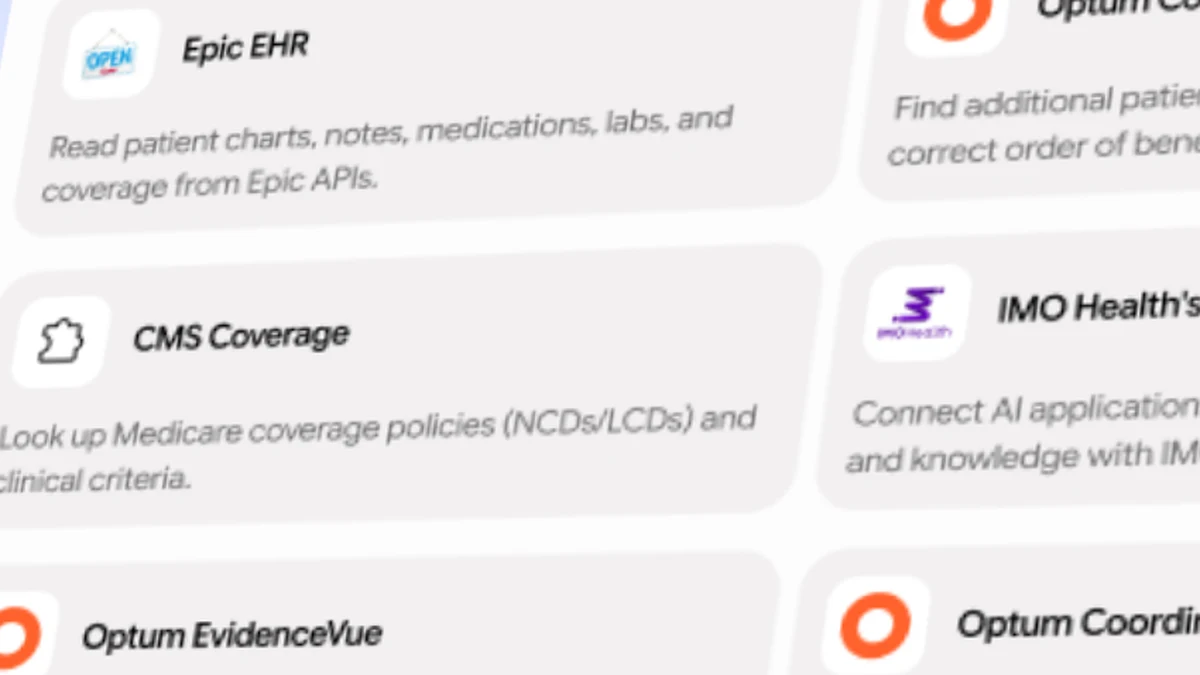
The connector library covers electronic health records, eligibility and claims, terminology and coding, coverage rules, clinical guidelines and enterprise productivity tools. The two largest EHR integrations are read-only by design: Epic gives authorized users access to patient conditions, medications, labs, clinical notes and specialist documentation, with no write-back to the underlying chart, and Oracle Health surfaces read-only patient histories, diagnostics and lab results while enforcing zero write-back.
Other connectors include InterSystems FHIR Server and Keragon for data interoperability, Optum tools for coordination of benefits and eligibility (in limited release), TriZetto for coverage checks across Medicare, Medicaid and major commercial plans, GoodRx for prescription pricing, Infinitus Relay for payer phone calls, CMS Coverage for Medicare rules, BMJ Digital Health for clinical guidelines, and integrations with Salesforce Health Cloud, Suki, UiPath, Alteryx, ServiceNow, Microsoft 365 and Google Workspace.
Early Customers and Partners
Google Cloud named HCA Healthcare, Highmark Health and Northwell Health as launch partners working with the platform, alongside Blue Cross Blue Shield of Massachusetts, Hartford HealthCare, Optum and Stanford School of Medicine. Sixteen systems integrators, including Accenture, Cognizant, Deloitte, KPMG and PwC, will help customize and scale the capabilities.
“Making it easier for physicians to access and understand a patient’s medical history helps them spend less time gathering information and more time focused on patient care,” said Michael J. Schlosser, MD, MBA, FAANS, Executive Vice President and Chief Clinical Officer at HCA Healthcare. “Through our work with Google Cloud, we’re exploring how Gemini can interpret and synthesize complex patient information from multiple electronic health record systems and care settings.”
“By leveraging Gemini for healthcare, we will be able to use technology in a way that elevates the patient experience and strengthens the relationship between caregivers and those they serve,” said Dr. John D’Angelo, President and CEO of Northwell Health. “Through these integrated solutions, we expect to ease some of the administrative burden on our clinical teams and give them more time for what matters most: caring for their patients.”
“The real promise of AI in healthcare isn’t simply doing today’s work faster. It’s creating a better way for the health system to work,” said Sandeep Dadlani, Chief Executive Officer of Optum Insight. “When payers and providers can connect data, insights and workflows more seamlessly, we can remove unnecessary complexity, improve performance and help the entire system work better.”
Availability
Gemini for healthcare is available starting today in preview in the United States. Google has not disclosed pricing or a general availability date. Support for NextGen Healthcare is still in development and is expected in the coming months.
The launch puts Google Cloud in direct competition with other vendors racing to automate healthcare administration. Google’s answer is governance first, with read-only EHR access, audit logs and citations as the selling points rather than speed alone.