ChatGPT now fields a volume of search-like queries roughly one-fifth the size of Google’s total query volume, OpenAI’s consumer product lead Adam Fry told Big Technology’s Alex Kantrowitz in a fireside chat at an OpenAI-hosted dinner in New York on Monday night. The disclosure, published November 3, is one of the first times OpenAI has publicly benchmarked its search activity directly against Google.
What Was Announced
Fry said ChatGPT added 200 million weekly active users in just 60 days, jumping from 1 billion to 1.2 billion weekly active users. “That’s roughly 100 million users in 30 days, and another 100 million in another 30 days. The growth is just going big, and we’re staying very focused on how fast ChatGPT is growing,” he said.
On the search comparison, Fry was direct: “ChatGPT’s volume of search-like queries is now roughly one-fifth the volume of queries of Google.” He explained how the company counts a search: “Every time you ask a question and go search the web, that’s a search.”
Fry also put new figures on two other fast-growing modalities. ChatGPT’s voice features, covering both dictation and spoken conversation, now have 250 million combined weekly active users, and users create 1.5 billion images per week.
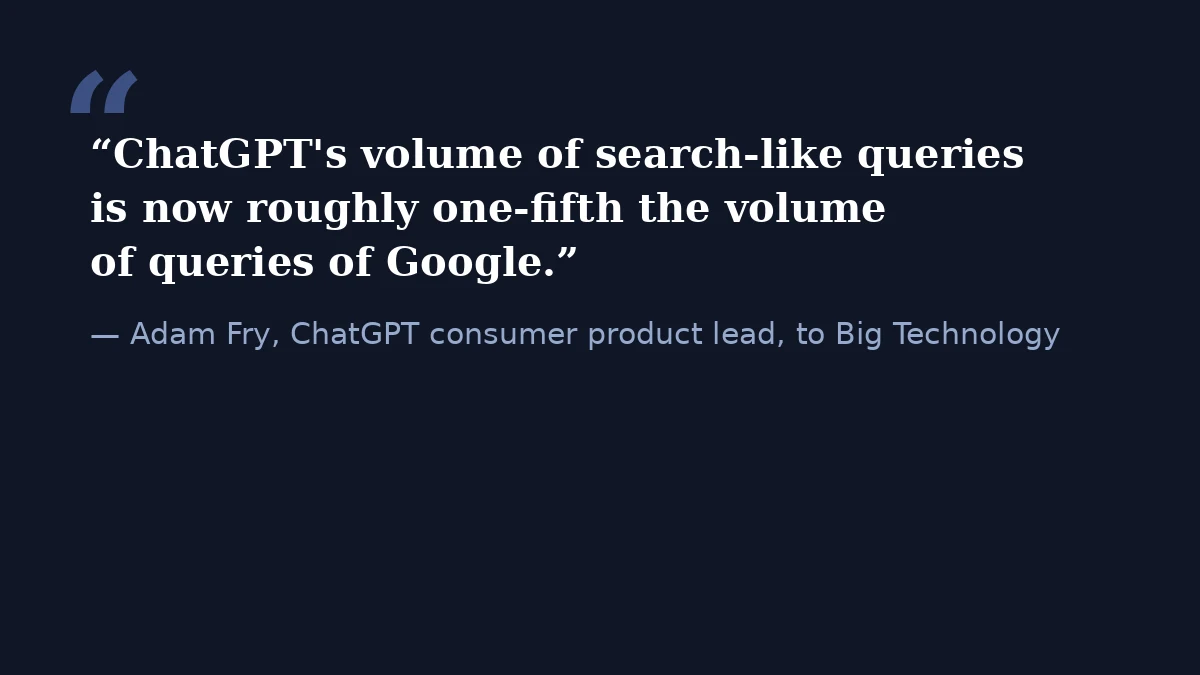
Adam Fry, ChatGPT consumer product lead, to Big Technology. Graphic: GPTOnline.
Key Details and Caveats
The search claim deserves careful reading, because it is a volume comparison from OpenAI’s own internal analysis, not a claim of search market share. Fry did not disclose absolute search numbers or explain how OpenAI estimated Google’s total query volume. When Kantrowitz noted that Bing holds around 5% of the search market and asked whether that made ChatGPT several times larger than Bing, Fry sidestepped and answered with the user-growth figures instead.
Independent estimates have put ChatGPT’s search-equivalent footprint in a similar neighborhood but vary widely in methodology. As cryptobriefing noted, estimates range from 7.5% (seoClarity, October 2026) to around 12% (Ahrefs, February 2026), while OpenAI’s own Signals v3.0 report classified roughly 20.1% of ChatGPT messages as “seeking information.” Volume is also only part of the story: analyses have found ChatGPT’s click-through rate below 1% and its referrals accounting for less than 1% of organic sessions, so Google still sends roughly 190 times more traffic to websites.
On voice, Fry said the 250 million figure reflects both quick questions and long conversations, and that the recent jump was driven by the GPT Live 1 and 1.1 models, which made voice interaction “much more natural” through backchanneling and interruptibility. “We are at 250 million weekly active users,” he said. “It’s no longer just a novelty. People aren’t just trying out voice. We’re seeing them use voice input day to day in their daily life.”
Fry also touched on monetization. OpenAI passed 50 million paid subscriptions “several months back” and the number has “grown considerably” since, while the ChatGPT ads business passed $1 billion in annualized revenue within 200 days of launch. He confirmed the plan to merge ChatGPT’s Chat and Work modes into a single interface, echoing the email to subscribers GPTOnline reported on earlier this week.
Why It Matters
Search is the most valuable habit in consumer internet, and Google still dominates it: on October 29, Alphabet said Google searches grew at their fastest year-over-year rate in five years, and Search and related products brought in $63.35 billion in third-quarter revenue. But a chatbot handling one-fifth as many search-like queries as Google, just 18 months after ChatGPT had “no up-to-date information,” reframes the race. Fry pointed to the shift in what people use ChatGPT for: writing and coding help no longer need fresh information, but lookups of people, places, finance and health questions now route through web search inside the chatbot, “anything that a user would have traditionally gone to a traditional search engine for, but is now deciding to go to ChatGPT for.”
The numbers also show where OpenAI’s growth is coming from. With voice and image generation scaling alongside text, ChatGPT is becoming a multi-modal interface that competes with search not as a better ten-blue-links page but as a context-aware assistant. “The growth is just going big,” Fry said, and OpenAI is betting that trajectory continues even as it starts selling advertising inside the experience.
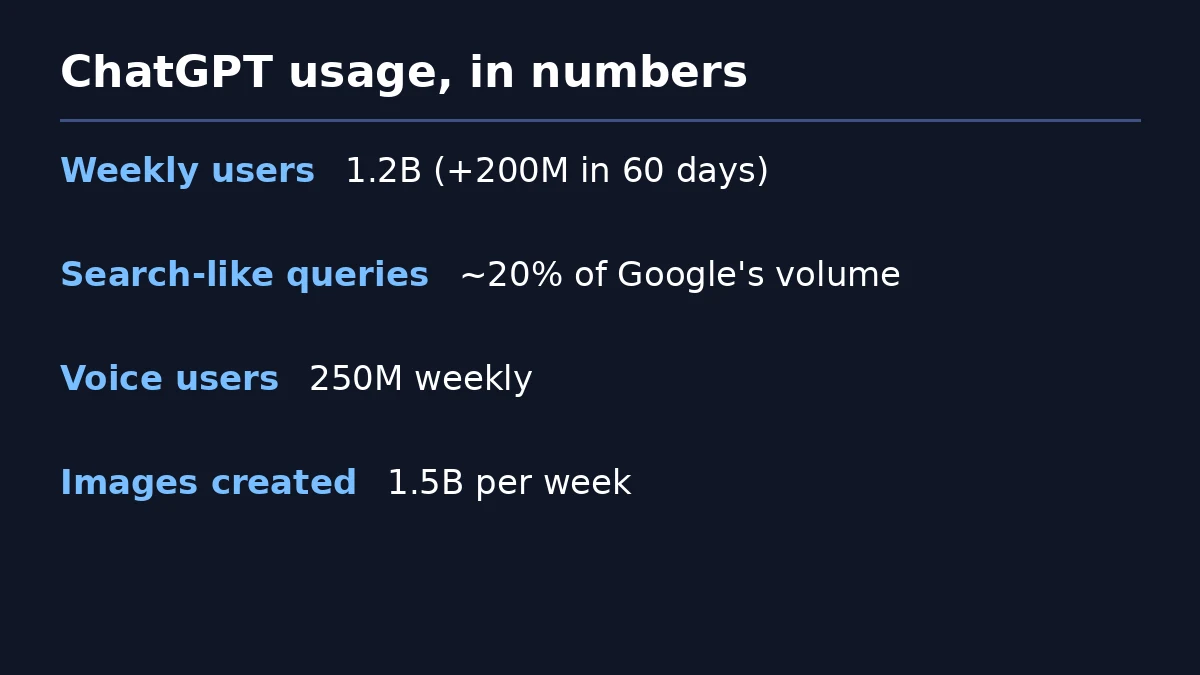
Key ChatGPT usage figures. Graphic: GPTOnline.
Sources
- Alex Kantrowitz, Big Technology: OpenAI: ChatGPT Search Is About 20% of Google’s (November 3, 2026)
- AI Stock Wire: ChatGPT search volume is about 20% of Google’s, OpenAI says
- Crypto Briefing: OpenAI says ChatGPT search volume has reached about one-fifth of Google’s