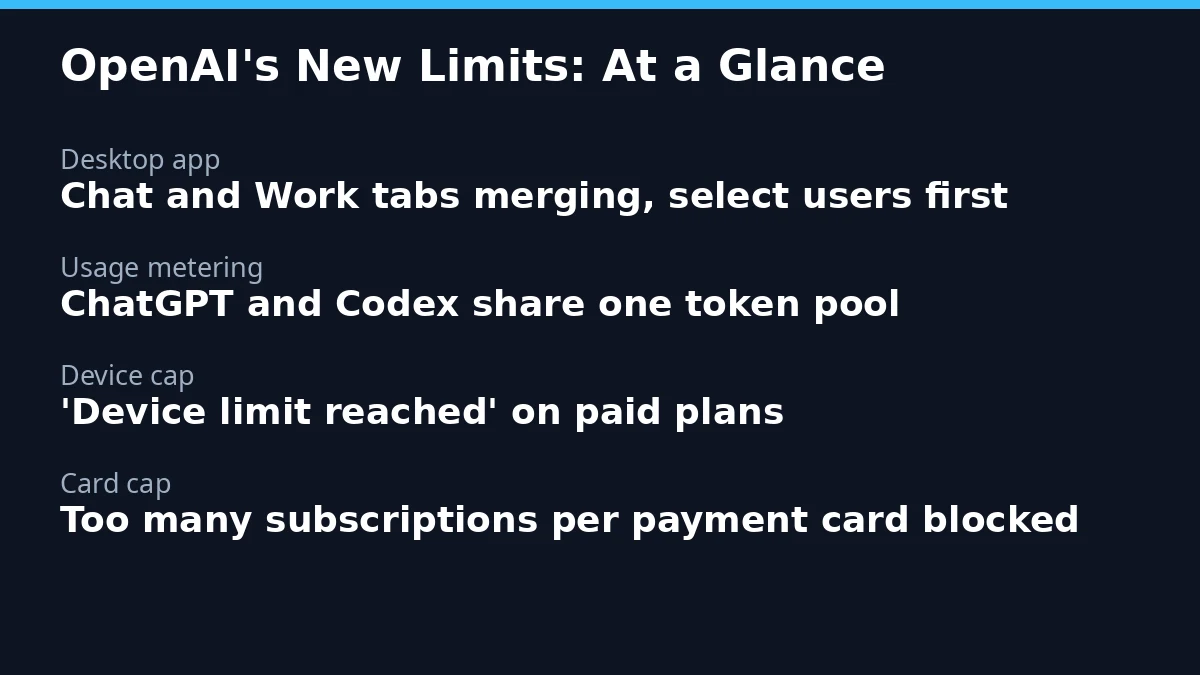
OpenAI is merging the Chat and Work tabs inside the ChatGPT desktop app and folding ChatGPT and Codex into a single shared token pool, according to an email the company sent to users, TechCrunch reported on November 2. The change arrives alongside new limits on how many paid ChatGPT accounts can run on one device or payment card.
“This will enable you to move from exploring an idea to having ChatGPT carry it through, all in one place. You can bring in your files and plugins and ask ChatGPT to build a website, create a presentation, or do things for you on the web, while reviewing and guiding its work. Codex will remain a separate experience in the ChatGPT desktop app,” the email said.
One tab, one token pool
The merged Chat and Work experience will initially go to select users for feedback before rolling out widely, the email said. With the transition, both ChatGPT and Codex will draw tokens from the same allowance pool. OpenAI told users the change will not affect most of them, but that “based on usage and model, some folks might need to wait for resets more frequently.”
The move mirrors rival Anthropic, which merged Claude’s chat and Cowork functions into one screen in September. OpenAI has been testing a combined Chat and Work experience for weeks, and its updated help documentation says Plus, Pro and Business plans will share a usage allowance across ChatGPT and Codex from December, Precise Impact reported.
New caps on devices and cards
Separately, OpenAI’s help center now documents two restrictions aimed at subscription sharing. Users who exceed the number of paid ChatGPT accounts allowed on a single device see a “Device limit reached” message, and signing out does not free up a slot. The device cap applies to Go, Plus and the three Pro tiers, but not to Free, Business, Enterprise or Education accounts, OpenAI’s help article states.
A second check blocks checkout when too many subscriptions are associated with a single payment card, showing the message “Too many subscriptions associated with this card or device.” The updated documentation, published in OpenAI’s help center, reads as a crackdown on resold and shared accounts, a practice that has plagued ChatGPT subscriptions since their early days.
Why it matters
Taken together, the changes point to OpenAI tightening both the product and the billing around ChatGPT. Merging tabs simplifies an app that even TechCrunch called confusing, while a shared token pool and hard device and card caps close loopholes that let heavy users stretch one subscription across many machines or many people. For legitimate users running ChatGPT and Codex side by side, the practical effect is a single budget for both tools, with heavier users likely to hit resets sooner.