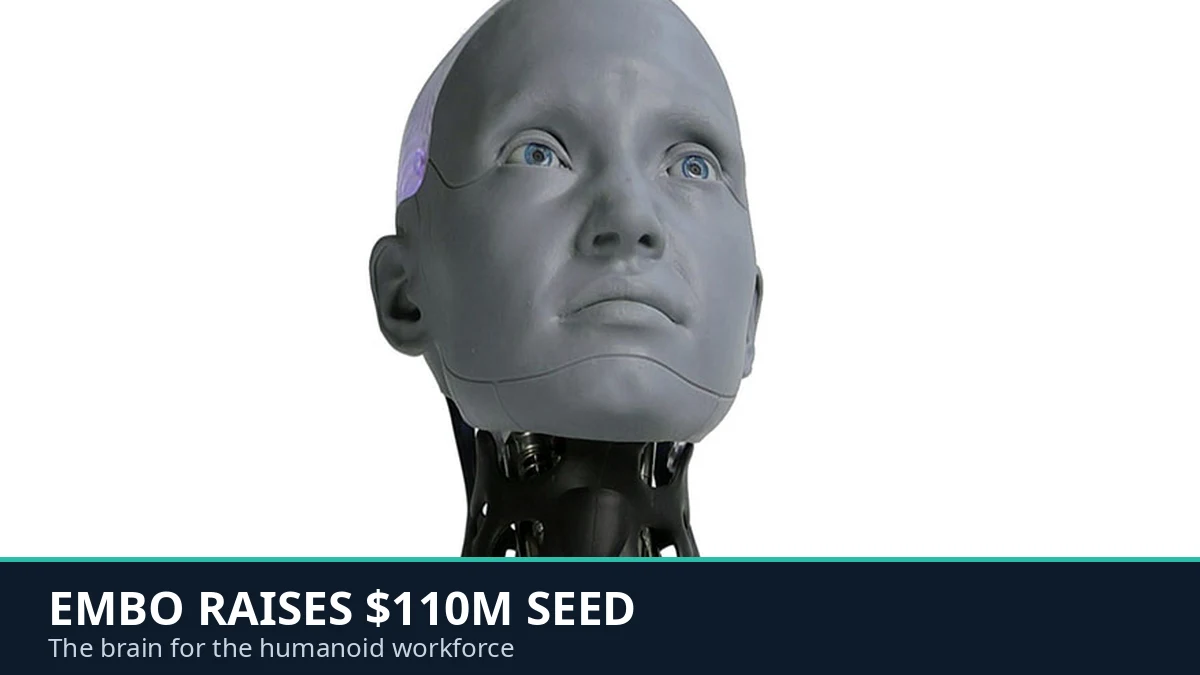
Embo, a new robotics startup from the researchers behind the Dreamer world-model agents, has come out of stealth with a $110 million seed round for the Embo robot brain, which it calls the brain for the humanoid workforce. Andreessen Horowitz led the round, announced on November 23, with Khosla Ventures, DST Global, Nvidia’s venture arm NVentures, Striker and other strategic investors taking part.
The round is unusually large for a seed deal and lands as investors pour money into foundation models for robots. Dealroom notes that at $110 million, the round ranks in the top 1% of seed rounds for computer vision startups in the United States. Physical Intelligence raised $600 million in November 2025, and Skild AI pulled in $1.4 billion in January 2026 at a $14 billion valuation.
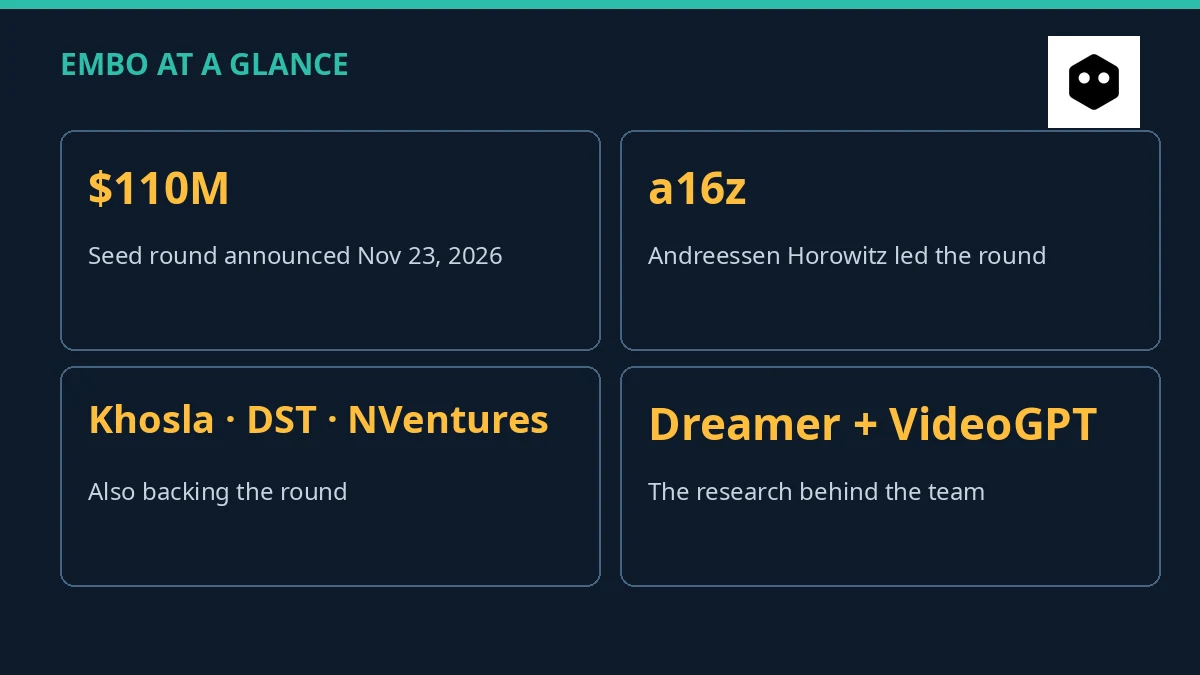
Graphic: GPTOnline, using Embo brand assets. Data: Andreessen Horowitz and Dealroom.
What Embo Is Building
Embo is betting on world models, AI systems that learn how the physical world behaves by predicting what happens next in video. The company pretrains its robot brain from scratch on internet-scale video and text, then lets it practice motor skills inside the model across thousands of imagined scenarios, improving through reinforcement learning, including learning from its own failures. The trained model is then connected to real motors and sensors on the company’s own fleet of humanoid robots, with real-world data fed back in.
Andreessen Horowitz, which published an investment note confirming it led the round, framed the approach as the next step for frontier AI. “Embo’s conviction is that world models are the next generation of frontier AI: models that learn how the world works, enabling robots to anticipate the consequences of their actions, recover from mistakes, and adapt to unfamiliar situations,” the firm wrote.
Embo says it is “building the next generation of AI, with a deep understanding of physical reality and fine-grained motor skills,” and that its robot brain will control humanoids in new environments “out of the box.”
Two Problems: Generalization and Resilience
The company says it is tackling two closely related problems. The first is generalization: a robot trained in one kitchen should work in any other kitchen it has never seen before. The second is resilience: when an object slips or a drawer sticks, the robot needs to recover and keep going instead of failing.
World models are Embo’s answer to both. Learning from human demonstrations has driven much of the progress in robotics so far, but Andreessen Horowitz notes that “we can’t demonstrate every task in every environment or every way it might go wrong.” Internet video, by contrast, holds an enormous record of how objects move, how materials interact and how people perform tasks. Training on that data, then practicing inside the learned model, gives the robot far more experience than could practically be collected on physical hardware, including the failures and unexpected situations that demonstrations rarely capture.
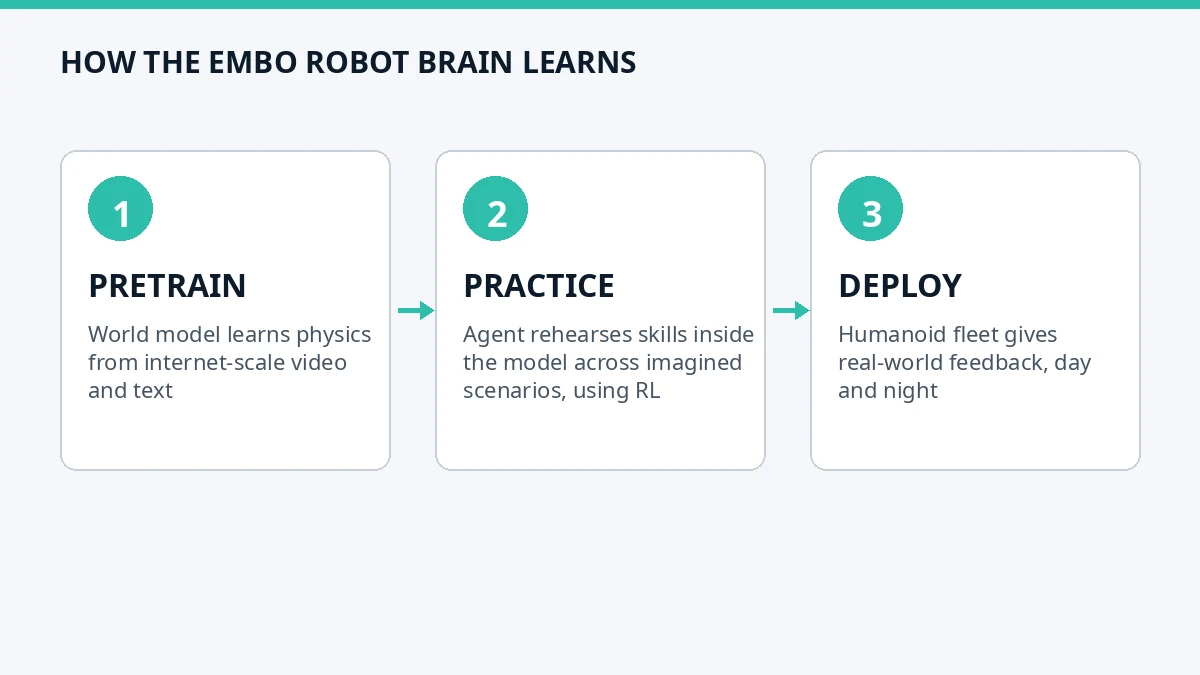
Graphic: GPTOnline. Embo’s three-step approach: pretrain on video, practice in imagination, deploy on a humanoid fleet.
The Team Behind Dreamer and VideoGPT
Embo is led by chief executive Danijar Hafner, who spent nearly a decade on world-model agents and created Dreamer, a family of AI agents that learn to act by practicing inside a learned world model. Its latest version, Dreamer 4, learned to obtain diamonds in Minecraft from previously collected data, with its training done entirely through imagined experience. Hafner is joined by chief technology officer Wilson Yan, who built VideoGPT and has worked with Hafner on world models for years.
The broader team draws on experience from Google DeepMind, Meta Superintelligence Labs, NVIDIA Cosmos, UC Berkeley and MIT, and its research includes Dreamer, VideoGPT and Diffusion Forcing.
Why It Matters
Humanoid robots can already do remarkable things in demonstrations, from folding laundry to preparing food. But those skills are often fragile: move an object, change the lighting or introduce something unfamiliar, and the robot can struggle. If Embo’s approach works, robots could learn general physical common sense from video before they ever touch a task, then sharpen their skills through imagined practice, a path that scales with compute rather than with slow, expensive real-world data collection.
For now, the bet is on the team and the thesis. Embo has no public product, no disclosed customers and has not revealed its valuation, headquarters or headcount. It has also not announced a product launch date. What it has shown is early results that Andreessen Horowitz describes as “remarkably promising,” and a $110 million vote of confidence that world models are the way to get robots out of the demo and into the real world.