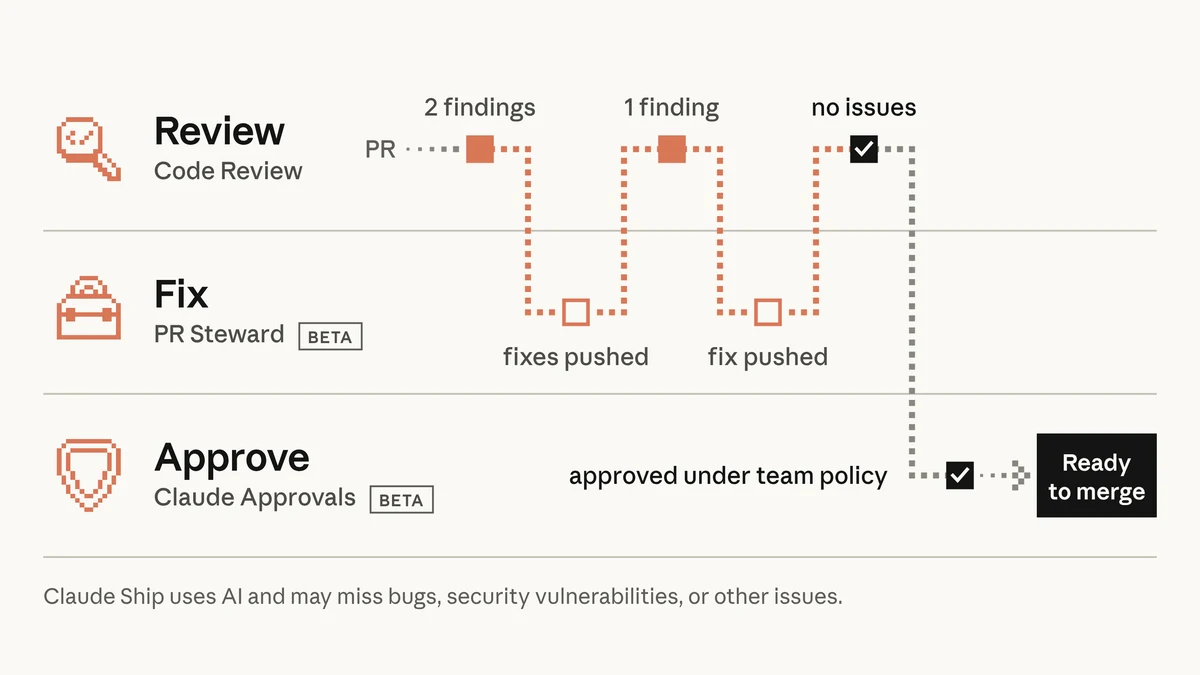
Anthropic has launched Claude Ship, a new product that lets Claude review GitHub pull requests, fix the problems it finds, and approve the changes a team’s own policy allows. The company announced Claude Ship on November 23, and it is available now in beta for Claude Team and Enterprise plans.
“It can review PRs, fix them, and decide what’s ready to merge based on policies each team sets,” Anthropic said in the announcement. “The goal: ship code as fast as teams write it.”
The launch targets a bottleneck that has grown as AI coding agents write more code. Reviewing that code, fixing review feedback, and getting an approval still takes human time, and Anthropic argues the steps after a pull request opens should move as fast as the writing itself.
What Was Announced?
Claude Ship is not a single tool. It combines three agents that hand a pull request from one step to the next, so teams do not have to manage each stage by hand.
Code Review, already generally available, performs an in-depth review of a pull request against the wider codebase. It collects findings, checks them against each other, categorizes them, and posts them to the pull request. Teams can choose Quick, Standard, or Deep review levels for each repository.
PR Steward, new in beta, works to keep a pull request green. It jumps in on failing CI checks, merge conflicts, and review feedback from Code Review, other review tools, or team members. After every push, it comments with what it changed and how to undo it. It is designed never to approve or merge a pull request, and developers can steer it by commenting @claude with an instruction, or tell it to step back with @claude stop.
Claude Approvals, also in beta, applies an approval policy the team writes as a file in the repository. It works like a smarter CODEOWNERS file, approving routine changes on its own where the policy allows it, and requiring deeper human sign-off for the scenarios the policy flags. Anthropic recommends enabling it first in observe-only mode, to build confidence before branch protection requires its green light.
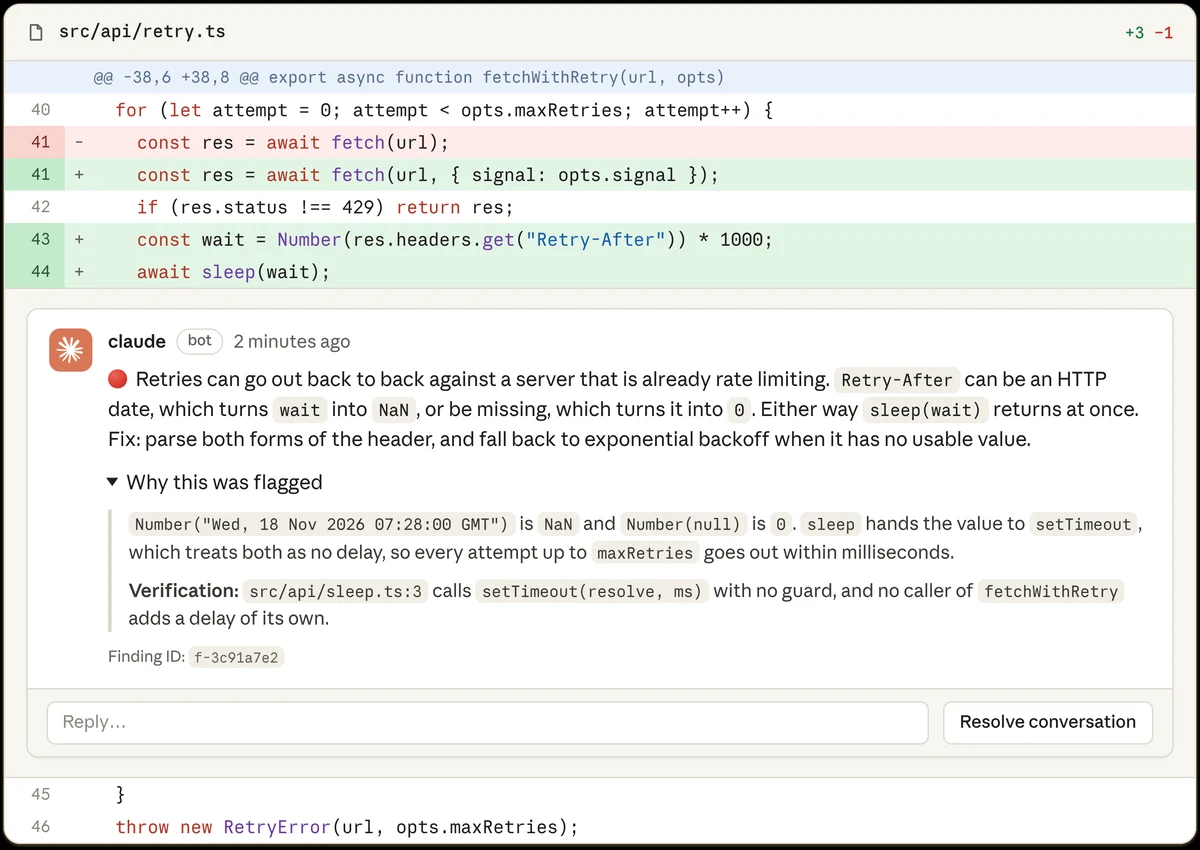
Image: Anthropic
How Developers Use It
Individual developers can try Claude Ship with a new /ship command in Claude Code. When a change is ready, they run /ship, and Claude pushes it, opens the pull request, reviews the change, and works on feedback and failing checks to help get it ready to merge. The command is rolling out in Claude Code and the desktop app starting today, and running it counts as regular Claude Code usage.
For whole teams, an admin can turn Claude Ship on for an entire repository, so it works across pull requests automatically under settings and an approval policy the team controls. Admins choose where it runs, pick the review level and when reviews run, and set spend limits. Claude Ship works with existing branch protection and required checks, and teams can start with a single repository.
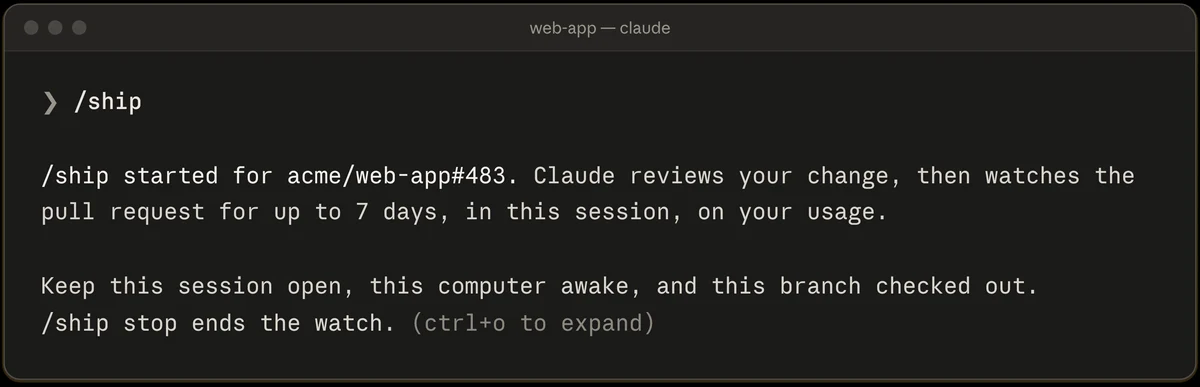
Image: Anthropic
Early Results Inside Anthropic
Anthropic says it runs Claude Ship on many of its own pull requests, and the internal numbers are striking. On the Claude Code team, where Claude writes most of the code, merged pull requests more than doubled from June to September, while the share of changes that had to be reverted fell by more than 40%.
The company gave one example of how the workflow changes who can act on feedback. A product manager read a customer report that the Analytics API documentation implied an Admin key could pull Pro and Team usage, talked through a fix with Claude Tag, and Claude opened a pull request. Code Review found nothing blocking, a docs reviewer signed off, Claude Approvals passed, and the fix merged that same evening.
Pricing and Availability
Claude Ship is available on Claude Team and Enterprise plans for repositories on GitHub. Usage is billed on tokens, so turning it on can add to an organization’s costs, depending on the number and size of pull requests covered, the review level, how often reviews run, and how much work PR Steward does. Admins can set spend limits for Code Review and PR Steward. Claude Approvals has no base charge, though classifiers in a policy are billed on the tokens they use.
Eligible Claude Enterprise organizations can claim at least $10,000 in Claude Ship credits to use within 30 days of claiming. Claims must be made by January 15, 2027, and terms apply.
There are limits on who can use it. Claude Ship is not available to organizations with Zero Data Retention, the HIPAA configuration, or customer-managed encryption keys. It also supports GitHub repositories only for now.
Why It Matters
The launch comes days after Anthropic began trading on Nasdaq, and it extends the company’s push from writing code to running the whole software pipeline. If review, fixes, and approvals can be automated under a written policy, small teams could ship at a pace that used to need a much larger engineering organization. The risk is the one Anthropic flags itself: Claude Ship uses AI and may miss bugs, security vulnerabilities, or other issues, which is why the approval policy and observe-only mode matter as much as the automation.
Anthropic is also one of the largest renters of AI compute in the industry, buying capacity from SpaceX under a deal worth up to $120.5 billion through 2029, as GPTOnline reported on November 23. Investors reacted cautiously to the Claude Ship launch, with Anthropic shares falling more than 3% in late trading on Monday, according to Seeking Alpha.