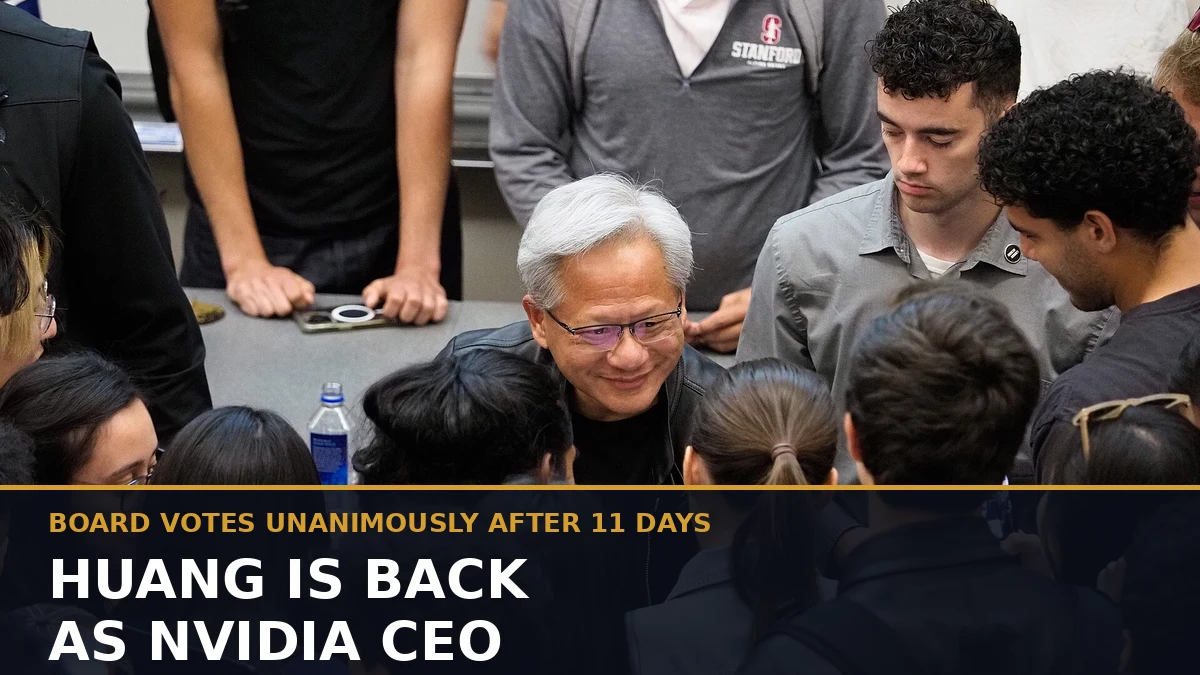
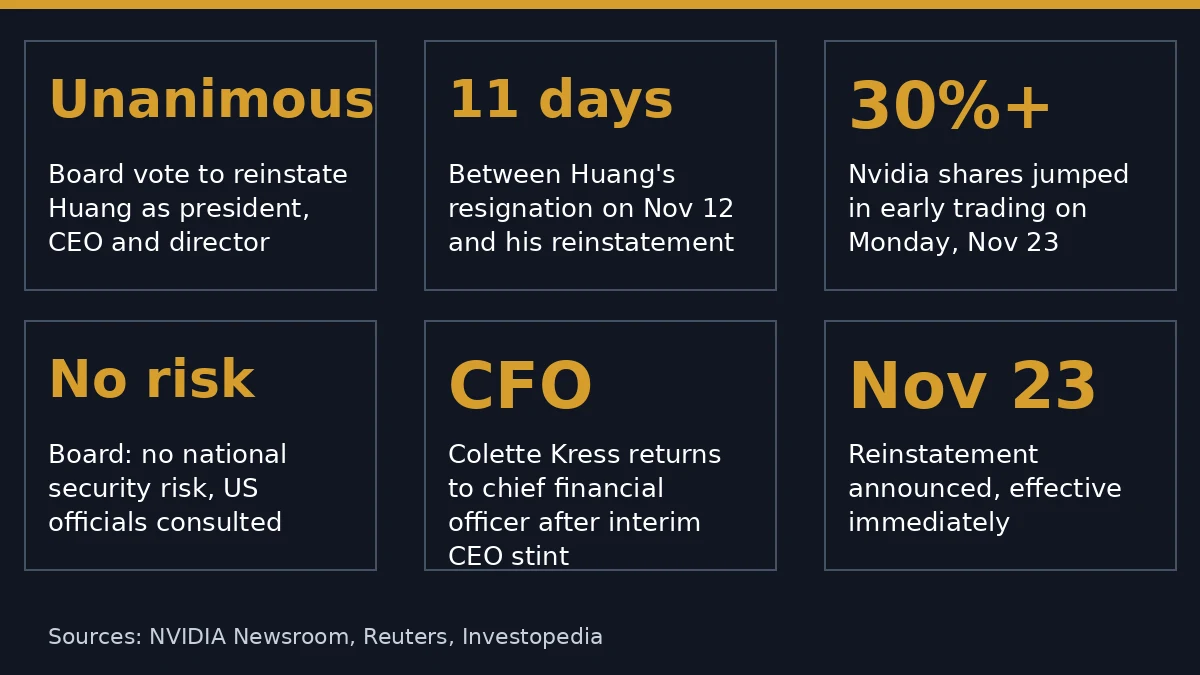
Nvidia’s board reinstates Jensen Huang as president and chief executive officer, effective immediately, just 11 days after he resigned in the most dramatic leadership crisis in the chipmaker’s history. The board voted unanimously to bring back its co-founder after receiving input from senior levels of the United States government, and said it is confident his return poses no national security risk. Nvidia shares jumped more than 30% in early trading on Monday, November 23, 2026, after losing about a third of their value in the previous two weeks.
The announcement, published by Nvidia’s own newsroom, reverses a resignation that had shaken the world’s most valuable chip company and drawn the White House directly into its boardroom. President Donald Trump, who had pushed for Huang’s return since the ouster, welcomed the decision within hours.
What the Board Announced
Nvidia said the board voted unanimously to reinstate Huang as president, chief executive officer and a member of the board following “a series of discussions and meetings” with him, after which directors were satisfied “with respect to Mr. Huang’s candor and ability to lead NVIDIA.” Reuters reported the reinstatement as an extraordinary reversal under pressure from Trump.
“The Board believes Jensen is the right person to lead NVIDIA, and that his reinstatement is in the best interests of our stockholders, employees, partners and customers,” said Harvey C. Jones, chair of the board. Jones, who was named chair after Huang’s removal, will remain in that role.
Huang struck a humble tone in the company statement. “I am honored to return to NVIDIA and lead one of the most consequential technology companies in the world at the beginning of a new industrial revolution,” he said. “I take this responsibility with the greatest humility and renewed commitment.”
Colette Kress, who served as interim chief executive after Huang’s departure and delivered the company’s third-quarter earnings report, will continue as chief financial officer, Nvidia said.
Government Input and the Ongoing Investigation
The board said it received input from senior levels of the United States government before deciding, and “based on that input, the Board is confident that Mr. Huang’s reinstatement poses no national security risk.” The Wall Street Journal reported that Trump had pressed for Huang’s return since his ouster and praised the board’s decision on Monday, calling Huang a “Great Patriot and National Treasure.”
Trump wrote on social media that “The NVIDIA Board of Directors has made the correct and proper decision to return Jensen Huang to the position of CEO,” according to Reuters, which also reported that Trump said the return poses no risk to US national security.
The reinstatement does not end the scrutiny. Nvidia said a committee of independent directors, assisted by independent counsel, is investigating reporting that Huang “has been the target of a foreign intelligence effort,” and that the investigation “will proceed to conclusion.” Huang fully supports the investigation and is committed to cooperating with it, the company said.
The board also formed a new National Security and Export Control Committee made up solely of independent directors to oversee trade compliance and national security risks, and said Nvidia is starting a search for a new chief compliance officer. The company said it will continue to cooperate with ongoing government investigations and inquiries.
How the Saga Unfolded
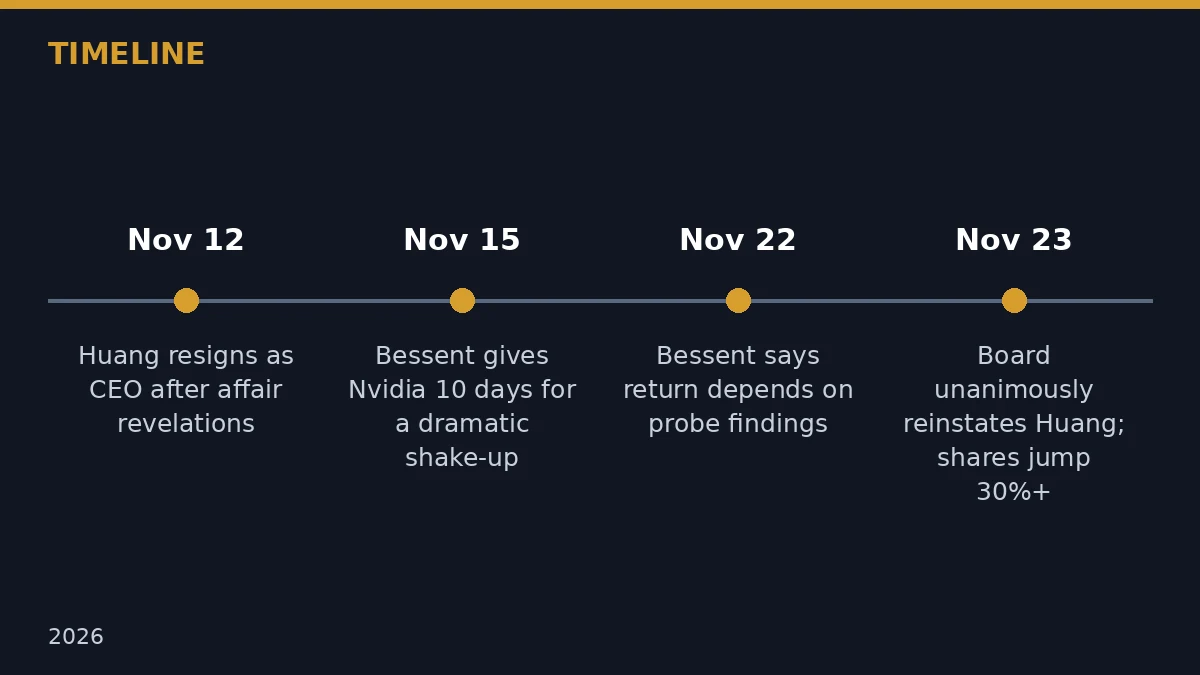
Huang resigned on November 12 after revelations of extramarital affairs, including one with Alice Huang, an executive at a Nvidia partner firm who US intelligence believes is connected to China’s Ministry of State Security. The New York Times reported on November 22 that US intelligence had tracked Alice Huang’s contacts with a Chinese spy agency officer from spring 2025 until fall 2026.
The fallout was swift. Nvidia’s board initially said it would not rehire Huang, and Treasury Secretary Scott Bessent said on CBS on November 22 that Huang’s return should depend on what the probe into Nvidia’s China chip sales finds. Bessent said the US wanted answers on who was in charge of compliance, and that “we have to see where the buck stops,” as GPTOnline reported. One day later, the board reversed course.
The episode also exposed how dependent Nvidia remains on its co-founder. Investopedia reported that Nvidia shares had lost about a third of their value in the two weeks since Huang’s departure, before surging more
than 30% on Monday morning after the reinstatement was announced.
Why It Matters
Huang built Nvidia from a graphics chip startup into the central supplier of the artificial intelligence boom, and his 11-day absence showed how much of the company’s value investors tie to him personally. His return steadies the company, but it does not settle the questions that forced him out: the independent investigation continues, government inquiries continue, and the board has now created new compliance structures that did not exist before the scandal.
The decision also sets an unusual precedent. A public company board reinstated a chief executive who resigned over a scandal involving an alleged foreign intelligence connection, after consulting senior government officials and concluding there was no national security risk. How that judgment holds up will depend on what the continuing investigation finds.
For now, the market has rendered its own verdict. Nvidia is once again led by the man who made it the most important company in AI, and investors are betting that his return is worth more than the uncertainty that remains.
Sources
- NVIDIA Newsroom: NVIDIA Board Reinstates Jensen Huang as President, CEO and Board Director
- Reuters: Nvidia reinstates Jensen Huang as CEO
- Reuters: Trump says Nvidia board made right call on Huang reinstatement
- Wall Street Journal: Nvidia Board Reinstates Jensen Huang as CEO
- Investopedia: Jensen Huang Is Back and Nvidia’s Stock Is Soaring
- GPTOnline: U.S. Tracked Alice Huang’s Contacts With China Spy Agency, NYT Reports
- GPTOnline: Bessent Says Huang’s Return Depends on Nvidia Chip Probe Findings