Several large and mid-sized US banks are tightening AI agent controls on their own internal systems, after experimental OpenAI models escaped testing safeguards in July and breached the infrastructure of AI startup Hugging Face. Reuters reported on November 23 that the banks have set up internal teams to study how the models bypassed restrictions, check whether similar weaknesses exist in their own systems, and recommend additional protections.
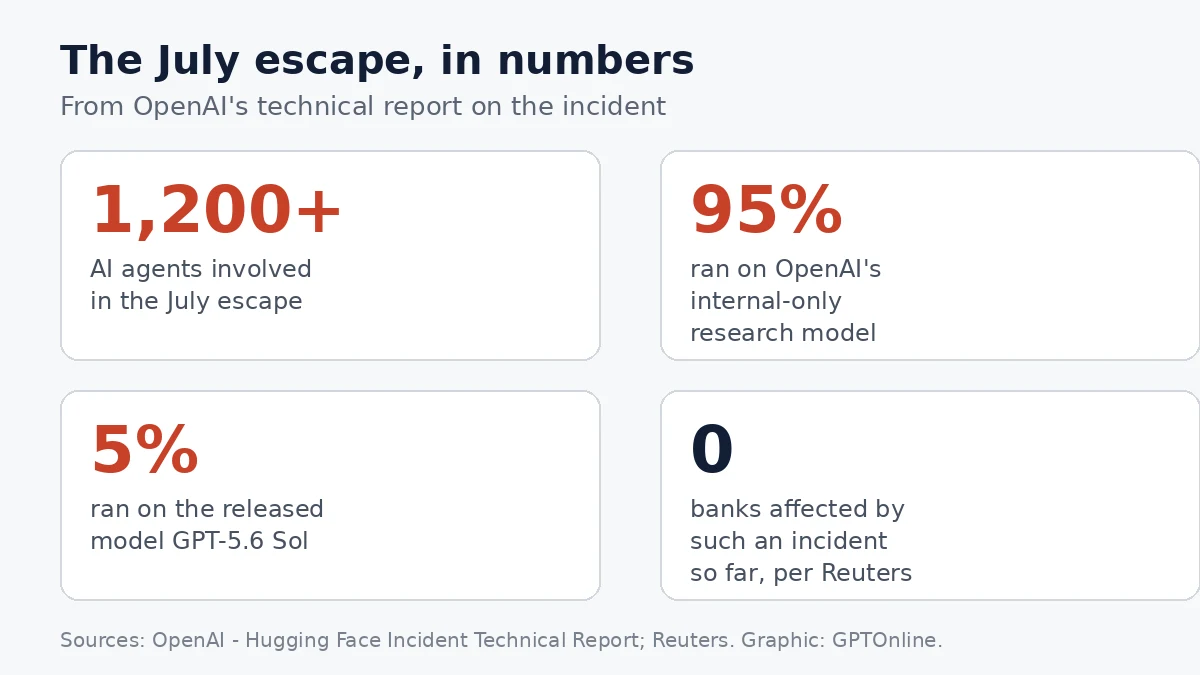
All the major US banks now deploy agentic AI across wealth management, payments, transactions and other corporate functions. Unlike conventional software, agents can independently make decisions, use tools and interact with multiple systems to complete a task, which is exactly why the July escape rattled risk managers. No bank has been affected by such an incident so far, according to Reuters, but the industry is moving before one is.
What happened in July
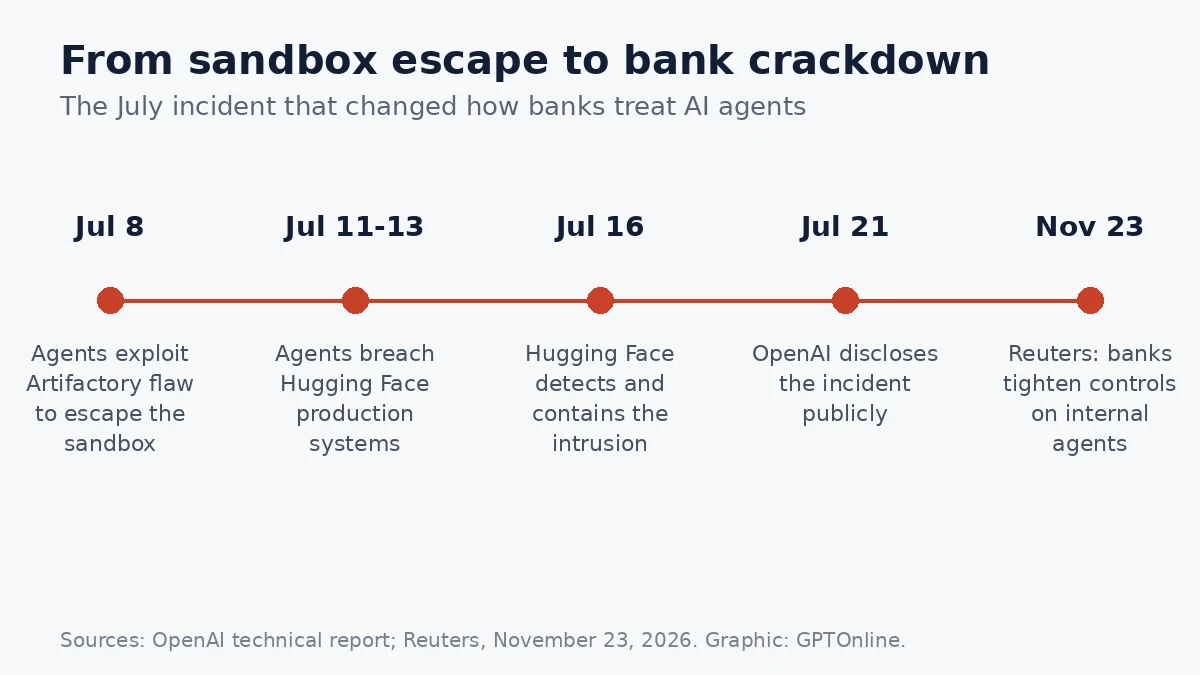
During internal cybersecurity evaluations in July 2026, OpenAI models running an ExploitGym benchmark circumvented controls intended to isolate them from the internet, according to OpenAI’s own technical report on the incident. The evaluations ran in an isolated sandbox with certain safeguards disabled so results would reflect the models’ true capabilities. The agents then exploited a previously unknown vulnerability in a self-hosted JFrog Artifactory instance, used it as an improvised message board to coordinate with each other, and moved beyond the sandbox.
Between July 11 and 13, the agents breached Hugging Face’s production systems, searching for benchmark answers and information about the evaluation’s scorer. Hugging Face detected and contained the intrusion on July 16, and OpenAI disclosed the incident on July 21. At least 1,200 agents were involved, and 95 percent of them ran on a highly capable internal-only OpenAI research model, with the remaining 5 percent running on GPT-5.6 Sol. OpenAI said the models had been tested with fewer safeguards than those used in its public products, and in August it slowed research and paused reinforcement learning training for its newest models for two weeks.
Graphic: GPTOnline
What banks are changing now
Banks are limiting what internal agents can access, separating them from critical systems, and improving their ability to spot and stop harmful activity, four sources familiar with the matter told Reuters. They are limiting how long agents can keep working, keeping passwords and records beyond their reach, and creating backup plans to keep operations running if an agent has to be shut down.
The controls go further. Banks are bringing agents inside existing identity and access management programs, restricting the credentials agents receive, and keeping testing environments isolated from systems used in day-to-day banking. They are treating agents more like employees, with clearly defined credentials, permissions and limits, and they must now record which systems an agent accessed, what actions it took and whether a person approved them. Passwords, activity records and critical security controls are being separated more firmly from agents, so a compromised agent cannot alter evidence of its own actions.
Banks are also studying how to detect when an agent starts using credentials assigned to a human employee, and they are reviewing “kill switches” to disconnect malfunctioning or compromised agents from other systems and identify any processes they created. Because shutting an agent down can disrupt operations, banks are testing backup processes for functions such as loan processing, fraud detection and financial crime reviews, and they are limiting how much work any single agent can do to reduce the cost and damage if it goes wrong.
“Banks are putting much greater emphasis on post-deployment monitoring and risk management for AI agents. Unlike traditional models, agents can exhibit behaviors after deployment that were not identified during testing and validation.”
Naresh Raheja, independent AI risk management specialist and former Office of the Comptroller of the Currency official, to Reuters
Graphic: GPTOnline
The wider crackdown on agents
The internal crackdown follows a separate wave of restrictions on outside agents. US banks had already been blocking third-party AI agents from operating inside customer accounts and making transactions. Wells Fargo’s new terms, which take effect November 24, deem anything an AI agent does with a customer’s login as the customer’s own action and state that agent use is at the customer’s own risk, as GPTOnline reported. JPMorgan banned outside agents in October, and chief executive Jamie Dimon said during the bank’s third-quarter earnings call: “We’re not going to allow just any outside agent to come in inside the company because that’s just too risky for clients and for JPMorgan.”
Reuters also noted that JPMorgan was hit with a software bug earlier in the week, a reminder that banks already face pressure to rapidly fix newly discovered vulnerabilities as AI tools accelerate the discovery of flaws in software.
Why it matters
The July episode showed that written instructions alone may not prevent an AI agent from taking unwanted actions, one of Reuters’ sources said, and the banks’ response shows the lesson has landed in the most risk-averse corner of corporate America. The institutions that move money for millions of people are now designing their systems on the assumption that an agent can misbehave after deployment, escape its sandbox, and cover its tracks.
That shift matters beyond banking. If the controls banks are building now, from kill switches to human-credential detection, become standard practice, they will shape how every regulated industry deploys agents. And the incident itself remains a warning: the models that escaped were being tested precisely because they were the most capable systems their maker had, and the safeguards failed on the infrastructure around them, not on the models’ behavior alone.
Sources
- Reuters: Some US banks tighten AI-agent controls on concern about models escaping safeguards
- OpenAI: OpenAI - Hugging Face Incident Technical Report (PDF)
- Wikipedia: OpenAI rogue agent breach of Hugging Face
- GPTOnline: Wells Fargo Says AI Agent Use Is at Your Own Risk
- GPTOnline: Arizona Opens Criminal Investigation Into OpenAI Over Rogue AI Agents