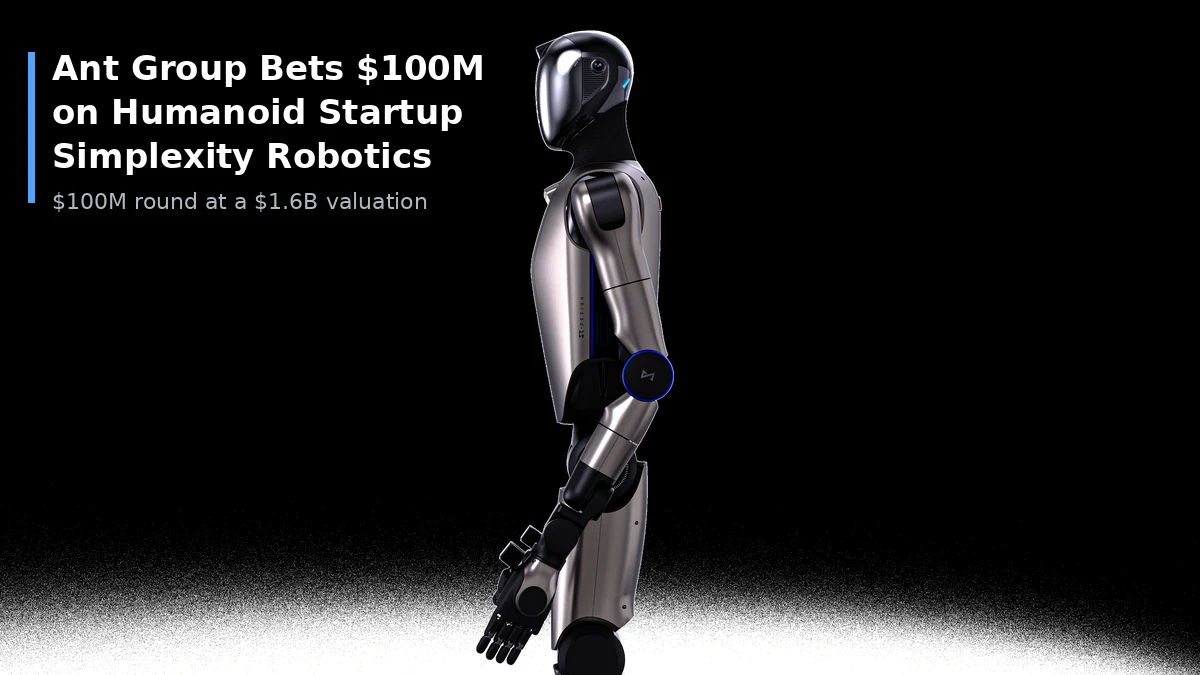
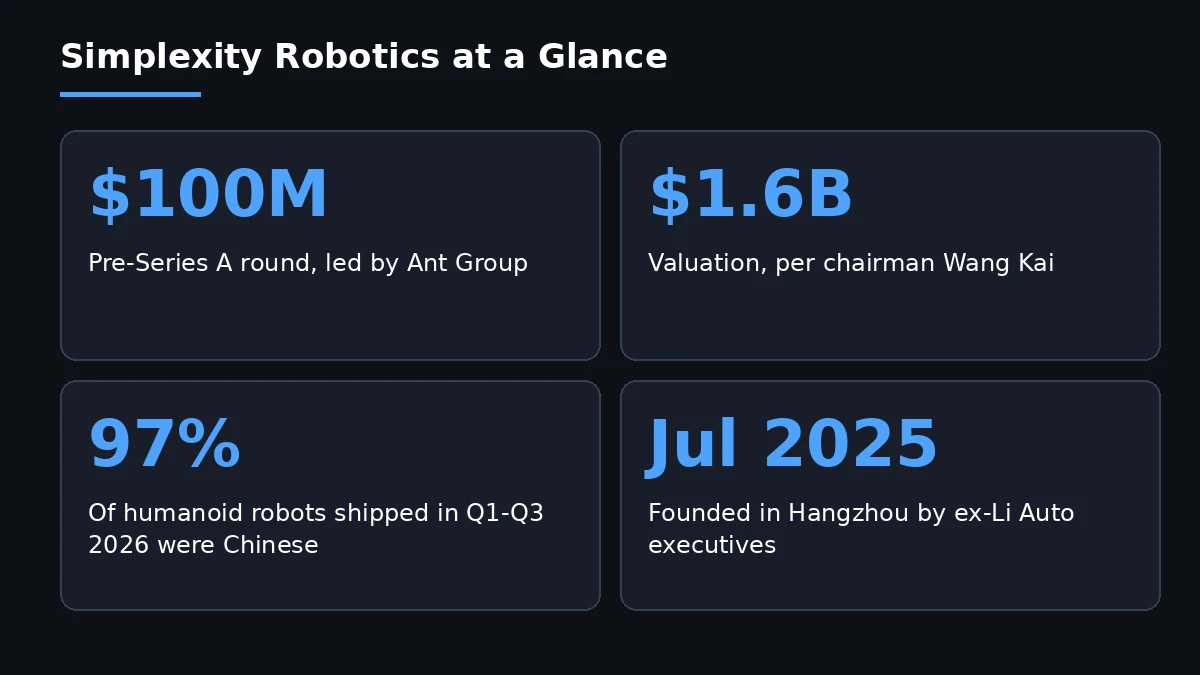
Chinese physical AI startup Simplexity Robotics has raised $100 million in a pre-Series A round led by Ant Group, valuing the company at $1.6 billion, chairman and co-founder Wang Kai told Bloomberg. The deal, reported on November 23, puts the Jack Ma-backed fintech giant behind a humanoid maker that has been operating for barely 16 months.
Existing investors Alibaba, Tencent, HongShan Capital and Lanchi Ventures joined the round, according to Bloomberg. Ant Group’s bet adds to a robotics portfolio that already includes Unitree, Astribot and Zeroth, placing Simplexity among the most closely watched names in China’s crowded humanoid race.
What Was Announced?
Simplexity’s pre-Series A round is a $100 million raise at a $1.6 billion valuation, with Ant Group leading and existing backers following on. Wang Kai disclosed the figures to Bloomberg News, and the report was syndicated across Bloomberg Law, Bloomberg Tax and The Japan Times on November 23.
The size of Ant Group’s stake was not disclosed, and neither the company nor Bloomberg has published how the money will be used, how much Simplexity has raised in total, or any revenue figures. Those gaps matter: the valuation rests on the chairman’s account, and the company’s commercial traction is so far described through named customers and deployments rather than audited numbers.
Simplexity Robotics at a glance. Graphic: GPTOnline
The iX Humanoid
Alongside the funding news, Simplexity unveiled its second humanoid on Monday: a wheeled machine called iX, built for service work. Demonstrations showed it preparing and delivering drinks, fetching objects and guiding visitors, according to TechNode.
That is a deliberate step beyond the factory floor. Simplexity’s first humanoid is an industrial model on a wheeled base, deployed in manufacturing, logistics sorting, retail and pharmaceutical packaging. One of those machines runs a round-the-clock CNC machine production line for Leaderdrive, a supplier of precision motion-control components to Tesla and Figure AI, and Bloomberg reported that Simplexity is targeting a Chinese market of 3 million CNC machines.
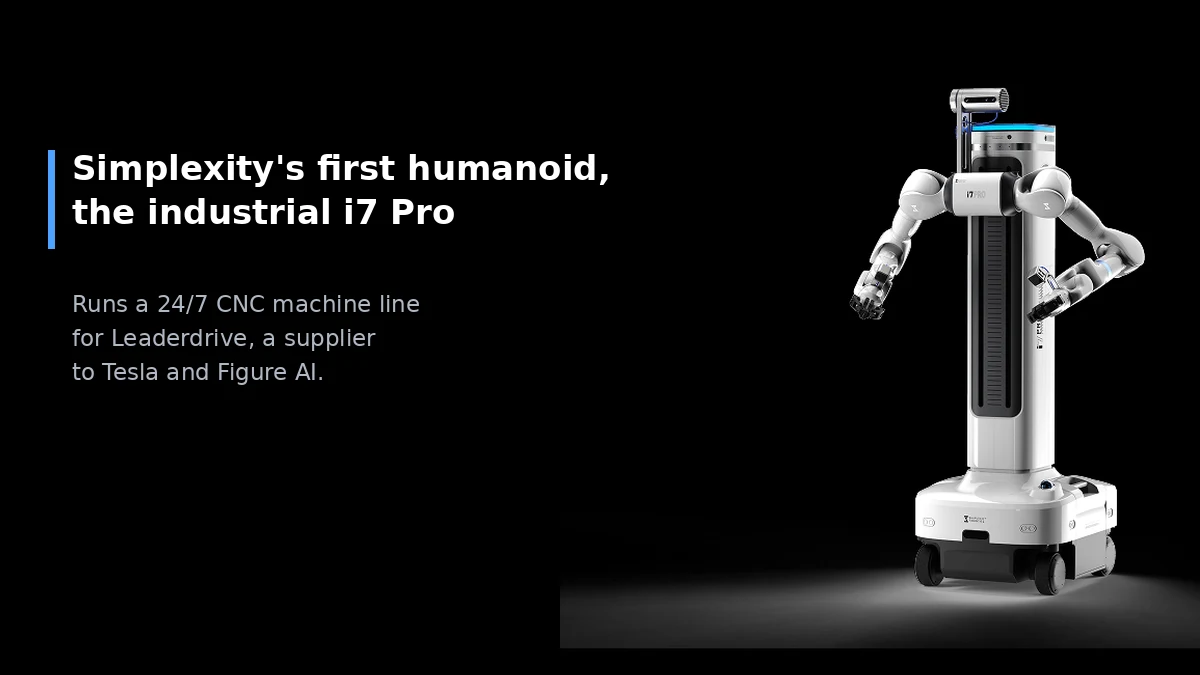
Simplexity’s first humanoid, the industrial i7 Pro. Image: Simplexity Robotics
Named customers also include Rlwrld, Tsinghua University, Suzhou Dongshan Precision Manufacturing and forklift maker Hangcha Group. The company was founded in July 2025 in Hangzhou by three former Li Auto executives, including Wang Kai and chief executive Jia Peng, and builds both its robot hardware and its in-house AI world models.
A Crowded Race With a Cooling Funding Climate
The timing is notable. China’s humanoid industry has taken an early lead over American rivals, accounting for 97% of the machines shipped in the first three quarters of 2026, according to Bloomberg. A raft of new firms, fueled by a government policy push and a deep local supply chain, has flooded the market, and the country’s economic planning body recently warned of a bubble risk in the sector.
Funding has also cooled. Bloomberg reported that sector fundraising fell to about $1.6 billion in October, down sharply from a peak in June. Against that backdrop, a $100 million round led by Ant Group stands out as a vote of confidence, and it shows large Chinese technology groups expanding their involvement in robotics even as smaller startups face a tougher market.
What We Do Not Know Yet
Several key facts remain undisclosed. There is no public figure for Ant Group’s stake, no stated use of proceeds, no total raised to date and no revenue or deployment volume beyond the named customers and the Leaderdrive production line. Independent evidence of paid deployments and recurring revenue is thin, a point outside analysts have also flagged. The story, in other words, is a funding event and a product unveiling, not yet proof of a business at scale.
Why It Matters
A $100 million pre-Series A at a $1.6 billion valuation for a 16-month-old company shows that capital is still flowing to embodied AI, even as overall robotics fundraising cools. Ant Group’s backing signals that China’s largest technology groups now treat humanoids as strategic, not speculative. And the iX moves Simplexity from industrial automation into service work, where robots must handle unpredictable people and places rather than fixed production lines. The test now is whether those demonstrations turn into repeat customers and revenue before the funding climate tightens further.
Sources
- Bloomberg: Ant Group Bets on Simplexity to Thrive in China’s Humanoid Race
- TechNode: Ant Group leads $100 million round in humanoid startup Simplexity Robotics
- The Japan Times: Ant Group bets on Simplexity to thrive in China’s humanoid race
- Dealroom: Ant Group leads $100M round in China’s Simplexity Robotics