Chinese AI company MiniMax says an internal research model it calls MiniMax’s Internal Model (MIM) has produced the first practical breaks of several cryptographic schemes that previously had no known practical attacks, and solved public challenge problems up to 43,400 times faster than the prior record. The company published technical papers and proof-of-concept code on November 20, and the work drew wide attention on November 22.
“The model identified several previously unknown structural flaws and turned multiple theoretical attacks into practical breaks,” MiniMax wrote in its research post. The claim is striking, but it comes with a clear boundary the company itself stresses: the targets were academic designs, past competition candidates and public challenge parameters, not the encryption standards in everyday use.
What MiniMax Reported
MIM was tested on Tier 2 of CryptanalysisBench, a benchmark assembled by researchers from ETH Zurich, Anthropic and collaborators for NeurIPS 2026. Tier 2 holds 135 publicly reviewed schemes with no known practical attacks, plus seven production-strength challenge schemes. MiniMax says MIM broke several of them for the first time in practice.
The headline results, all self-reported by MiniMax, include collisions for Waterfall-256, a SHA-3 candidate, across all output lengths in 0.045 seconds on a single core; full-round collisions for Blender-256 in 0.36 to 2.3 seconds; a shared secret recovered for the post-quantum scheme LOCKER in about two seconds; and an equivalent secret key recovered for ROLLO-I-128 in about six seconds.
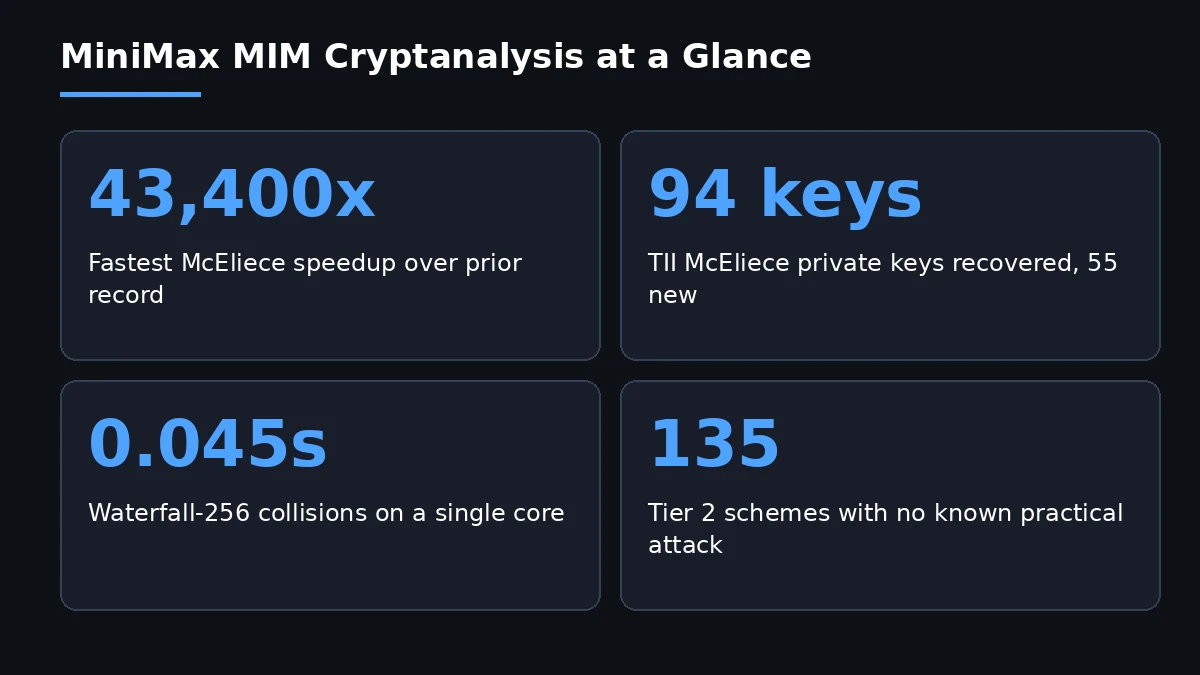
MiniMax MIM cryptanalysis at a glance. Graphic: GPTOnline
MiniMax also reports new attacks on peer-reviewed and competition-winning designs: a forgery attack on COLM, a winner of the CAESAR authenticated-encryption competition, using only two encryption queries; a full secret key recovered for the post-quantum signature scheme SBC-VOLE from a single signature in 0.06 seconds; and practical key recovery for the NSA’s ARADI block cipher extended from five rounds to eight. The model also found more than a dozen previously unreported bugs in reference implementations, including a mistyped logical operator in the DRS signature scheme that MiniMax says enabled forgery with zero signing queries.
The McEliece Record
The most eye-catching numbers come from the TII McEliece challenges, a public set of hard mathematical problems underlying code-based cryptography. MiniMax reports recovering 94 private keys, including 55 instances with no previously published solution. For instances with earlier records, solve times fell to 1.80 to 5.36 seconds on a single 64-core server, which MiniMax puts at 6,180 to 43,400 times faster than both the 9.20-hour record set at CRYPTO 2026 and a multi-GPU solver built by Anthropic.
That comparison is deliberate. MiniMax evaluated MIM on the same benchmark Anthropic’s researchers helped create, and the company frames the result as a head-to-head win over Anthropic’s own cryptanalysis work, including cutting bit-security estimates for the HAWK lattice scheme by a further 9.3 to 23.8 bits beyond Anthropic’s analysis.
Why Cryptanalysis Is the Test
MiniMax chose cryptanalysis because it is unusually hard to game. A model must turn mathematics into runnable attack code, and the code either recovers the secret or it does not, leaving little room for the vague scoring that plagues many AI benchmarks. That is also why the published papers and code matter: outside researchers can rerun each attack and check whether it works, even though they cannot reproduce MIM’s own search process, because the model itself is internal and not public.
Access is limited. MiniMax says researchers and developers can apply for testing access by email, and it gives no release plan, API, model size or price for MIM. The post also does not report how many attempts failed or a per-task success rate, so the published results are selected examples rather than a full scorecard.
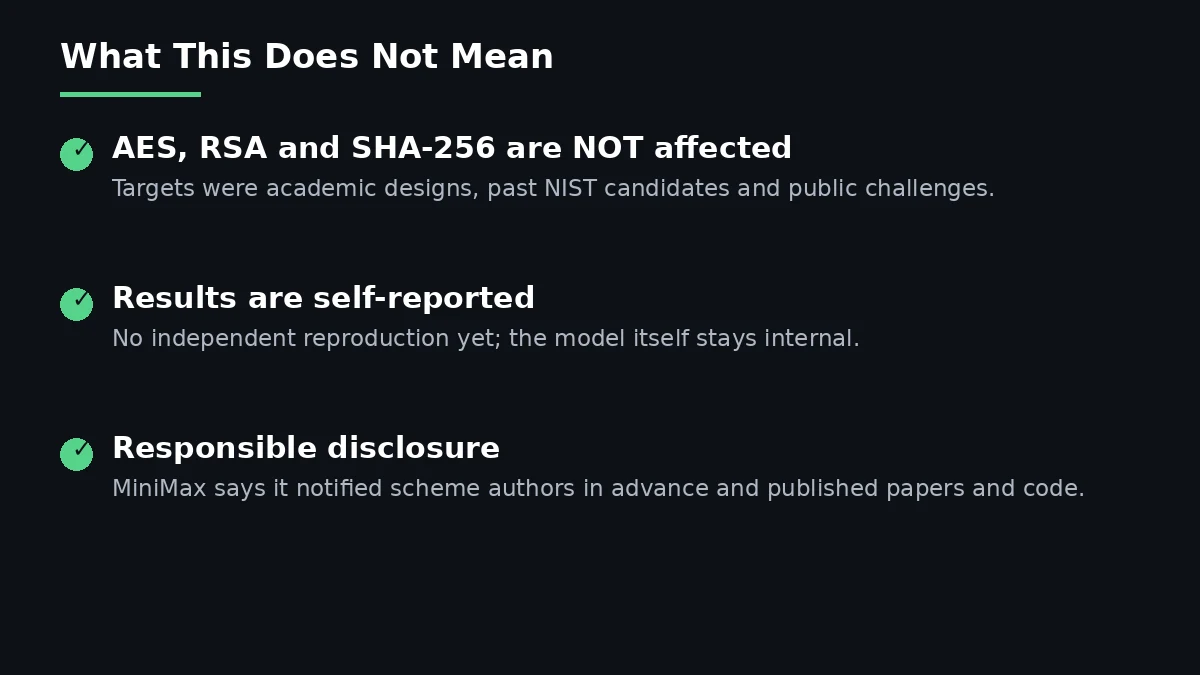
What the MiniMax results do not mean. Graphic: GPTOnline
What This Does Not Mean
The most important caveat is scope. MiniMax states plainly that the work covers academic designs, past competition candidates and public challenge parameters, and that it does not affect deployed cryptographic standards such as AES, RSA or SHA-256. Nobody’s bank login or encrypted messages became less safe because of this research.
MiniMax also says it shared the findings with the affected scheme authors in advance and published the model’s reasoning traces alongside the code, following coordinated disclosure. Independent reproduction has not yet appeared, so the figures should be read as MiniMax’s account until cryptographers outside the company verify them.
Why It Matters
Even with those limits, the work is significant for two reasons. First, it shows frontier AI models moving from solving textbook problems to finding real flaws in designs that survived years of human review, which raises the bar for how cryptographic schemes must be vetted before deployment. Second, it turns cryptanalysis into a measurable reasoning benchmark, one where a model’s claims can be checked by running code. If the results hold up under independent review, they suggest that AI-assisted red-teaming of cryptography is arriving faster than many expected, and that the security margins of future standards will need to be set with AI attackers in mind.