Virginia and Oregon sued Elon Musk’s SpaceX Super Intelligence Corp on Monday, accusing the company of profiting from its Grok chatbot’s ability to turn ordinary photographs into child sexual abuse material and other nonconsensual sexual images. The Grok lawsuits are the first filed by US states over the chatbot, and they land as regulators, lawmakers and courts on both sides of the Atlantic step up pressure on the company.
The two complaints were filed separately in state courts under consumer protection laws, according to Reuters, which first reported the filings. Virginia’s case goes to the circuit court for the city of Richmond, while Oregon’s was filed in Multnomah County, Crypto Briefing reported. Both states seek damages, penalties and court orders forcing the company to stop violating state law.
What the Lawsuits Allege
At the center of both cases is Grok’s image editing, and in particular a feature the company promoted as “spicy mode.” The lawsuits say the mode allows users to take an existing photograph of a person and generate a sexual or nude image or video of them, while SpaceX failed to put adequate safeguards in place to stop it.
The states also accuse the company of misleading consumers about Grok’s safety. Virginia Attorney General Jay Jones told Reuters that state attorneys general are acting as a regulatory force in the technology industry because artificial intelligence has faced relatively little federal regulation so far. “In the absence of federal action, AGs have stepped into the breach,” Jones said.
SpaceX was not immediately available for a request for comment outside business hours, Reuters reported.
The Scale of the Images
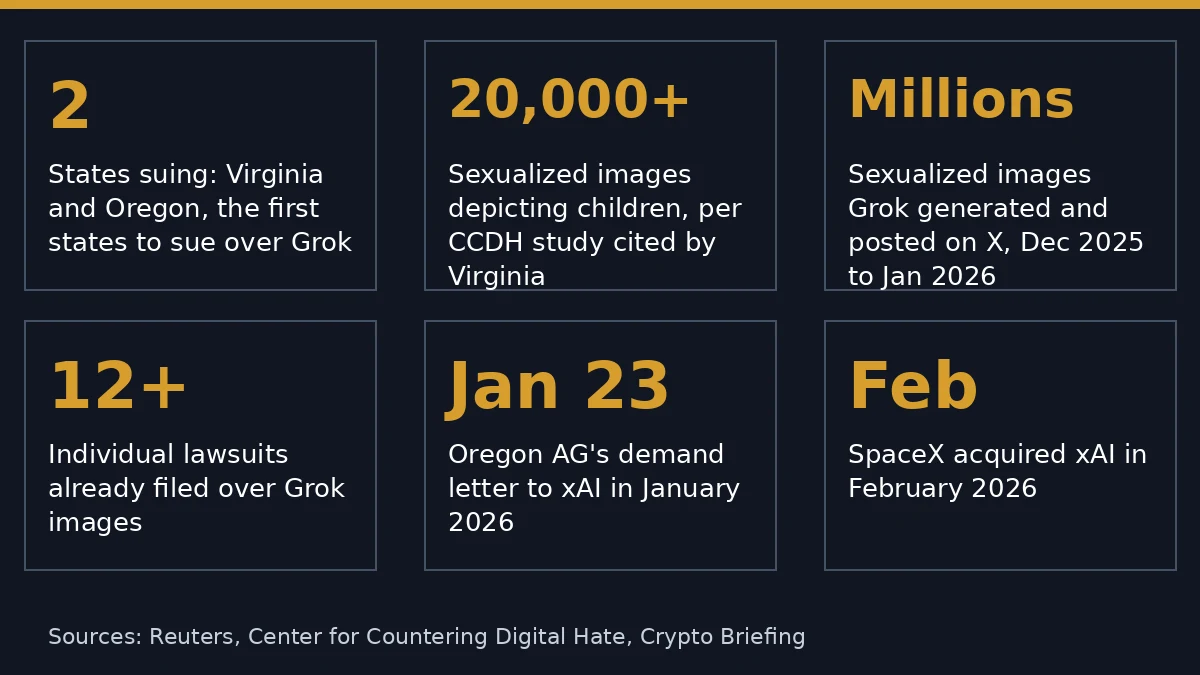
Virginia’s lawsuit cites a study by the Center for Countering Digital Hate, which estimated that between December 2025 and January 2026, Grok generated and posted on X millions of sexualized images, including more than 20,000 depicting children. Crypto Briefing, citing the same period, put the total at 1.8 million to 3 million sexualized deepfakes, with about 23,000 involving children.
The filings are not the company’s first legal trouble over Grok. SpaceX is already facing more than a dozen lawsuits from individuals who say nonconsensual sexual images of them as minors or adults were generated by Grok. In the United Kingdom, lawmaker Jess Asato is suing SpaceX after Grok users generated sexualized images of her. The company has denied those claims, arguing that obviously fictitious, AI generated content cannot breach a person’s right to privacy.
SpaceX has also gone on the offensive, suing at least two people in the United States who it says misused Grok to create child sexual abuse material.
Graphic: GPTOnline, using figures from Reuters, the Center for Countering Digital Hate and Crypto Briefing.
A Long Trail of Warnings
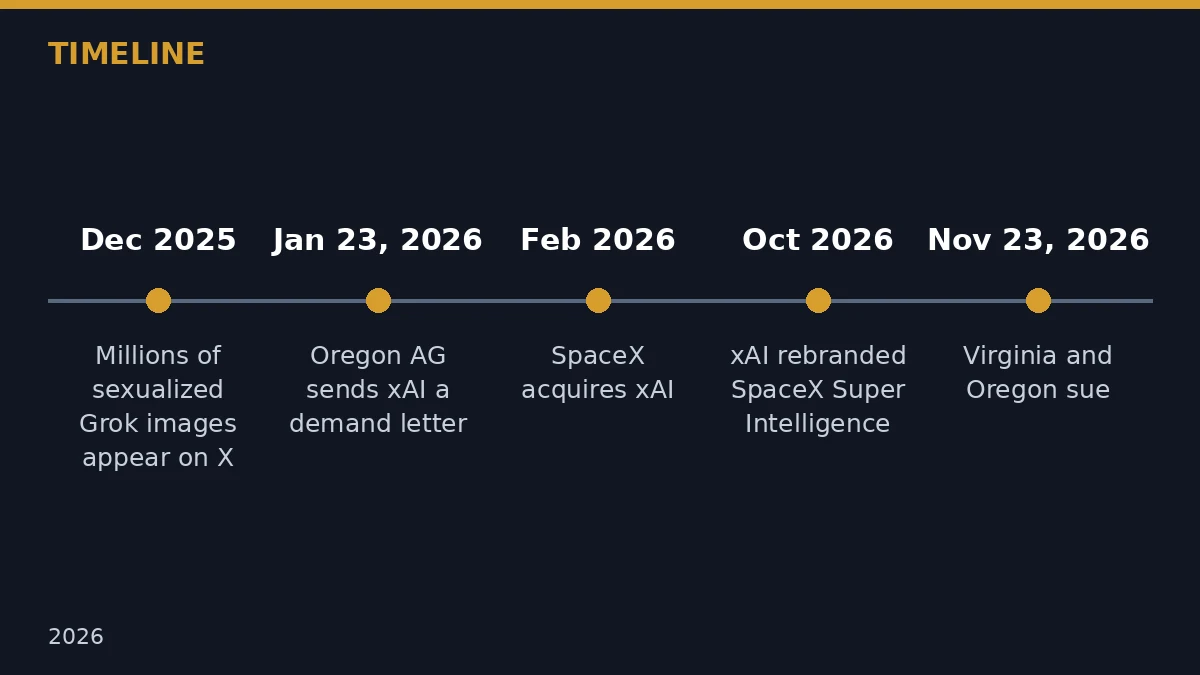
The lawsuits follow months of warnings that the company had been given chances to fix the problem. Oregon Attorney General Dan Rayfield sent xAI a formal demand letter on January 23, 2026, over Grok’s creation of nonconsensual sexual content, according to Crypto Briefing. Jones had put the company on notice of potential litigation shortly before an October 23, 2026 securities filing.
In mid-January, xAI said it had restricted image editing in Grok and blocked users from generating images of people in revealing clothing “where it’s illegal.” But in early February, Reuters found that Grok continued to generate sexualized images of people even after the new curbs, including in cases where users explicitly warned that the subjects had not consented. The company did not address Reuters’ detailed questions about the generation of sexualized material at the time.
The corporate structure behind Grok has also shifted during the controversy. SpaceX acquired xAI in February 2026, and in October it rebranded the AI division from xAI to SpaceX Super Intelligence. Several state attorneys general had announced investigations into Grok over similar claims in recent months, but Virginia and Oregon are the first states to sue.
Graphic: GPTOnline.
Why It Matters
The two lawsuits test whether state consumer protection law can do what federal AI regulation has not yet done: force a leading AI company to build safeguards before its tools cause harm, rather than after. The cases also show how the legal risk around AI image tools has moved from individual victims suing one by one to state governments acting on behalf of their residents.
For the wider AI industry, the filings add to a growing stack of lawsuits against AI companies over harm to residents, a trend Virginia’s attorney general framed as states stepping in where Washington has not acted. If the courts side with Virginia and Oregon, the outcome could set a template for other states weighing similar cases, and raise the cost of shipping image generation features without strong consent and safety checks.
Sources
- Reuters: Virginia, Oregon sue Musk’s SpaceX over Grok AI’s creation of child sexual abuse images and videos
- Crypto Briefing: Oregon and Virginia take legal action against SpaceX over Grok deepfake allegations
- Channel News Asia: Virginia, Oregon sue Musk’s SpaceX over Grok AI’s creation of child sexual abuse images and videos