Cisco and OpenAI have launched Shirudo, an open source runtime that helps security teams protect Linux systems while they prepare and roll out patches. Announced on November 23, the project is built for a problem every operator knows well: finding a vulnerability is fast, but patching every affected system can take days or weeks, and attackers only need one machine that has not been patched yet.
Shirudo, Japanese for “shield,” uses eBPF, a Linux technology that runs small programs at specific points inside the operating system kernel without changing its source code. With it, an AI agent can find a vulnerability, build a targeted safeguard called a shield, and test whether that shield blocks the attack without disrupting the service. The shield goes live only when the evidence says it is safe, and only after a human operator approves it.
How Shirudo works
The core idea is to buy defenders time. A patch fixes the underlying flaw, but testing and deploying it across a fleet is slow. In the meantime, an exploit and a legitimate request may rely on the same Linux operation, so blocking that operation outright could take a service offline. Shirudo is designed to navigate that tradeoff: the shield blocks only the behavior that exposes the vulnerability while letting legitimate requests through.
OpenAI and Cisco describe four core capabilities. First, live protection: eBPF shields can block vulnerable code paths without restarting the system, and teams can watch how a proposed shield would affect applications before enforcing it. Second, defense at machine speed: agents get programmable controls to investigate vulnerabilities, develop targeted shields, and validate them against exploits and real workloads, while security teams control what gets deployed. Third, trusted deployment: every shield is cryptographically signed and verified before loading, and the Linux eBPF verifier checks each program against its safety rules. Fourth, hardware-backed verification: Shirudo uses a Trusted Platform Module (TPM) to keep a verifiable record of protections being loaded or removed, so operators can check whether systems meet their security requirements.
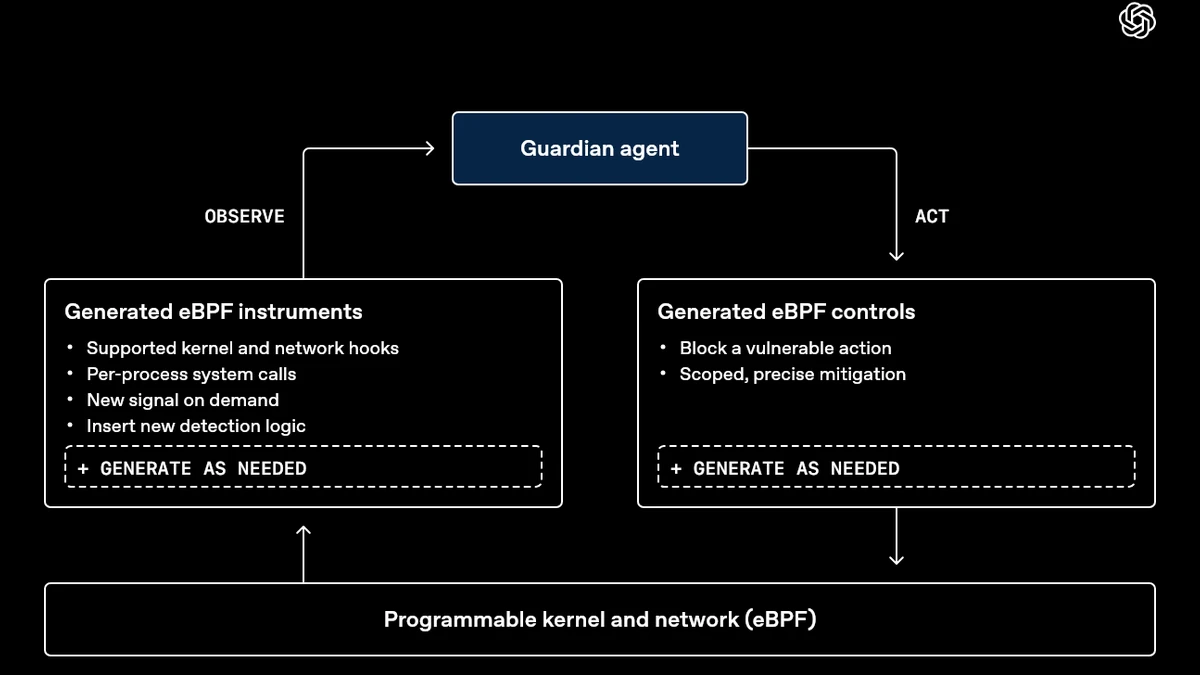
Image: OpenAI.
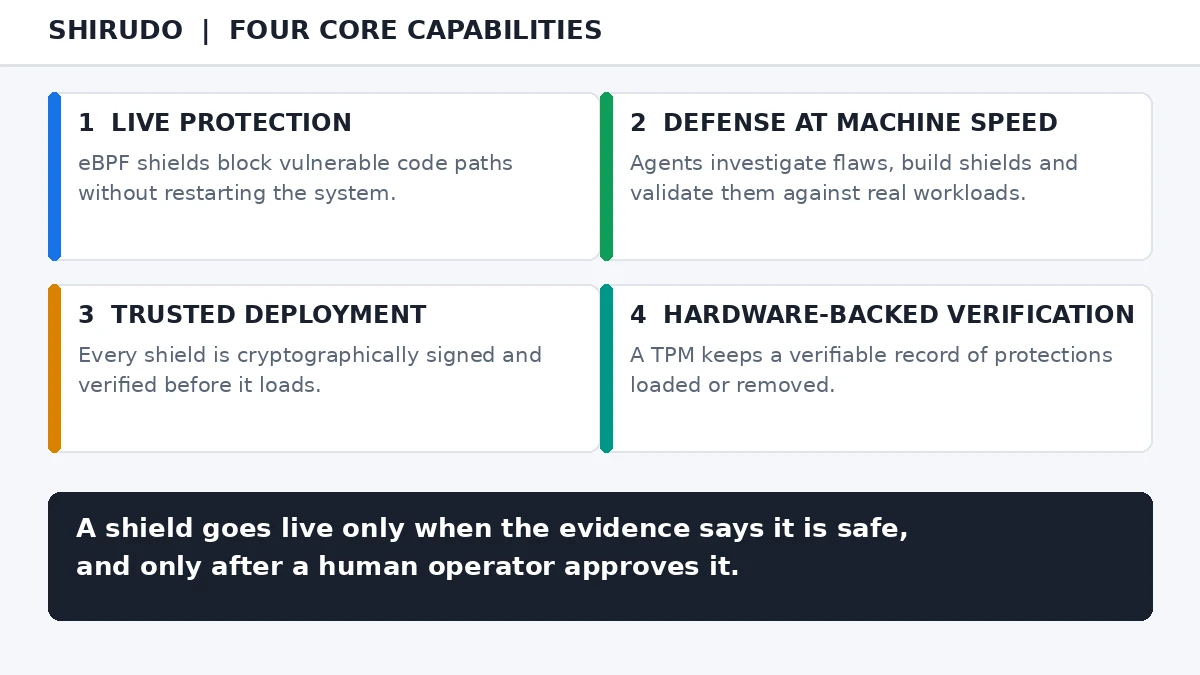
Graphic: GPTOnline, based on OpenAI and Cisco.
Tested against real exploits
The companies say Shirudo has already been tested against recent critical vulnerabilities. In a controlled test described by OpenAI, a shield generated by Codex blocked a Java4Shell exploit attempt against a running Elasticsearch service without requiring a restart. The shield added an input check to Java’s Base64 decoder and attached it directly to the running Elasticsearch process; when the exploit was attempted, the shield rejected the malicious input while Elasticsearch kept running. Cisco adds that Shirudo also wrote code that detected and blocked attempts to exploit a recent PHP flaw.
“There is nothing more important than giving security teams the tools they need to match the speed of the AI-driven threats they are facing,” said Jeetu Patel, Cisco President and Chief Product Officer. “We need self-defending infrastructure that acts at the speed of code, learns in real time, and shields itself until patches are safely rolled out.”
OpenAI President and co-founder Greg Brockman framed the project as a shared effort: “We are partnering closely with Cisco on Shirudo to help teams protect the systems they need to keep running while they build and roll out a fix. So many teams rely on the same software that it makes sense to build these tools in the open. Now when one team finds a better way to protect a system, others don’t have to start from scratch.”
Why it matters
Shirudo arrives as AI changes both sides of the security race. Attackers can use AI tools to find and weaponize vulnerabilities faster than most organizations can patch, in some cases before a flaw is even publicly disclosed. Cisco and OpenAI argue the answer is to give defenders the same machine speed: agents that investigate a flaw, write a narrow shield, prove it works, and hand a human the decision to deploy it. The launch was also covered by The Wall Street Journal.
The project is also a notable pairing. Cisco brings decades of infrastructure and security work, including its Isovalent team behind the eBPF tooling, while OpenAI brings frontier AI and security research. The companies describe Shirudo as a first step toward infrastructure that hardens itself from the moment it is built, keeps getting harder to attack, and can be restored to a known-good state if it is compromised.
Availability
Shirudo is open source and available now on GitHub. It is licensed under BSD 2-Clause, with its BPF programs dual-licensed under BSD and GPL. OpenAI and Cisco say their goal is to make tested shields available alongside vulnerability disclosures, so operators can evaluate and deploy temporary protections while preparing permanent patches. Developers can try it through a virtual machine quickstart, and the companies will host a technical deep dive webinar on December 15.
Sources
- Cisco Newsroom: Cisco and OpenAI Launch Shirudo, A New Project to Safeguard Agentic AI
- OpenAI: OpenAI and Cisco introduce Shirudo
- The Wall Street Journal: Cisco, OpenAI Launch Project to Safeguard Agentic AI
- The Register: Cisco and OpenAI pitch eBPF kernel plugins as the way to tame the patchpocalypse
- Shirudo on GitHub