
What Bloomberg Reported
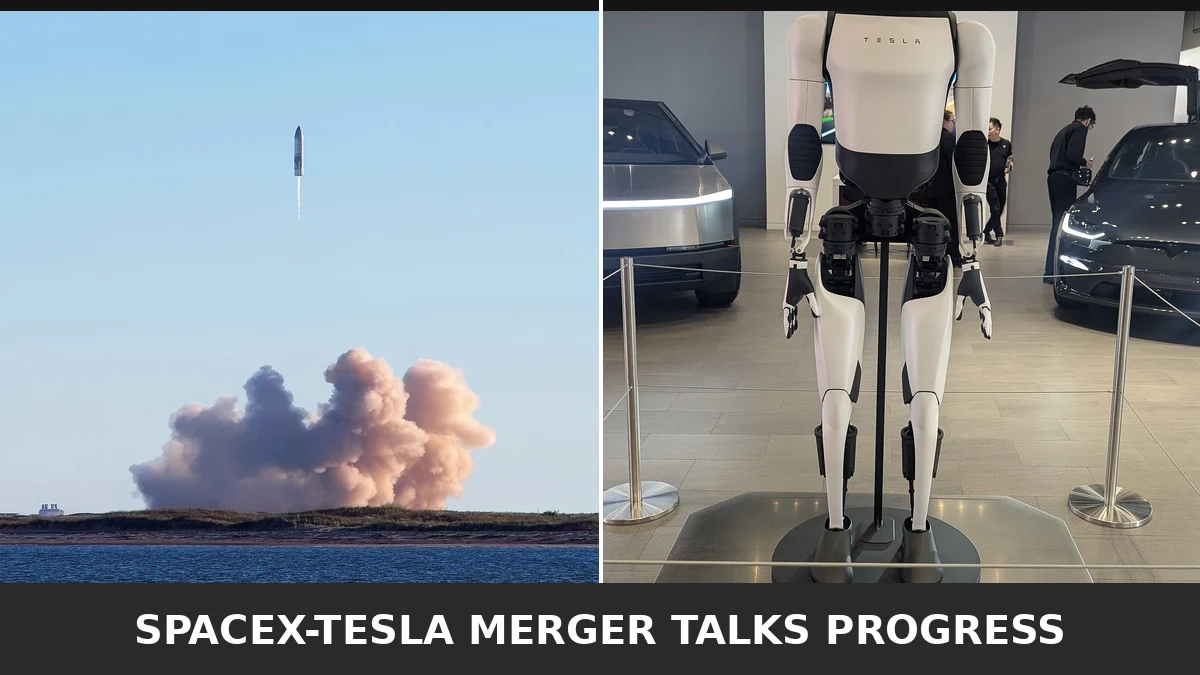
SpaceX and Tesla are progressing in their merger negotiations, and a deal could be announced as early as December, Bloomberg News reported on Thursday, November 12, citing people familiar with the matter. Reuters carried the report on Thursday evening.
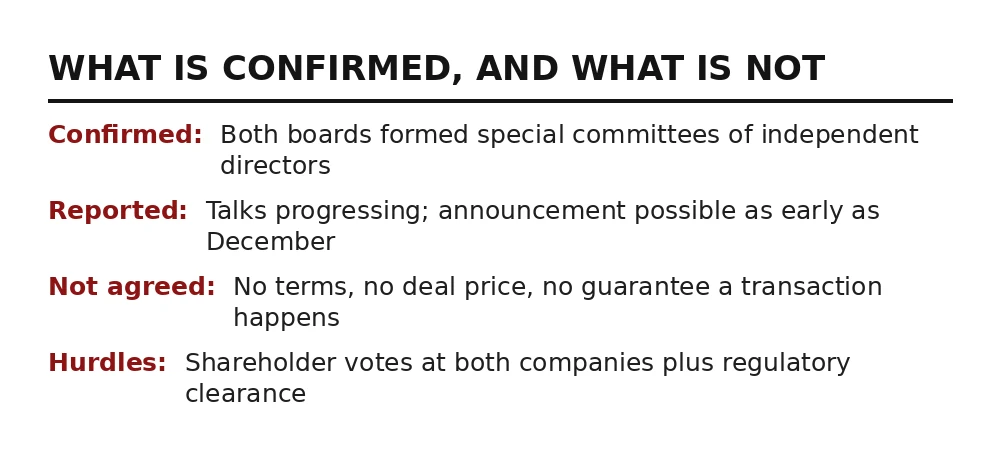
The report is the clearest sign yet that talks between Elon Musk’s two companies have moved from an idea under study to an active negotiation. Neither company has confirmed the talks, and Bloomberg did not say what terms are under discussion, or whether the two sides have agreed on a deal structure.
A combination would unite Tesla, the electric vehicle maker whose valuation rests heavily on its autonomous driving and robotics ambitions, with SpaceX, the rocket and satellite company that absorbed Musk’s artificial intelligence company xAI earlier this year. It would rank among the largest corporate mergers ever attempted.
How the Merger Talk Built Up
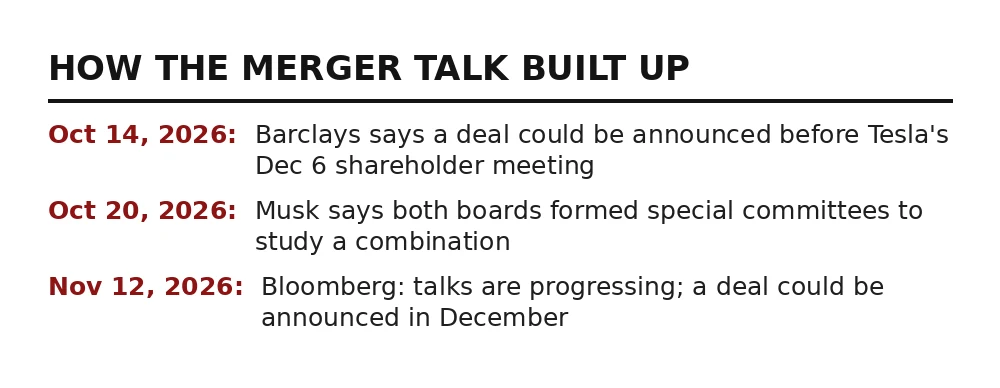
The idea became public in stages. On October 20, Musk said on SpaceX’s third quarter earnings call that both companies had formed special committees of independent directors to study a possible combination, according to reports of the call. Musk stressed at the time that there was no guarantee a deal would happen, and that he would not take part in the committees’ deliberations because he leads both companies.
Tesla confirmed the process in its own filings. Its third quarter Form 10-Q, filed on October 22, disclosed that the board had formed a special committee of disinterested directors to explore deepening Tesla’s relationship with SpaceX, which could include a business combination, according to a tracker of the company’s disclosures.
Wall Street had already started pricing in the possibility. On October 14, Barclays analyst Dan Levy told clients that Tesla and SpaceX could announce a deal before Tesla’s annual shareholder meeting, which must be held by December 6, Bloomberg reported at the time. Barclays sketched SpaceX as the likely acquirer in an all-stock transaction, with SpaceX valued at roughly $2.1 trillion and Tesla at about $1.5 trillion, according to coverage of the note.
The AI Case for a Deal
The industrial logic, as analysts describe it, is about vertical integration of AI rather than financial engineering. Barclays argued that the merger’s primary value would lie in combining technologies, including artificial intelligence, according to Korean press coverage of the bank’s analysis.
The two companies already share engineering talent and AI infrastructure. SpaceX absorbed xAI, the company behind the Grok chatbot, before listing on Nasdaq in June, and the two companies are jointly building Terafab, a semiconductor manufacturing project that also involves xAI, with a reported $16.8 billion initial investment, according to reports of the project.
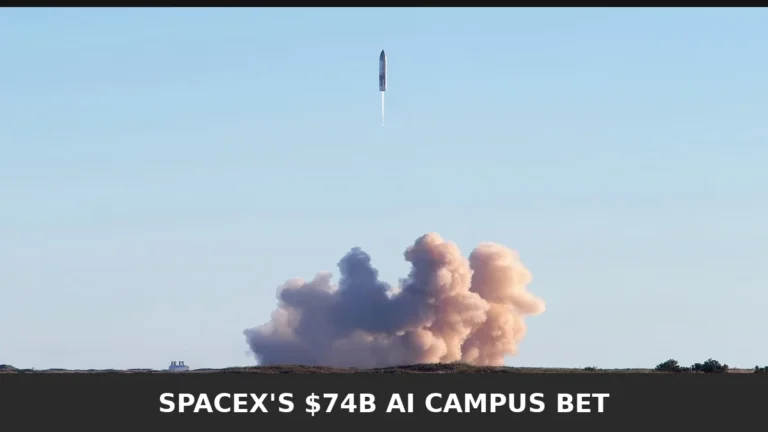
A merged company would bring Tesla’s work on robotaxis and the Optimus humanoid robot under the same roof as SpaceX’s satellite network and xAI’s models and compute. It would also concentrate the AI chip demand of both companies, which is already enormous: SpaceX closed a $40 billion debt deal in October to buy AI chips, GPTOnline reported at the time, and is planning a $24 billion gas plant and supercomputing facility at its Starbase site in Texas, as GPTOnline reported on November 9.
What Analysts Expect, and What Markets Doubt
Analysts are split on whether a deal actually closes. Wedbush analyst Dan Ives has estimated an 80 to 90 percent probability that a Tesla-SpaceX transaction closes in 2027, according to coverage of his estimate. Barclays, meanwhile, has said an announcement could still come within six to 12 months even if the December shareholder meeting window is missed.
Prediction markets are far more skeptical. Traders on Polymarket and Kalshi have put the odds of a merger announcement by the end of 2026 at roughly one in five, well below the confidence expressed by some Wall Street analysts. The gap reflects how much of the story still rests on unnamed sources rather than company disclosures.
Thursday’s Bloomberg report narrows that gap. Unlike the October analyst notes, which were scenario planning, the new report describes negotiations that are actively progressing, with a possible announcement in December. That is a material step, even though the same report makes clear that no agreement has been reached.
What Could Still Stop It
Even if the talks produce an agreement, the deal would face steep hurdles. It would need shareholder approval at both companies, and regulatory clearance, including antitrust review. JPMorgan has flagged approvals in China as a practical bottleneck, since SpaceX’s ties to the US government could raise national security concerns for a merged group selling cars there, according to coverage of the bank’s view.
Governance is another complication. Musk is the controlling figure at both companies and holds large stakes in each, which is why he is excluded from the special committees’ work. Any transaction would need to satisfy independent directors and minority shareholders on both sides that the terms are fair.
For now, the story is a negotiation, not a deal. But the December timeline in Thursday’s report gives investors and the AI industry a date to watch. If an announcement comes, it would combine two of the most valuable private and public technology companies in the world, and reshape the competitive map for AI, robotics, space and energy in a single transaction.
Sources
- Reuters, “SpaceX, Tesla merger talks progress, Bloomberg News reports”
- Beinsure, “Tesla-SpaceX merger could be announced before December, valued at $3.6 tn”
- InvestingLive, “Barclays sees possible Tesla-SpaceX merger announcement before December”
- Tesla Blog, “Tesla and SpaceX Merger Watch: The Evidence Tracker”
[…] xAI earlier this year and listed on Nasdaq in June. It is now in merger talks with Tesla, GPTOnline reported on Thursday, with a deal possibly announced as early as December. Tesla, SpaceX and xAI are jointly building […]