What Was Announced?
Google introduced Gemini 4 Hydrogen on Thursday, November 12, 2026, a new model built for rapid execution across agentic workflows. The announcement, published on Google’s official blog, positions Hydrogen as the fast, everyday counterpart to Google’s frontier models, Gemini 4 Carbon and Gemini 4 Argon. “Hydrogen brings cutting-edge intelligence to everyone,” Google said in the post, which was written by Koray Kavukcuoglu, senior vice president at Google DeepMind and Google’s chief AI architect.
“While our frontier models, Gemini 4 Carbon and Gemini 4 Argon, excel at deep, long-horizon reasoning on your hardest problems, Hydrogen is built for rapid execution across diverse agentic workflows,” the company said. Hydrogen is the successor to Gemini 3.8 Flash as Google’s fast tier, and it is rolling out globally starting today across the company’s developer, enterprise and consumer surfaces.
Faster Than the Model It Replaces
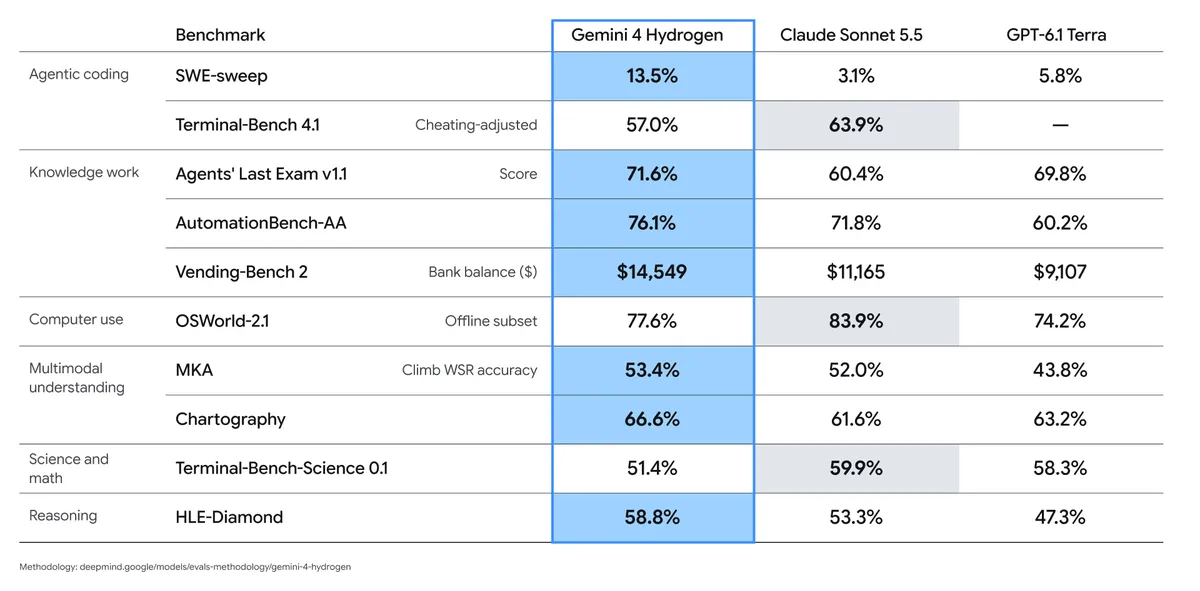
Google says Hydrogen is a major standalone upgrade over Gemini 3.8 Flash. At its high default thinking setting, it finishes tasks 2.5 times faster while more than tripling scores on Terminal-Bench 4.1, to 57% from 18.2%, and cutting fabricated claims by more than 5x. In early testing across complex graphs, SQL and data-heavy enterprise workflows, Google’s partners saw Hydrogen run 2x to 2.8x faster while reducing token usage by 12% to 23%, compared with 3.8 Flash.
Hydrogen also edges past the larger Argon model on one headline benchmark. It scores 51 on the Artificial Analysis Intelligence Index at its default high thinking level, against 50 for Argon, and reaches 54 at its highest xhigh setting. On multi-step agentic work it ranks #5 on Agent Arena’s live benchmark, leads its class on HLE-Diamond at 58.8%, ranks #1 overall on the Vals Tax Agent Bench at 52.3%, ties for #1 on the Vals Legal Research Bench at 55.8%, and scores 53.4% on the Multimodal Knowledge Agent benchmark and 71.6% on Agents’ Last Exam v1.1.
The model pairs a native 1 million-token input window with up to 1 million output tokens, letting it synthesize dense PDFs, spreadsheets, charts, audio and recorded video into cited reports and structured deliverables. It offers four thinking levels, low, medium, high (the default) and a new xhigh tier, so users can trade reasoning depth for speed and cost.
Pricing and Availability
Hydrogen is priced flat across its entire 1 million-token context window at $1.50 per million input tokens and $7.50 per million output tokens. It is available starting today in the Gemini API and Google AI Studio, in the Gemini app, in Google Search for all users, in Gemini for business, in the paid tier of Android Studio, and in Google Antigravity for paid Google AI Pro and Ultra subscribers. It is also coming to Gemini in Google Sheets for Pro and Ultra subscribers.
Orchestrator Switches Models Inside Antigravity
Alongside the model, Google introduced Orchestrator in Google Antigravity. Rather than using a single model from start to finish, Orchestrator dynamically switches between models like Carbon and Hydrogen within the same session. On Terminal-Bench 4.0, Google said Orchestrator reached near-Carbon task success rates while consuming 24% less quota and completing tasks 19% faster on average. For workflows that run parallel agents, Carbon can act as coordinator while Hydrogen powers worker and verifier agents to build and test changes simultaneously across isolated workspaces.
A Bigger Upgrade for Search
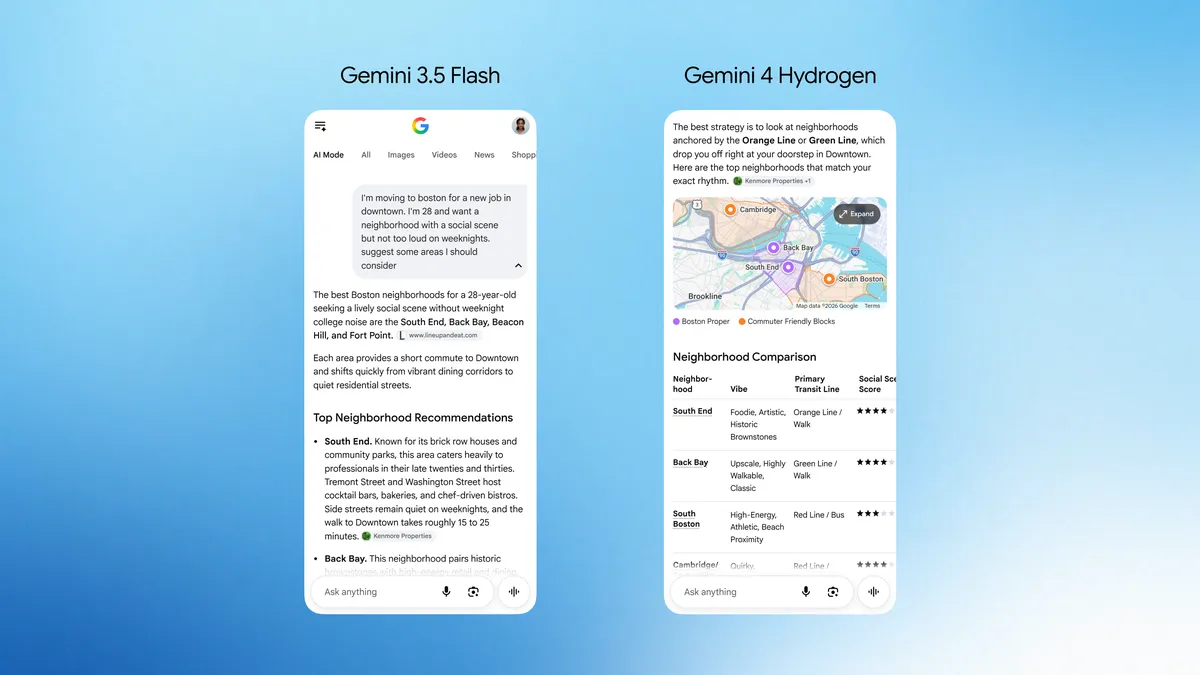
For consumers, Hydrogen is also significantly upgrading Google Search, delivering more helpful and intuitive responses for all users globally. Google said Search will better understand the true intent behind multi-part questions, typos and highly specific requests, show more visual and easy-to-scan responses, and connect users to a wider range of links through an upgraded query fan-out technique. TechCrunch reported the Search upgrade as a promise of better answers to users’ most complicated questions.
In the Gemini app, Google said Hydrogen follows instructions more closely across multi-turn conversations, calls the right tools more often, and produces email drafts, study guides and documents that come back ready to use on the first try. It can also pull context from uploads, Gmail and Google Drive, and from connected apps such as Airtable and Dropbox.
Safety and Alignment
Google said Hydrogen brings improvements from its latest Gemini 4 safety and security stack to its broadest audience yet. For agentic work, it reduces overreach by up to 81% and under-service by up to 79%, and cuts misaligned actions and task shortcutting across tool-use and coding evaluations by 12x. When faced with impossible or blocked tasks, it is up to 2x less likely to bypass permission boundaries and achieves a 96.7% honesty rate on Google’s internal agent honesty evaluation.
Hydrogen also preserves 99.9% chain-of-thought legibility with zero deceptive reasoning edits across more than 200,000 audited turns, and is more than 2.3x more resilient against indirect prompt injection attacks on the Gray Swan IPI benchmark. False refusals on HealthBench Pro stay under 0.4%. Full technical details are in the Gemini 4 Hydrogen model card linked from Google’s announcement.
Why It Matters
Hydrogen arrives one week into a fast-moving Gemini 4 rollout, with Carbon already available and Argon positioned as the deep-reasoning flagship. By pricing a model that beats Argon on a headline intelligence index at Flash-tier prices, Google is pushing frontier-class capability into everyday coding, research and office work, and into the free Search experience used by billions. The Orchestrator move matters just as much: if multi-model sessions can match frontier quality at roughly a quarter less quota, the cost of running coding agents drops sharply for teams that adopt Antigravity. The open question is whether the benchmark leads hold up in independent testing, and whether the Search upgrade changes what users see in practice. Both will be watched closely in the coming days.