What Cerebras Reported
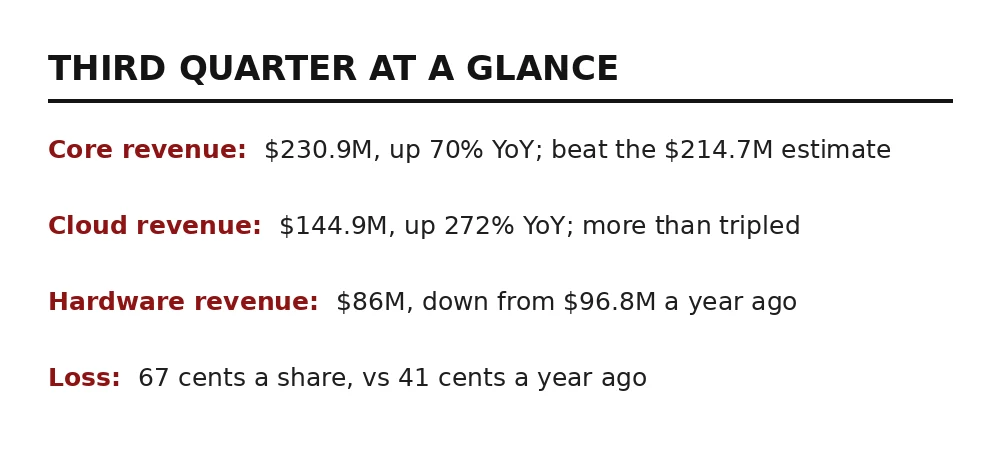
Cerebras Systems raised its annual revenue forecast on Thursday, buoyed by surging demand for AI computing capacity, Reuters reported. The AI chipmaker’s core revenue rose 70 percent in the third quarter to $230.9 million, beating analysts’ average estimate of $214.7 million, according to data compiled by LSEG.
On a non-adjusted basis, revenue grew 55 percent to $210.8 million. The net loss widened to 67 cents per share, from 41 cents in the same quarter last year. Shares rose more than 10 percent in extended trading after the results, as investors focused on the revenue beat and the raised outlook rather than the loss.
The mix inside the quarter tells the story of where the business is heading. Core cloud and services revenue more than tripled to $144.9 million, an increase of 272 percent from a year earlier, reflecting the company’s large computing agreement with OpenAI. Core hardware revenue, which covers direct sales of Cerebras’s AI inference chips, fell to $86 million from $96.8 million, according to the Wall Street Journal. Cerebras is selling less hardware directly and renting out far more computing capacity through the cloud.
Microsoft and Oracle Join as Customers
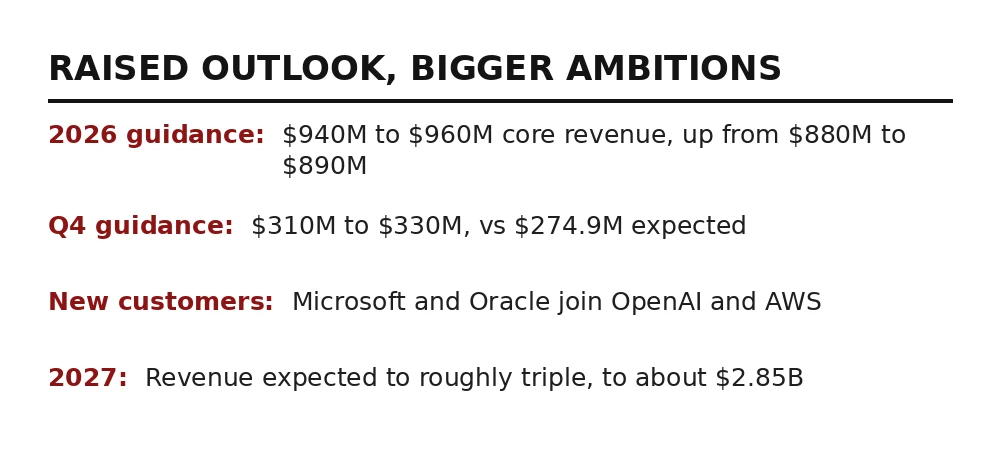
The headline from the quarter was not the earnings beat but the customer list. Cerebras scored business from two new hyperscale cloud-computing customers in the third quarter: Microsoft and Oracle, Investor’s Business Daily reported. Microsoft signed its deal in October, and revenue from the agreement is expected to begin showing up in the first quarter of 2027, CNBC reported.
Those names matter because hyperscalers are the small group of cloud giants that buy computing capacity in enormous volumes. Cerebras already counts OpenAI and Amazon Web Services among its customers, and it is racing to expand chip volumes to support a $20 billion multi-year agreement to provide computing power for OpenAI, Reuters reported.
“Cerebras’ technology remains the undisputed champion of speed,” Chief Executive Andrew Feldman said in a news release. “We’re giving customers more ways to access our technology and scale with us be it through direct system sales, Cerebras Cloud or third-party cloud providers.”
Raised Outlook and 2027 Ambitions
Cerebras now expects 2026 core revenue of between $940 million and $960 million, up from its previous expectation of $880 million to $890 million. For the current fourth quarter, the company guided for core revenue between $310 million and $330 million, well above the $274.9 million Wall Street was modeling. Core gross margin was 41 percent in the third quarter, and the company guided to 47 to 49 percent for the fourth quarter.
Looking further out, Feldman said the company expects to triple its revenue in 2027, to approximately $2.85 billion. Cerebras ended the third quarter with $26.1 billion in remaining performance obligations, up from $25.4 billion at the end of the second quarter, a measure of contracted future revenue.
The results come after a rough stretch for the stock. Cerebras went public on May 14 and notched a record high of $386.34 on its first day of trading, but the shares had fallen to a low of $77.84 on November 5, Investor’s Business Daily reported. Thursday’s report is the company’s case that the demand behind the stock’s early surge is real, even if the share price has not yet recovered.
Why It Matters
Cerebras is the most prominent challenger to Nvidia in AI inference, the data crunching that happens when a user queries a chatbot. Its pitch is a single wafer-scale chip the size of a dinner plate, containing trillions of transistors, which it says is more efficient than connecting thousands of smaller graphics processors.
Winning Microsoft and Oracle as customers is the strongest validation yet of that pitch. Hyperscalers do not sign chip deals lightly, and adding two of them in a single quarter suggests Cerebras’s technology is moving from a niche product to a real alternative in the data center. The timing helps too: the results landed on the same day Nvidia’s leadership crisis deepened, and investors are actively looking for credible alternatives in the AI chip market.
The watch item is the hardware decline. If direct chip sales keep falling while cloud revenue grows, Cerebras becomes more of a cloud company than a chip company, with different margins and different risks. For now, though, the market is rewarding the growth: the beat, the raised guidance and the two new hyperscaler names were enough to lift the stock sharply after hours.
Sources
- Reuters, “Cerebras raises annual sales forecast on strong AI-linked demand”
- Investor’s Business Daily, “AI Chipmaker Cerebras Tops Q3 Views, Adds Big Customers”
- Wall Street Journal, “Cerebras Lifts Outlook as Cloud Revenue Surges in Third Quarter”
- CNBC, via Traders Union, “Cerebras Systems tops Q3 revenue estimates, adds Microsoft cloud deal”