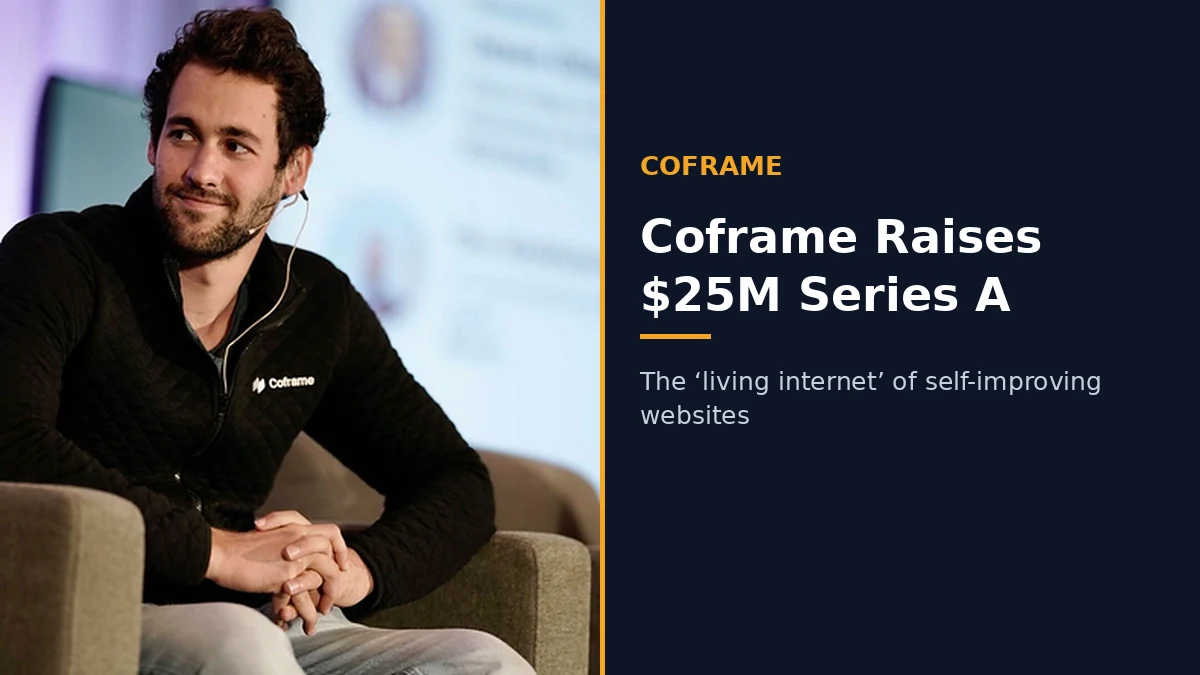
Coframe, a San Francisco startup building websites that rewrite themselves, has raised a $25 million Series A, the company announced on November 9. The Coframe Series A was co-led by Khosla Ventures and Hanabi Capital, with participation from leaders at OpenAI, Anthropic and Google DeepMind, and brings Coframe’s total funding to $35 million.
Founder and chief executive Josh Payne calls the company’s vision the “living internet”: instead of every visitor seeing the same static website, Coframe plugs into a company’s website or advertising campaigns and continuously generates, tests and deploys new variations, personalizing what each visitor sees and improving performance in real time. Apps and email are next on the roadmap, according to the company.
How the platform works
Behind the product is a specialized transformer model trained on user interactions, plus a team of AI agents assigned distinct roles: a strategist, a designer, a software engineer, a QA specialist and a data scientist. Together they can ideate, build, test and optimize hundreds of website and ad variations in minutes, Coframe says, replacing a process that traditionally takes weeks of engineering, design and QA work for each experiment.
The company says its model is trained on how people move through digital experiences across hundreds of millions of sessions each month, so every experiment makes the next one smarter. Coframe also says it is building for a future in which a growing share of web traffic comes from AI agents that research, compare and buy on people’s behalf, and it is baking agent best practices directly into every website it builds.
The numbers Coframe cites
Coframe says its platform has generated more than $300 million in incremental revenue for its customers, including conversion rate increases of 158% for Dropbox, 410% for Replit and 60% for Cash App. Across thousands of variants, the company reports a 39% experiment win rate, more than three times the industry average, and says it has increased customers’ testing velocity ten times or more. Conversion rates have improved by more than 20% on average across its customer base, which includes Dropbox, BCG, Block, Backcountry and Sur La Table.
For one Fortune 500 customer, Coframe says it launched dozens of variations and delivered a 70% lift in conversion within 30 days of contract signature. At Dropbox, an experiment that previously required four weeks of engineering, design and QA work was built and deployed in 30 minutes, according to the company. These performance figures are company reported and have not been independently verified.
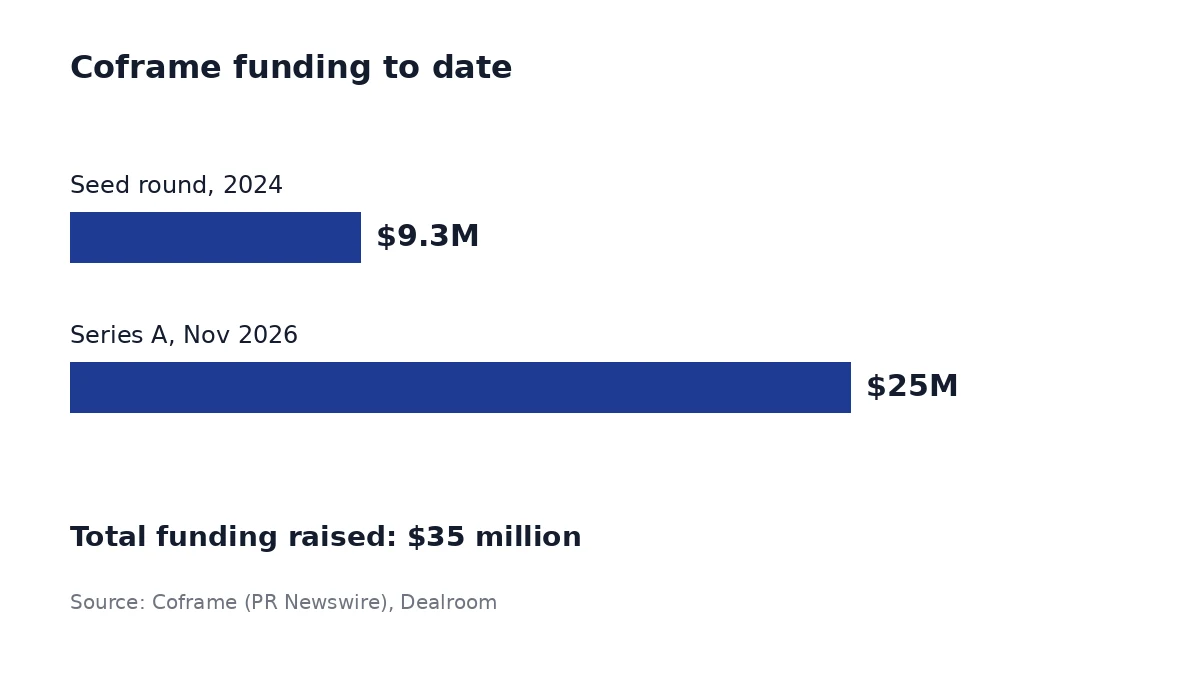 Coframe funding to date. Chart: GPTOnline, based on figures from Coframe and Dealroom.
Who is behind it
Payne founded Coframe in 2023 after studying mathematics and computer science at Stanford University, where he focused on AI. He previously co-founded Autograph with Tom Brady, which reached a valuation of more than $2 billion, and created GPT-Migrate, an early autonomous coding agent that became the top ranked project on GitHub globally. Co-founder Pavlo Razumovskyi serves as vice president of engineering.
The company has also acquired companies founded by two early Optimizely executives, Bo Mohazzabi, now vice president of go to market, and Steven Ebin, now general manager of revenue optimization. Before the Series A, Coframe raised a $9.3 million seed round in 2024, according to Dealroom. The company did not disclose a valuation for the new round.
 Coframe founder and CEO Josh Payne. Image: Coframe
The OpenAI connection
Coframe is already working with OpenAI on its ChatGPT ads offering, enabling customers to optimize the ad and the landing page as one continuously learning experience. The work builds on an earlier partnership between the companies on training a specialized model for generating on brand code and creative assets.
“We’re building an internet that improves itself,” Payne said. “A digital experience should understand what it is trying to accomplish, adapt to the person interacting with it and learn from every result. Instead of waiting months for the next redesign, companies should have websites and applications that get better every day.”
Vinod Khosla, founder of Khosla Ventures, framed the bet as a break from decades of static web design. “For decades, the web has been frozen in place, showing every visitor essentially the same page,” Khosla said. “Coframe is building the living internet, where two people can visit the same website and have completely different experiences, personalized to who they are and what they need. These interfaces continuously learn and improve themselves. This is a huge leap beyond traditional A/B testing and the next iteration of the internet.”
Why it matters
Website optimization has long been a bottleneck: growth teams queue experiments behind design reviews and engineering tickets, and most tests run one at a time. Coframe is betting that AI agents can collapse that queue entirely, running hundreds of variations in parallel and personalizing pages per visitor rather than per segment. If the approach holds up at scale, it would shift conversion optimization from a craft practiced by specialists to a continuous, automated layer of the web itself.
The funding will be used to accelerate product development, expand Coframe’s AI agent capabilities and scale operations, according to Finsmes. The open question is whether the large conversion lifts Coframe reports for early customers will hold across a broader customer base, and whether visitors will welcome pages that change every time they return. For now, Khosla Ventures and Hanabi Capital are betting that the static website is on its way out.
Sources
- Coframe, via PR Newswire: Coframe Raises $35 Million to Build the “Living Internet”
- Dealroom: Coframe raises $25M Series A to build a self-improving “living internet”
- Finsmes: Coframe Raises $35M in Total Funding
- Business Insider, via Techmeme: Coframe raised a $25M Series A
- Coframe: official website