CoreWeave Q3 revenue jumped 168% year over year to $3.66 billion, the AI cloud provider reported on Tuesday, beating Wall Street estimates and showing that demand for GPU compute is still outrunning the company’s ability to build data centers fast enough. The result landed after a brutal month for the stock, which had fallen by roughly half as investors questioned how CoreWeave would pay for its buildout.
The Livingston, New Jersey company, which rents out Nvidia-powered computing capacity to AI labs and enterprises, also raised its full-year guidance and said its revenue backlog reached $132.5 billion at the end of September. Shares rose about 3% in after-hours trading after the report, according to Barron’s.
What CoreWeave Reported
Revenue of $3.66 billion for the three months ended September 30 topped the roughly $3.54 billion analysts expected, and it was up by more than $1 billion from the second quarter alone. A year earlier, CoreWeave reported revenue of $1.37 billion.
Operating income rose to $207 million, a 6% margin, from $52 million a year earlier. Adjusted operating income, the company’s preferred measure of core profitability, reached $379 million, up 75% from a year earlier, for a 10% margin. Chief executive Michael Intrator called it a breakout quarter, noting that adjusted operating margins reached double digits a quarter ahead of plan.
“This was a breakout quarter for CoreWeave, with revenue increasing by more than $1 billion sequentially and adjusted operating margins reaching double digits a quarter ahead of plan,” Intrator said in the earnings release.
The bottom line still showed the cost of the buildout. CoreWeave posted a net loss of $709 million, or $1.27 per share, compared with a $110 million loss a year earlier. Net interest expense climbed to $846 million from $310 million, more than double the company’s adjusted operating income. Adjusted EBITDA reached $2.26 billion at a 62% margin.
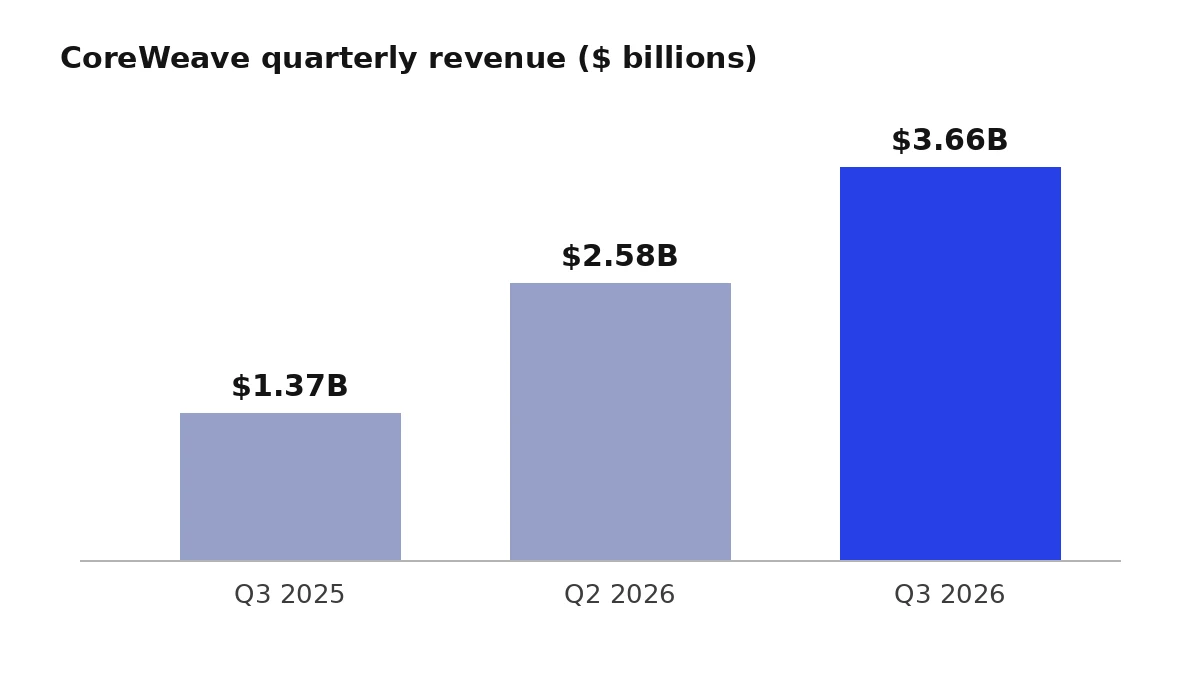
CoreWeave quarterly revenue has nearly tripled in a year. Graphic: GPTOnline, based on CoreWeave Q3 2026 results.
Backlog and Capacity Keep Growing
The revenue backlog of about $132.5 billion counts signed customer contracts and remaining performance obligations, and it grew from $104 billion at the end of June, plus more than $25 billion in new commitments signed early in the third quarter. The backlog is the center of the CoreWeave bull case, and it is also the center of the bear case, because the contracts only turn into cash when the data centers are built and powered.
On that front, CoreWeave added more than 200 megawatts of active power in the quarter to reach over 1.7 gigawatts, doubling its active footprint since the start of the year. Total contracted power grew by more than 900 megawatts to over 4.6 gigawatts, and the company said it still expects to end the year with more than 1.85 gigawatts of active power.
New customers in the quarter included Canva, Serve Robotics, Substack and Wayve, while existing relationships expanded with OpenAI, Perplexity, Cohere and the Chan Zuckerberg Initiative. The company also launched CoreWeave Forge, a development environment for training, inference, evaluation and agent work, and said its first production workloads on Nvidia Vera Rubin NVL72 systems, for the coding company Cognition, delivered 4.8 times the token throughput of the previous GB200 generation.
Image: CoreWeave
Guidance Raised for 2026
CoreWeave raised its full-year 2026 revenue guidance to $13.0 billion to $13.3 billion, up from $12.4 billion to $13.2 billion. It also raised adjusted operating income guidance to $1.275 billion to $1.375 billion, a 26% increase at the midpoint from its prior outlook, and lifted its expected annualized run-rate revenue exiting 2026 to $20 billion to $21 billion.
Capital spending remains enormous. The company now expects full-year 2026 capital expenditures of $37 billion to $39 billion, raising the low end of its prior range, because it expects to deploy infrastructure and deliver it to customers sooner than planned. It expects interest expense of $1.05 billion to $1.15 billion in the fourth quarter alone.
The Financing Question
The numbers that matter most for CoreWeave are not on the revenue line. The company finances its data centers largely with debt, and its debt and lease liabilities rose by $14.6 billion in the quarter to $66 billion, according to Barron’s. Its 2032 bonds yielded above 16% in October, a sign of how expensive that funding has become.
Management pointed to several sources of flexibility. CoreWeave said it expects about $9 billion in customer prepayments and deposits in the next three months, raised about $4.2 billion through an upsized convertible note offering, and closed a $2.6 billion delayed-draw term loan facility, its first designed for shorter-duration customer contracts. On the earnings call, Intrator said the company was moving away from unsecured public debt toward delayed-draw facilities that use customer contracts as collateral and let CoreWeave borrow money as it needs it.
Why It Matters
CoreWeave is the purest public test of the AI infrastructure boom: a company that borrows heavily to buy Nvidia chips, rents them out under long contracts, and grows revenue at triple-digit rates while losing money on a GAAP basis. Tuesday’s report answered the demand question emphatically, with revenue, backlog and guidance all moving up at once. The financing question is still open, and it will be decided by whether power comes online fast enough, and cheaply enough, to convert that $132.5 billion backlog into cash before the interest bill swallows the operating profit.
For the broader AI industry, the report is a reminder that the compute shortage is real and that the companies supplying it are scaling at a pace rarely seen outside a wartime mobilization. Nebius reports its third-quarter results on Thursday, November 12, giving investors a second read on the same trade within days.