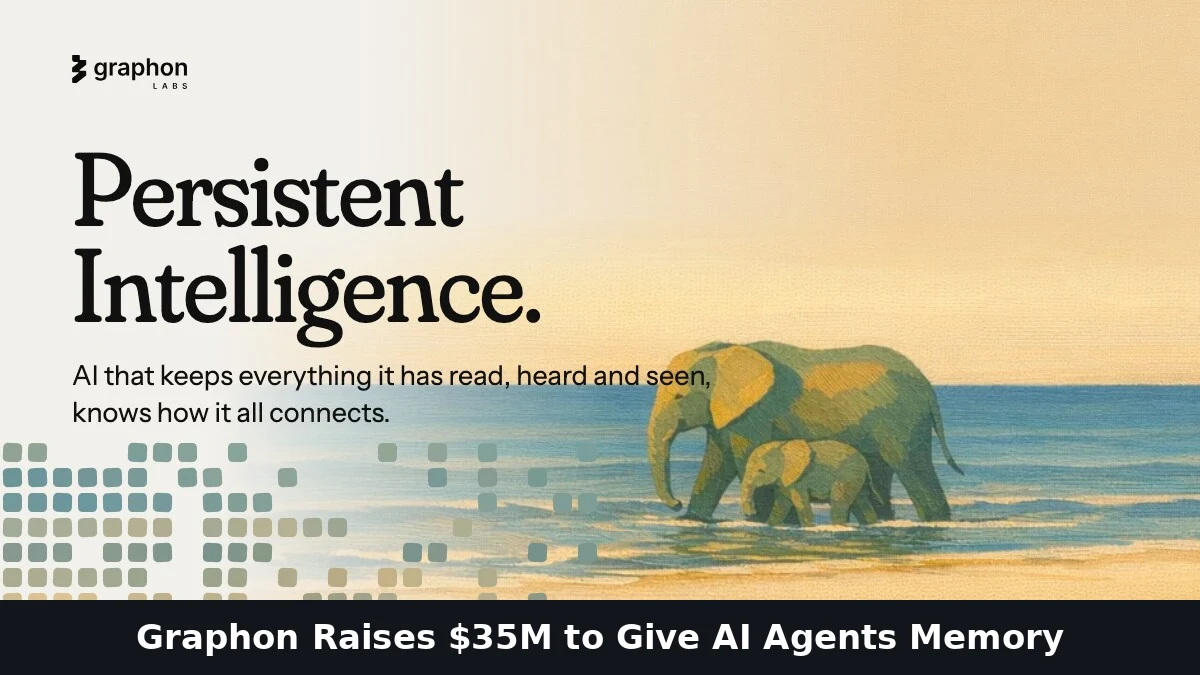
Graphon Labs, a San Francisco startup building memory infrastructure for AI agents, has raised $35 million in a Graphon Series A round led by RRE Ventures, the company announced on November 10. HP, Energy Impact Partners, Hitachi Ventures and Gaia VC joined the round, which brings Graphon’s total funding to $43.3 million less than six months after the company emerged from stealth with an $8.3 million seed round.
The funding lands as agent memory becomes one of the most closely watched categories in enterprise AI. Modern agents can write code, search databases and run multistep tasks, but they still forget what happened in earlier sessions and struggle to keep track of company data that changes over time. Graphon calls its answer “Persistent Intelligence”: a memory layer that lets agents continuously access, understand, remember and build on everything that came before.
What Graphon Builds
Graphon was founded in July 2025 by Arbaaz Khan, Clark Zhang and Deepak Mishra, a team of senior engineers and researchers from Amazon, Meta, Google, Apple and NVIDIA. Its approach is built on graphons, a mathematical framework for analyzing very large graphs that the founders developed during their PhD research. Instead of treating a company’s documents, videos and images as isolated snippets, Graphon maps the connections among them, including where information came from and when it changed.
“The old way, using vector search, is like searching through the pages of a torn-up book,” Khan said in the announcement. “We take those pages and turn them into a connected map, unlocking seamless memory search.”
The system rethinks each layer of the stack, from storage through search, retrieval and reasoning to memory, so an agent keeps what it knows, what it has done, what changed and what happened as a result, with relationships, sources and timing intact. The company says the approach also cuts the compute time needed to represent and reason across large amounts of information.

Benchmark Results
Graphon says it achieved the highest accuracy among evaluated systems on three benchmarks for long-term context: LoCoMo, ConvoMem and ATM-Bench. On LoCoMo, the company scored 93.9% accuracy while using 58% fewer tokens than loading the full conversation into the model. On ConvoMem, it reached 90.2% accuracy with 95% fewer tokens. On ATM-Bench, a University of Cambridge benchmark that tests question answering across video, audio, images and text, Graphon scored 81.7%, 5.0 percentage points ahead of the next system on the public leaderboard.
One caveat is worth noting: the LoCoMo and ConvoMem comparisons use baseline results published by Databricks, according to the announcement, so the figures reflect the company’s own benchmark runs rather than an independent test.

Three Products and Early Customers
Graphon sells its architecture as three products. Graphon Enterprise provides governed memory across enterprise data and can be hosted by Graphon, deployed in a Graphon-managed or customer-managed virtual private cloud, or installed on premises. Graphon Developer is aimed at builders working across data types without recreating the context stack. Graphon On-Device Memory targets phones, laptops, cameras, wearables and other devices. More detail is available on the company’s official website.
The company says its software is already in use at the San Francisco 49ers and HP, and Hitachi Rail has evaluated the technology for industrial use. “From uncovering new sponsorship opportunities to empowering our teams, we’re excited to explore how Graphon Labs’ technology can help us gain a competitive edge,” said Costa Kladianos, executive vice president of technology for the San Francisco 49ers.
The startup has about 20 employees and plans to use the new capital mainly to hire engineers and researchers, plus some sales and go-to-market staff, according to Dealroom. Khan said the funding “takes us from early experimentation to scaled enterprise deployments, opens our infrastructure to developers, accelerates our research, and brings Persistent Intelligence on-device.”
Why It Matters
Agent memory is emerging as a distinct enterprise AI infrastructure category rather than a feature bolted onto a model. Rivals are moving in the same direction: Mem0 raised $24 million across seed and Series A rounds in 2025 for a similar problem, and the major model providers keep expanding context windows. Graphon’s bet is that a model-neutral layer preserving relationships, provenance and change across documents, video and databases can become paid infrastructure before the model providers bundle the same capability.
RRE general partner Raju Rishi framed the investment in those terms. “Graphon Labs lets intelligence accumulate which can have profound impacts upon efficacy, compute time, complexity of queries, and much much more,” Rishi said. “We see it becoming the source of truth beneath every agent, and that’s why we led this round.”
The round sits above the 95th percentile for US enterprise software Series A deals, according to Dealroom, a sign that investors see memory as a layer worth owning outright. Whether Graphon can turn benchmark leads and early enterprise pilots into a durable business will depend on the next phase the funding is meant to pay for: scaled deployments, a developer offering and on-device memory.