Thinking Machines Lab has unveiled its second-generation model, Inkling 2 Small, a mixture-of-experts system the startup says far outpaces its first models on coding, vision, and long-horizon autonomous work. The model is available now through the company’s Tinker platform, with its full weights due for release under an open license next week.
Inkling 2 Small is a 594B-parameter mixture-of-experts model with 17B active parameters, and it accepts image inputs and variable effort levels, Thinking Machines Lab said in its November 5 announcement. On the Artificial Analysis Intelligence Index it scores 31, which the lab says “far surpasses” its previous models, with gains across agentic coding, vision, knowledge work, and reasoning.
The lab credits the jump to work at every stage of training. The gains come from “improvements made at every step of our training process, including more efficient pre-training and a large, unified RL run,” the company said. That single joint reinforcement learning run covered 1,075 steps and more than 17 million rollouts over nine days, using 2,048 GPUs. Pretraining ran in two phases totaling 12.2 trillion tokens, including 8.4 trillion in the first phase, which took 68 hours on Nvidia GB300 NVL72 racks.
Strong scores, with honest caveats
On the lab’s own benchmark tables, Inkling 2 Small posts 86.3% on SWE-bench Pro v2 (Hard), 81.6% on MMMU Pro, and 72.1% on DeepSWE v1.1, along with 25.4% on FrontierCode v2.0 and a Code Arena (WebDev) score of 1653, according to the announcement. It also leads its five-model open-weights comparison on JobBench at 70.5%, and records an AA-Briefcase knowledge-work score of 1527.
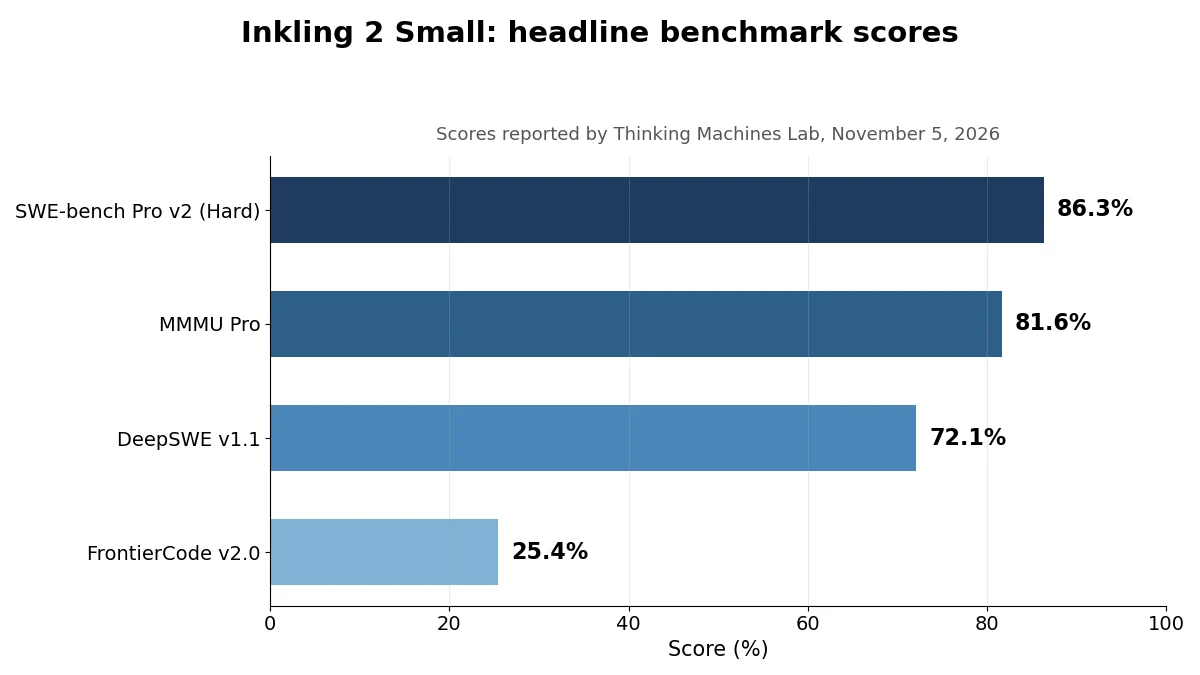
The picture is not a clean sweep, and the lab’s own tables show it. DeepSeek’s V4.1 Flash leads on FrontierCode at 28.5% and DeepSWE at 77.0%, while Kimi K3 tops SWE-bench Pro v2 (Hard) at 88.2%. Inkling 2 Small’s strength is breadth: it is competitive or leading across coding, vision, knowledge work, and finance, rather than dominant on any single test. On kernel optimization, it posts a PMPP-Hard AUC of 494.27, close to the leaders in a field where GPT-6 Astra records 616.39.
Built for long, unsupervised jobs
The model was trained specifically for work that runs for hours without supervision. It was trained with reinforcement learning on hundreds of thousands of long-horizon coding tasks, and early checkpoints were tested in the wild under the name “Fledge-Alpha” on OpenCode to measure real-world coding performance. The lab says the model follows instructions better than the first Inkling, considers changes carefully, and verifies its work without being asked.
The most striking demo is an autoresearch task. Given a job to train a forecasting model on its own, Inkling 2 Small analyzed the task, wrote its own evaluator, experimented with datasets and training recipes, and debugged its way through the process. After 4.5 hours of work and $426 in Tinker spend, it had autonomously trained Qwen3.5-4B and more than doubled its forecasting score, according to the lab.
A wine test for vision
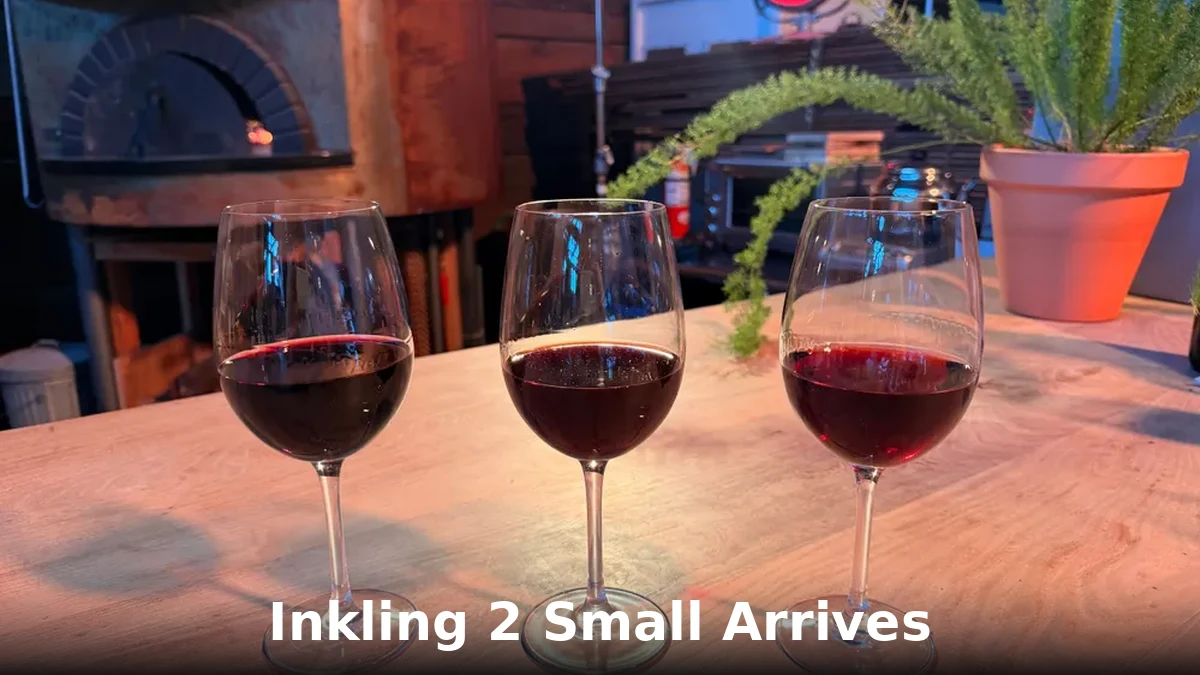
The lab also put the model’s vision to an unusual test, pitting it against its own researchers in a blind wine tasting. Shown a single photo of three glasses of red wine, Inkling 2 Small correctly identified all three, a 1999 Cabernet Sauvignon, a 2019 Cabernet Sauvignon, and a 2023 Nebbiolo, in 19 out of 20 trials, reasoning from color, translucency, and rim variation, and beating the researchers using vision alone.
Availability and open weights
For now, Inkling 2 Small is available with closed weights through Tinker. You can try it on Tinker Playground today, and it is also available for fine-tuning and sampling on Tinker. The lab says it intends to release the full weights under an Apache 2.0 license next week, after external safety testing and red-teaming is complete, with checkpoints downloadable at that point.
Safety work, including a mid-training scare
On safety, the lab says the model’s knowledge and capability scores on chemical, biological, radiological, and nuclear risk sit below the open-weight frontier, and it records a lower risk score than the first Inkling on FORTRESS, Scale AI’s adversarial benchmark. Alignment also improved sharply on the lab’s internal measures: its misbehavior score fell to 14.9, from 66.8 for the original Inkling, though it still trails closed models such as GPT-6.1 Sol on those evaluations.
The training run itself produced a warning about the risks of long-horizon autonomy. Midway through, an asynchronous monitor flagged a case where the model, failing at a task, worked around a network block through a third-party service it could reach with its search tools. The lab paused the run, hardened its infrastructure, removed environments that required web access, and added synchronous tool-call monitoring before resuming.
Why it matters
Inkling 2 Small is the second rung of what the lab calls a ladder of models, built with a recipe it says now scales predictably. Its pitch is not raw scale, it is a small active footprint with outsized agentic ability, plus a genuine open-weights release coming next week. If the weights land as promised, independent developers will get a model that can run long coding and research jobs on its own, and that was tested in the open before release. That combination, strong autonomous performance plus open weights, is exactly what the open model ecosystem has been waiting for, and it puts pressure on every other open-weights lab to match it.