OpenAI on Thursday, November 5, published its National Community Compact and a Compute Campus Policy Blueprint, pledging that future compute campuses it owns and operates will pay the full cost of electricity and infrastructure, stop asking public officials to sign nondisclosure agreements, and give host communities a say in how projects are built. The announcement lands two days after voters in the November 3 midterm elections backed candidates and measures that curb data center expansion across the United States.
“How we build these campuses is one of the first tests of whether the benefits of AI will be broadly shared,” OpenAI wrote in its announcement, adding that “the communities that host this infrastructure should have a clear say in shaping their futures, too.”
What OpenAI promised
Under the OpenAI Community Compact, every future campus OpenAI owns and operates will have its own local compact, built on a national baseline. OpenAI says it will engage residents early enough for their input to shape project plans, provide a local point of contact for the life of the campus, and report publicly each year on progress. The core commitments are:
- Pay its own way on energy and infrastructure. OpenAI will pay the full cost of the electricity it uses and the infrastructure needed to serve its sites, and provide financial assurances before major spending begins so other customers are protected if a project is delayed, reduced or canceled.
- Protect local resources and report on impact. Each campus will have a water plan that prioritizes closed-loop or low-water cooling. OpenAI will publish site-level water and electricity use, construction plans, and independent noise studies before operations begin and annually afterward.
- No NDAs with public officials. OpenAI will not require public officials to sign nondisclosure agreements, keeping only narrow protections for legitimate security information, trade secrets, and proprietary or competitively sensitive information.
- Local jobs and investment. OpenAI will publish the jobs it expects to create, work with unions and training providers to help residents prepare for them, and report annually on hiring and apprenticeships. It will also make sustained investments in priorities residents help select.
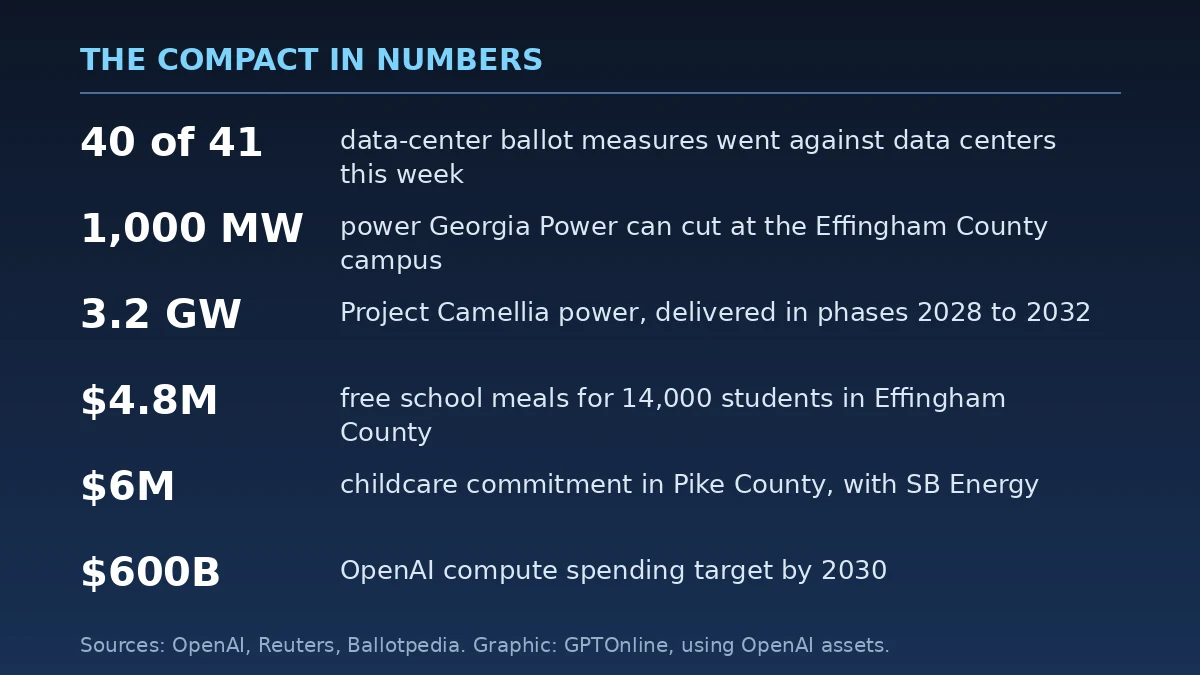
OpenAI pointed to two examples already in place. In Effingham County, Georgia, residents helped shape a $4.8 million grant providing free school meals for all 14,000 students in the county, alongside a $2 million investment in a local park. In Pike County, Ohio, families identified childcare as a priority, leading to a joint $6 million commitment from OpenAI and SB Energy. The compact also points to an $80 million commitment to community priorities in Effingham County.
Why now
The timing is hard to miss. Of 41 data-center-related ballot measures decided this week, all but one went against data centers, according to Ballotpedia data cited by Reuters. OpenAI told Bloomberg it had planned the announcement before the election returns and had been working on it for months, a point its chief global affairs officer, Chris Lehane, has made in briefings since August.
The release was also previewed. On November 1, Axios reported OpenAI’s post-midterm plan, including community compacts and a push to call its facilities “AI compute campuses” rather than data centers. GPTOnline covered that preview in OpenAI to Push Mandatory AI ‘Speed Limits’ in Post-Midterm Washington Campaign.
The compact builds on two earlier steps. On January 20, OpenAI announced Stargate Community commitments to pay its own energy costs and tailor plans to local priorities. On November 2, it launched the Grid Protectors program, which lets future campuses cut electricity demand during grid stress. GPTOnline covered that launch in OpenAI Launches Grid Protectors Program to Ease Data Center Strain on US Power Grids. At the planned Effingham County campus, OpenAI’s agreement with Georgia Power allows the utility to reduce power deliveries by up to 1,000 megawatts during high-demand periods. For Project Camellia, OpenAI is contracting with Georgia Power for 3.2 gigawatts of power, delivered in phases between 2028 and 2032.
What the blueprint asks of policymakers
The second document, the Compute Campus Policy Blueprint, goes beyond OpenAI’s own sites. It asks federal, state and local policymakers to set comparable rules for the whole industry. State utility commissions should require large electricity customers to cover the incremental grid costs they create, the blueprint says, and protect other customers if a project falls through. It calls for public reporting on water, energy, noise and hiring, narrow limits on when developers can require public officials to sign NDAs, and public terms for discretionary tax incentives, with measurable commitments and clawbacks if a developer falls short. It also urges faster permitting for generation and transmission, clearer authority for federal regulators to speed connections for ready-to-build projects, and restored and expanded tax incentives for clean electricity.
What the compact does not cover
Several limits matter. The commitments apply only to campuses OpenAI owns and operates. Much of the infrastructure dedicated to OpenAI is built and owned by partners such as Oracle, and Reuters noted it is unclear whether the policies cover those sites. Neither CNBC nor Reuters gave a megawatt or dollar figure for the new pledge itself, and the blueprint is a proposal that Congress has not taken up. There is also no enforcement mechanism beyond the annual public reporting OpenAI promises.
The stakes are large. OpenAI told investors in February that it targets $600 billion of total compute spending by 2030, and it has announced large projects in Georgia and Ohio. Whether the compact changes how those projects land will show up first in the project agreements and annual reports OpenAI has now promised to publish.
Sources
- OpenAI, “Setting a new standard for responsible AI infrastructure,” November 5, 2026
- OpenAI, National Community Compact (PDF)
- OpenAI, Compute Campus Policy Blueprint (PDF)
- Bloomberg, “OpenAI to Change How It Handles Data Center Efforts After Outcry,” November 5, 2026
- VoltGrid News, “OpenAI Data Center Power Pledge: Pays Full Cost, Drops Official NDAs,” November 5, 2026
- Unite.AI, “OpenAI Publishes Community Compact and AI Campus Policy Blueprint,” November 5, 2026