Updated October 26, 2026
| Name | Lmql |
| Overview | LMQL is a sophisticated programming language specifically designed for engaging with Large Language Models (LLMs). Its primary goal is to streamline the interaction with these models through various features like modular prompting, types, templates, and constraints. Users can utilize LMQL for an extensive array of tasks, from straightforward queries to intricate procedural programming assignments. Among its highlights is the ability to conduct nested queries, which fosters the reuse of prompt components and augments procedural programming capabilities. Furthermore, LMQL supports multiple inference backends, although configuration and supported features depend on the chosen backend. The construction and generation of prompts leverages Python’s expressive control flow and string interpolation, making it a dynamic and powerful tool for LLM interactions. |
| Key features & benefits |
|
| Use cases and applications |
|
| Who uses? |
|
| Pricing | The LMQL software is open source under Apache-2.0, with no software licence fee. Model-provider API charges and any local or hosted computing costs are separate; open-source access does not make every model call free. |
| Tags | LMQL, Large Language Models, Programming, AI Development |
| App available? | Installable Python package and command-line tools, plus a browser-based Playground IDE. This is developer tooling rather than a verified consumer iOS or Android app. |
Sources: LMQL documentation, supported backends, inference tracing, and official repository and software licence.
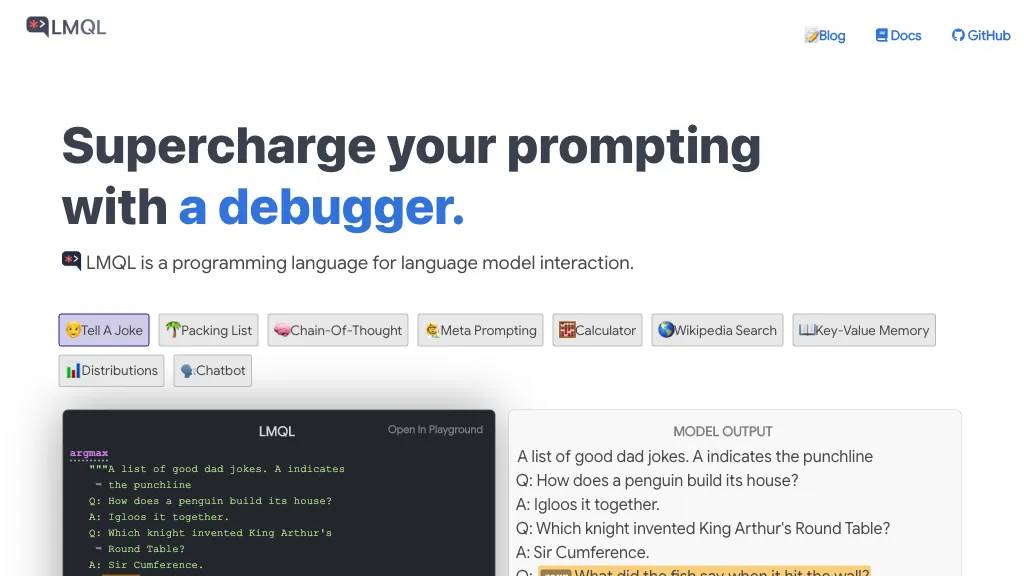
The existing image shows an earlier LMQL debugger demonstration, not a test of current model outputs.