Updated on October 20, 2026.
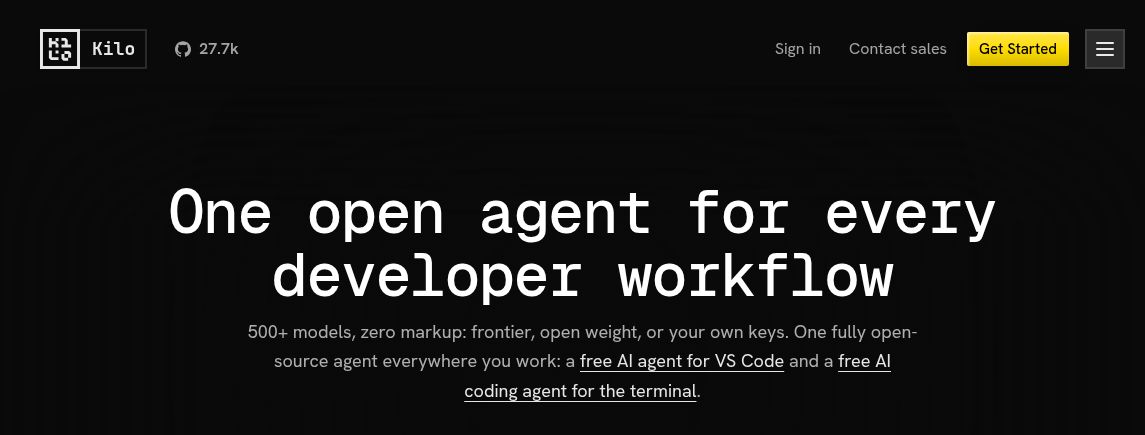
Featured image: screenshot of Kilo Code AI’s official website, captured October 20, 2026. Vendor presentation, not a hands-on test.
Kilo Code AI, now presented under the Kilo brand, is an open-source coding agent for software development. It can help explain a codebase, plan changes, edit files, run development commands, and review work. Its current offering extends beyond the original VS Code extension to desktop, terminal, other IDEs, and cloud workflows.
What Kilo can do
The official feature directory describes codebase indexing, debugging, memory, reusable skills, MCP tools, pull-request reviews, and an agent manager for parallel work. These capabilities can support refactoring, test creation, project scaffolding, and investigation of a bug. They do not remove the need to review changes and run appropriate tests.
Kilo offers VS Code and JetBrains integrations, a CLI, Cloud Agents, and a desktop application marked beta. Its iOS and Android apps are described as ways to run cloud agents, control desktop sessions, and review work remotely. Availability of an integration does not mean every interface has identical features.
The homepage advertises access to more than 500 models and support for bringing your own provider keys. Model availability and cost vary, so select a model for the task rather than relying on the older article’s fixed list of GPT-4, Claude 3, and Gemini versions.
Pricing: software, inference, and cloud compute
Kilo separates software access from the resources used by an agent. The pricing page shows the following US-dollar rates:
| Item | Displayed price or billing basis |
|---|---|
| Individual software access | Free; inference and cloud use can cost extra. |
| Teams | US$15 per user per month. |
| Enterprise | Custom quote; a 14-day evaluation is advertised. |
| Gateway inference | Pay as you go at provider rates; credit purchases add a 5% processing fee. |
| Cloud Code Reviews | US$0.33 per hour of compute, separately from inference. |
| Cloud Agent compute | Docker/Small: US$0.60 per hour; Standard: US$1.20 per hour. |
Cloud compute is billed per second. Free or local models and your own provider keys are alternative inference arrangements; a free application does not make a paid provider’s tokens free.
The optional Kilo Pass starts at US$19 per month, with US$49 and US$199 tiers also listed. Payments become paid credits, with bonus arrangements that depend on the billing option and subscription history. The annual-plan FAQ gives a US$228 yearly payment for Starter, with US$19 in paid credits issued each month; monthly bonus credits expire. Review renewal, credit validity, and cancellation terms before subscribing. A universal US$20 signup credit was not verified during this update.
A sensible first coding task
- Choose a small repository change with a clear acceptance test, such as fixing one reproducible bug.
- Ask the agent to explain the relevant files and propose a plan before editing.
- Check the selected model, inference budget, and whether work will run locally or in the cloud.
- Review file edits, commands, dependency changes, and any external tools before allowing them.
- Run tests and inspect the final diff before merging or deploying.
For example: “Find why this validation test fails. Explain the cause, propose the smallest fix, and add a regression test. Do not change unrelated files.” A bounded request makes the result easier to verify than asking an agent to improve an entire application.
Who is it useful for?
Developers and open-source contributors may use Kilo for code exploration, repetitive edits, and test preparation. Teams may value shared billing and agent workflows. Comparing it with another coding assistant should include model choice, permissions, repository support, review effort, and total usage costs, rather than software subscription price alone.
Before connecting a work repository, check your organization’s rules for source code, secrets, third-party models, and remote execution. Treat generated code as an unreviewed contribution. Claims about speed, security, or automatically fixed bugs are not independent guarantees.
This is an overview of official product information; no code execution, benchmark, or hands-on model comparison was performed. Sources checked: October 20, 2026. Browse related code assistants.