Updated October 15, 2026. This is a documentation-based overview. We reviewed public product pages, developer documentation, legal policies and the publisher’s Chrome listing. We did not create an account, install an app, run code, connect a repository or test a deployment.
Blackbox AI’s current website emphasizes enterprise AI inference, with coding tools documented alongside it. Readers returning to this older code-search listing should check the specific product and access terms they need: a browser extension, a terminal coding agent and an inference API serve different workflows.
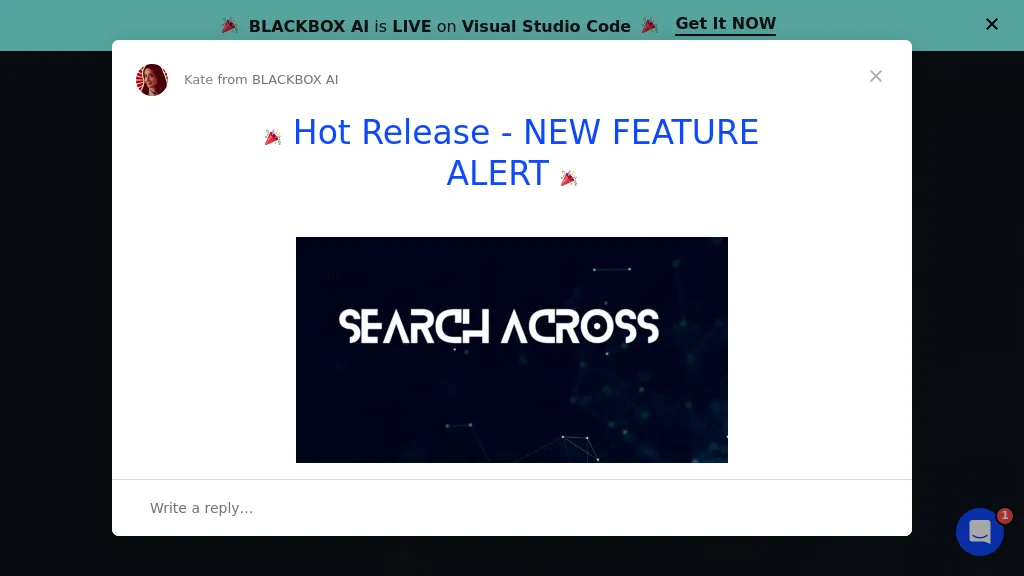
Archival image note: The featured image comes from this listing’s original 2024 version. Its “Hot Release” popup and Visual Studio Code banner are historical promotional material, not a current release announcement or evidence of our testing.
What is Blackbox today?
The current Blackbox website presents hosted model inference, dedicated deployments and model fine-tuning for organizations. Its coding-extension connection is verifiable: the publisher’s Chrome Web Store listing links to that same website. The old useblackbox.io address in our original listing could not be accessed during this update; we did not verify a redirect or the transfer of legacy accounts.
Coding tools and platforms
- Terminal assistance: The CLI guide describes reading project files, generating code, changing existing files and debugging. It documents macOS/Linux and Windows installation. Native Windows support is limited to Blackbox and Claude agents; other listed agents require Windows Subsystem for Linux.
- Parallel implementations: The command reference describes /multi-agent creating separate Git branches for alternative implementations. It requires an initialized Git repository. Comparing branches still requires a developer to assess correctness.
- Cloud tasks: The Agent API documents task creation, status checks, streamed logs and sandbox-file management. Repository work requires a separate GitHub connection, according to the task-creation guide.
- Browser extension: The Chrome listing describes coding questions, page context, GitHub code chat and image-to-text selection. It showed version 3.1.92, updated May 19, 2025. That listing does not establish that every old video or PDF extraction workflow still works.
CLI and browser-extension documentation exists, but we did not verify current native mobile or desktop-app distribution. Blackbox’s terms explicitly describe its Visual Studio Code extension as discontinued. Do not treat the archival banner as an installation recommendation.
Pricing and access limits
On the checked date, the public pricing page displayed a custom Enterprise offer with an annual purchase-order commitment. Usage reduces the committed balance; unused commitment expires at the billing period’s end. API, CLI and Agents API share that balance. Rate limits are negotiated, and multi-agent orchestration is metered.
The page lists model-specific input, output and cached-read rates per million tokens. For example, Kimi K3 was $3 input, $15 output and $0.30 cached reads. The model catalog identifies its currency as USD. These are reference rates for contract quotes, not a fixed monthly consumer subscription.
Two caveats matter. The dedicated-endpoint documentation describes GPU-minute billing while deployments run, so obtain a workload-specific quote. Also, the task-creation guide still mentions a Pro subscription although the public pricing page shows Enterprise. We could not reconcile that access requirement or verify a current consumer credit allowance, free tier or no-card signup. Confirm eligibility and charges before committing.
A safer first coding task
Consider this fictional evaluation for a small Python project: a function should deduplicate a list of product labels while preserving their original order. Use invented labels and a disposable repository with no credentials or customer data.
A useful prompt would be: “Propose a function that preserves the first occurrence of each exact string. Treat uppercase and lowercase as different. Include tests for an empty list, repeated labels and mixed case. Explain the approach. Do not add dependencies, access the network or deploy anything.”
Review the proposed change before executing it. Check that it does not sort the labels, alter the input list or silently normalize case. Run the tests in an isolated environment, inspect unexpected files and compare the result with a straightforward implementation you understand. This is an example evaluation plan, not a Blackbox result or a claim about its accuracy.
Privacy, licensing and practical limits
Blackbox’s privacy-controls page says request content is discarded after processing, training opt-out is enabled by default, and identifiers can be masked before routing to closed models. It qualifies upstream enforcement by whether a provider’s API supports it. These are vendor statements, not security controls we independently tested.
The separate Privacy Policy, labeled January 7, 2024, discusses account information, cookies and retention of personal data. Request-content retention claims should not be read as a promise that all account records disappear. Ask which contract, provider settings and storage rules apply to your chosen workflow before submitting confidential code.
The terms say Blackbox claims no ownership of results and that users retain their code, while shared content is subject to a license. They also disclaim output accuracy and suitability. Ownership language does not establish that generated code is free of third-party license obligations. Review provenance, dependencies, security-sensitive logic and applicable licenses before reuse.
Who should consider it?
Blackbox merits investigation if your team wants programmatic model access or documented terminal and cloud-agent workflows, and can evaluate the commercial terms. For an editor-centered option, see our Cursor AI overview and verify its current vendor documentation too. Choose around your actual task, permissions and review process rather than legacy repository counts or unsupported productivity promises.