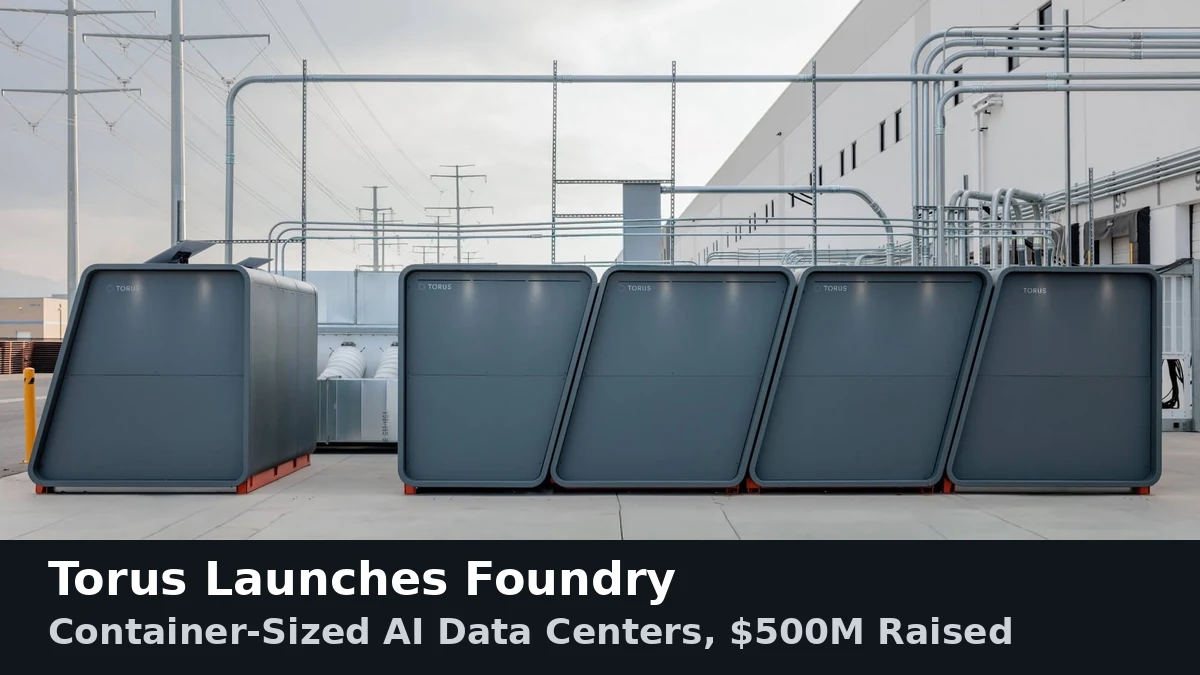
Torus Foundry, a prefabricated modular AI data center that pairs batteries with compute hardware in a shipping container sized unit, launched on November 11. Salt Lake City based Torus also announced $500 million in growth capital led by Magnetar, with participation from ICONIQ, Origin Ventures, Ridgeline Partners and Trinity Capital.
Foundry is built for the part of the AI market that is growing fastest: inference. Running trained models for real users, rather than training new ones, now drives most new demand for data center capacity. Torus said in its announcement that data center demand for AI inference is projected to grow 35 percent a year through 2030, compared with 22 percent for training, citing McKinsey. The bottleneck, the company argues, is not generating more electricity but getting power to chips fast enough, and Foundry is its answer: bring the chips to the power that is already available.
What Foundry Is
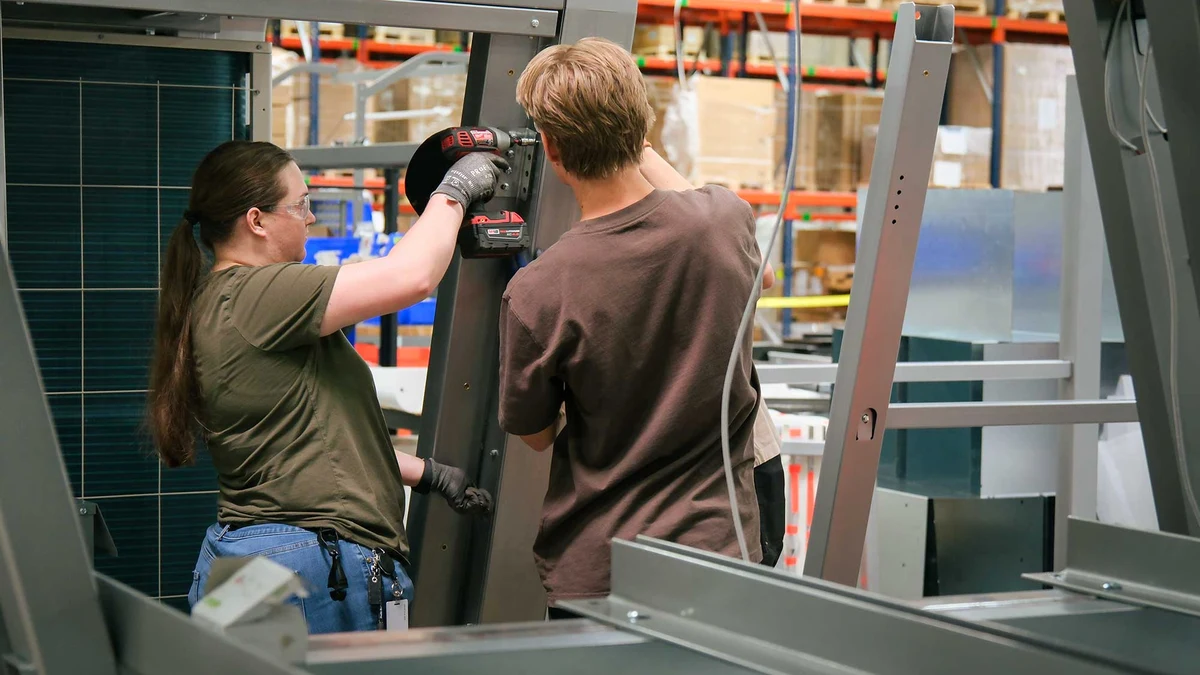
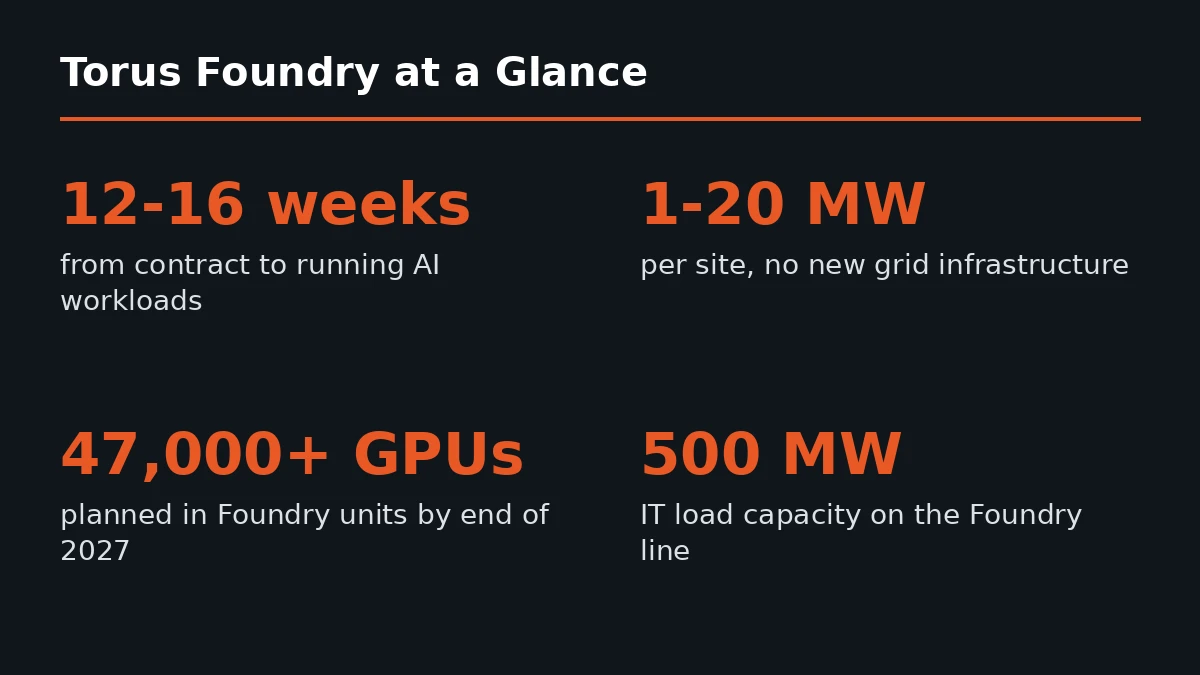
Each Foundry unit packages power, storage, cooling, networking and compute into a single prefabricated system. The units are built at GigaOne, Torus’s 545,000 square foot manufacturing facility in Salt Lake City, and shipped to a site where they can go from contract to running AI workloads in 12 to 16 weeks. A traditional hyperscale campus can take years to build. Foundry sites run at 1 to 20 MW, need no building construction, and the smallest system is roughly the size of a small cargo van.
The key trick is placement. Foundry installs behind the meter, using available headroom at individual transformers, so it adds steady, high load factor demand without new grid infrastructure or the upgrades that often push up electricity rates. Every unit is paired with Torus Reserve, the company’s energy storage and management product, whose integrated inertial flywheel and battery storage cover demand peaks so more compute fits on an existing interconnection. During grid outages, the same storage provides backup power.
Torus vertically integrates the whole stack, from fiber to site, chiller to coolant distribution unit, and grid to rack. Torus Reserve handles load shaping and redundancy, Foundry provides the inference compute, and Torus Protect covers integrated networking and security. Every deployment is turnkey, with ongoing operations and maintenance included.
Three Ways to Buy It
Torus is launching Foundry with its first customers, Hydra Host and another AI cloud provider, and offers three models. Strategic is a powered shell with power and enclosure but no GPUs. Partner is a turnkey bare metal unit that includes power, enclosure and GPUs. Direct is sovereign inference capacity sold to enterprise customers, with single tenant hardware allocated exclusively to one company’s workload.
The company says Foundry already has thousands of GPUs deployed, with plans for more than 47,000 GPUs in Foundry units by the end of 2027. The Foundry production line at GigaOne is online and will be capable of producing 500 MW of IT load, with plans to expand to 1 GW. GigaOne opened its first production line in early 2026 and has opened a new production line every 21 days this year, according to the company.
Why Power, Not Chips, Is the Bottleneck
“The industry has been trying to solve AI’s power problem by building net-new infrastructure, which causes costs to potentially rise and takes years to bring compute online,” said Nate Walkingshaw, CEO and founder of Torus. “Inference doesn’t have to wait. We’ve spent years learning how to make the grid more affordable, flexible, resilient, and intelligent, and Foundry applies that to compute: capacity in weeks, with power that’s already available. Most providers are bringing power to the chips. Foundry brings the chips to power.”
Magnetar, which led the round, framed the investment the same way. “One of the biggest challenges in scaling AI infrastructure is access to power, and the solution isn’t simply generating more of it, but making better use of what’s already available,” said Dave Snyderman, Managing Partner and Global Head of Alternative Credit and Fixed Income at Magnetar. “As demand for AI inference accelerates, we believe solutions like Foundry will become increasingly important.”
The capital will fund continued expansion of GigaOne and further Torus Reserve and Torus Foundry deployments across the United States. Bloomberg reported the round as a Series C, and Dealroom noted the $500 million raise sits in the 98th percentile of all time US Series C energy rounds.
Sustainability and Context
Foundry is designed to be gentler on local resources than a conventional data center. Its closed loop cooling system is waterless, using 95 percent less water than evaporative coolers, and because it runs on existing grid capacity it avoids the new transmission and generation buildout that large data centers often require. Each system also donates GPU time to medical research through Folding@home.
The launch lands as the AI infrastructure market splits into two races: one to build ever larger training clusters, and one to put inference capacity closer to users, faster. Torus is betting on the second. Its pitch is speed and placement rather than scale: prefabricated units, existing interconnections, and power storage that smooths the violent load swings of GPU clusters. The open question is how far that model scales beyond its first customers, and whether 47,000 GPUs by the end of 2027 is achievable from a standing start of a few thousand. The $500 million raise gives the company the manufacturing capacity to try.
Sources
- Torus Launches Modular AI Infrastructure, Foundry, to Meet Surging AI Inference Demand and Secures $500M in Funding, Business Wire, November 11, 2026
- Utah Startup Raises $500 Million for Modular AI Data Center, Bloomberg Law, November 11, 2026
- Torus raises $500M Series C for modular AI data centers, Dealroom, November 11, 2026