Alibaba has opened a preview of Qwen4-Max, the first model in its next flagship Qwen4 family, ending weeks of speculation about when the successor to Qwen3.8 would arrive. The preview is live now through Alibaba’s Token Plan subscription and across the company’s own apps, including Qwen App, Qoder, Qwen Office and QwenStudio.
The launch, on November 11, puts Alibaba’s most anticipated model in developers’ hands as a managed preview rather than as a full release. There are no downloadable weights yet, no published benchmarks and no model card, so the preview answers the question of when Qwen4 would appear while leaving the question of how good it is open for now.
What was announced
Qwen4-Max is the flagship tier of a four-model family Alibaba first showed on stage at its Apsara Conference in Hangzhou on September 22, alongside Qwen4-Flash, Qwen4-Plus and a 27B model built for local deployment. The Max tier is aimed at the top of the market, and Alibaba is pitching this generation at complex programming, frontend design and agent workflows, with an emphasis on professional office tasks and software operations where the model uses tools on its own to complete multi-step work.
Access runs through the Token Plan, a subscription that bundles model usage for coding agents and other API clients, and through Alibaba’s own surfaces: Qoder for agent-assisted software development, Qwen Office for workspace tasks, the Qwen App for mobile use and QwenStudio for custom agent development. The service works with clients that use OpenAI or Anthropic compatible protocols, so developers can point tools such as Qwen Code, Cline, Claude Code, Cursor, OpenCode and Codex at it by changing the provider base URL and API key.
Chinese financial press reported that preview users can try Qwen4 at a limited-time minimum of 10% of the price, and the Token Plan’s entry tier is advertised to new users from about $3. Alibaba has not published a per-token price list for Qwen4-Max.
What the preview offers
According to the Token Plan documentation, Qwen4-Max preview supports a 1 million token context window and up to 393,216 output tokens, with thinking and the final answer sharing one budget. It accepts image and video input alongside text, and offers three reasoning effort levels, low, medium and xhigh, with xhigh as the default. Those figures come from the product documentation rather than from a published model card, and Alibaba has not confirmed them in a formal announcement.
The 1 million token figure also appears in Alibaba’s own tooling. A change merged into the open source Qwen Code repository on October 28 assigns a one million token default to every model identifier starting with “qwen4”, and Qwen Code version 0.26.5 maps Qwen4 identifiers to the same low, medium and xhigh reasoning levels. Those are client settings, not a verified server specification, but they match the documentation figures.
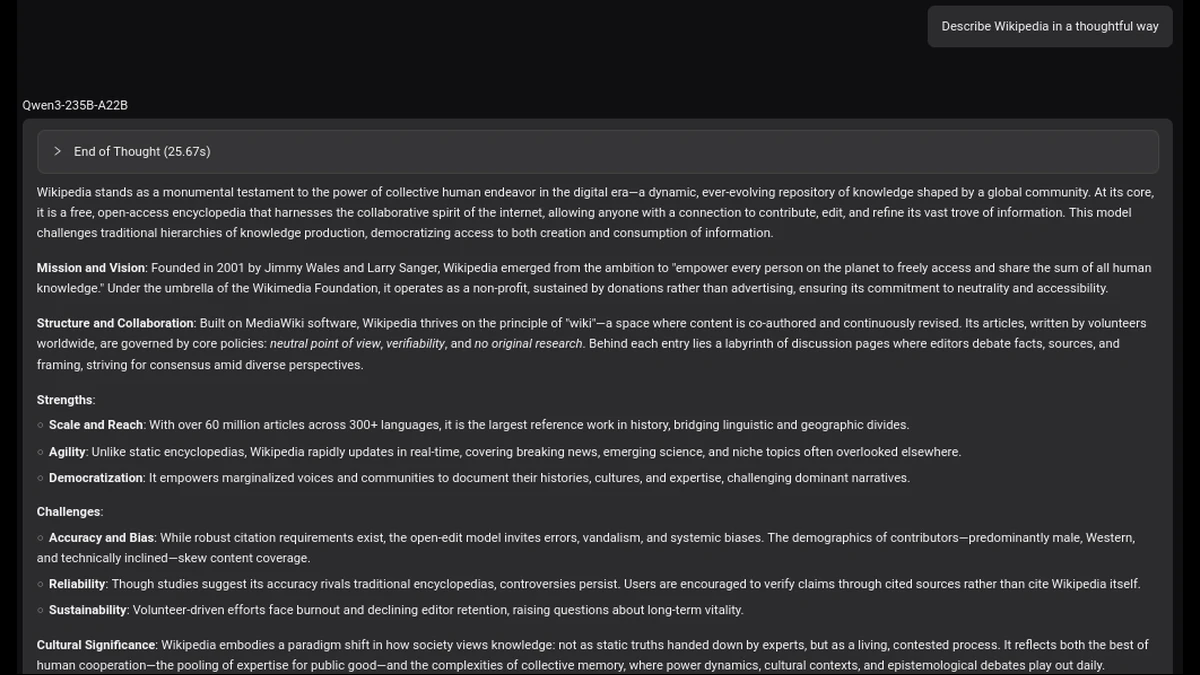
Image: Qwen (Wikimedia Commons). The Qwen chat interface, shown here running a Qwen3 model.
How we got here
Qwen4 has been one of the most closely watched model launches of the year. At Apsara in September, Alibaba said only that the model was in training, while also laying out a roadmap for later Qwen4.5 and Qwen5 models at a scale of 5 to 10 trillion parameters. On October 29, at the company’s first Apsara Conference in Europe in Amsterdam, Alibaba Cloud chief technology officer Feifei Li reportedly told attendees the family would arrive “next week”. A week later the official Qwen account on X posted a teaser poster of birds forming a giant fish, with the line “The becoming begins”, without naming the model or giving a date.
In between, the signals kept building. An anonymous model called Qoduck appeared in free preview inside the Chinese and international versions of Qoder from November 7, and Chinese outlets identified it as an early Qwen4-Max checkpoint, though Alibaba did not confirm that. Alibaba had already open sourced Qwen3.8-Flash-Next in late August, describing it in its model card as an experimental preview of the architecture behind Qwen4.
The predecessor, Qwen3.8-Max, launched on August 3 as a 2.4 trillion parameter mixture of experts model with 95 billion active parameters per token, priced at $2 per million input tokens and $6 per million output tokens, with a one million token context window. Its open weights were later published as Qwen3.8-2.4T-A95B. Qwen4-Max inherits none of those figures by default, and none has been confirmed for the new model.
Why it matters
Qwen is the most widely used open model family in the world, and its flagship releases set the pace for a large part of the open source ecosystem. A strong Qwen4 would put pressure on frontier labs and on rival Chinese developers at a moment when coding agents and long-running autonomous workflows are the main battleground for model makers. The preview’s focus on sustained performance across long tasks with repeated tool calls shows where Alibaba thinks the competition will be won.
The open question is whether Qwen4-Max will follow the Qwen3.8 pattern, with weights eventually published for the community, or stay behind Alibaba’s paid Token Plan. Alibaba has said nothing about open weights or a self-hosting license for Qwen4-Max, and the Flash, Plus and 27B tiers have no release dates yet. Until benchmarks arrive, the preview is best treated as an invitation to test the model rather than as proof of a new performance tier.
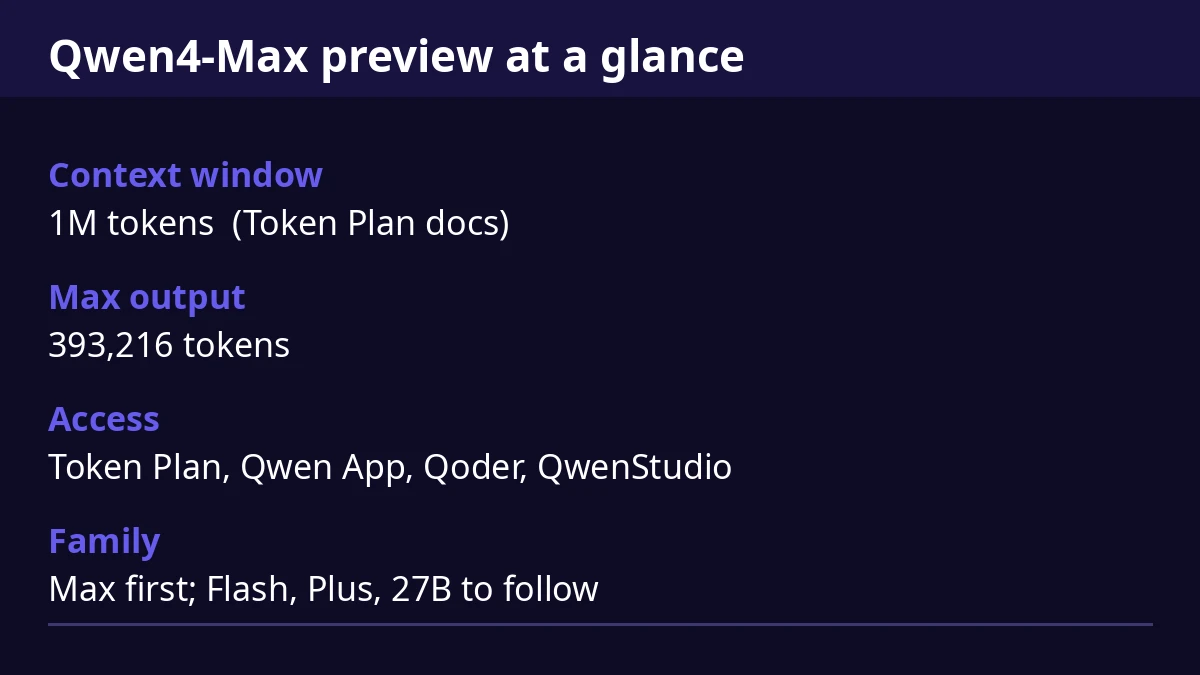
Graphic: GPTOnline, using figures from Alibaba’s Token Plan documentation and public roadmap.
Sources
- Alibaba Cloud Model Studio, model list (lists qwen4-max-preview)
- AlphaSignal, “Alibaba Launches Qwen4-Max With Agent-First Coding and 1M Token Support”
- KuCoin / BitPush News, “Qwen4 Launches with Max Preview Focused on Complex Programming and Software Operations”
- Cointime, “Alibaba Announces Upcoming Release of Next-Generation Qwen4 Model” (citing Sina Finance)
- AICoder live news, Qwen4-Max preview specifications from Token Plan documentation