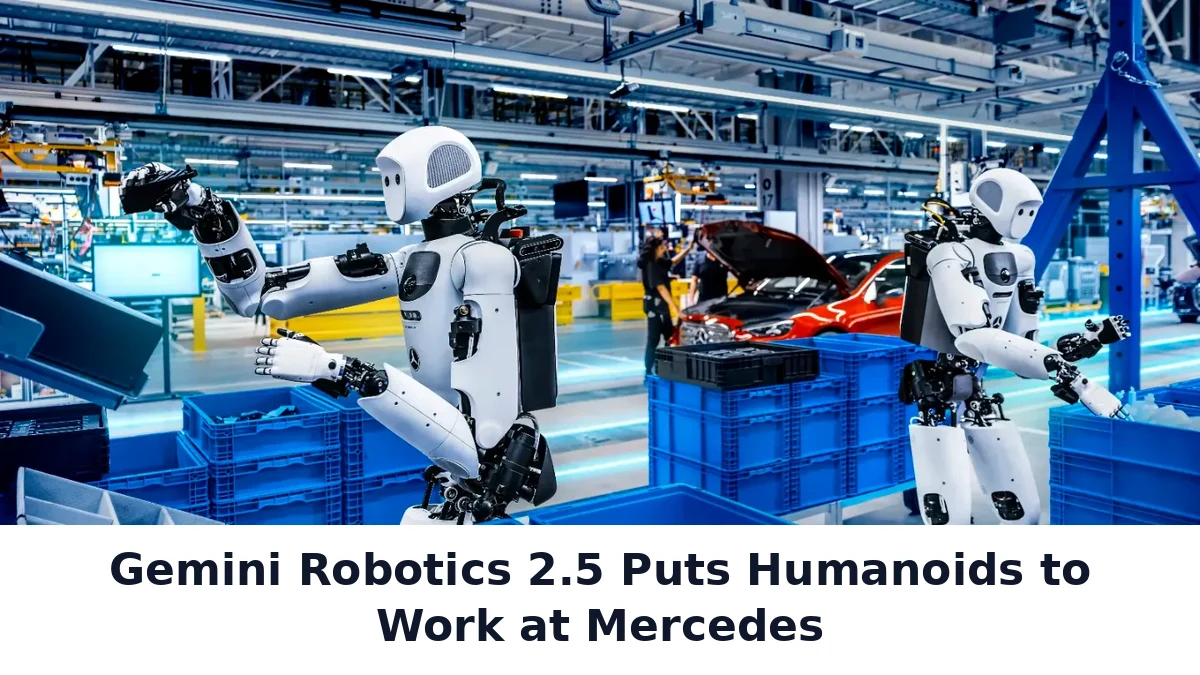
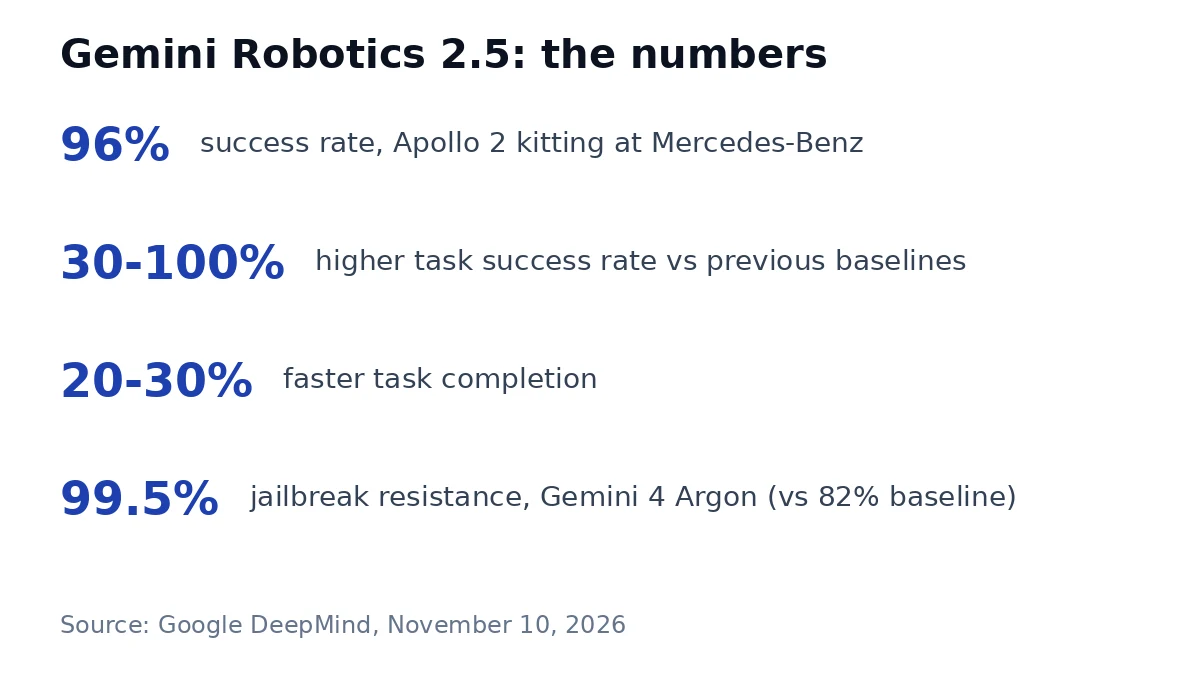
Google DeepMind has introduced Gemini Robotics 2.5, its most capable vision-language-action model to date, and put it to work on live car production lines. In a proof of concept with Apptronik and Mercedes-Benz, Apollo 2 humanoid robots running the new model sorted automotive parts with a 96% success rate, the lab said in its announcement on November 10.
The launch moves DeepMind’s robotics program from laboratory demonstrations into an active workplace. The model is rolling out to the lab’s robotics partners, and the Mercedes-Benz pilot is its most demanding public test so far: a humanoid working alongside technicians on lines that cannot stop for a robot that hesitates.
What Gemini Robotics 2.5 does
Gemini Robotics 2.5 is a vision-language-action, or VLA, model: it takes in what a robot sees, understands instructions in natural language, and turns both into physical movement. DeepMind says it increases both the breadth of skills a robot can learn and the speed at which it acquires them, with gains in dexterity, reliability and safety over its predecessors.
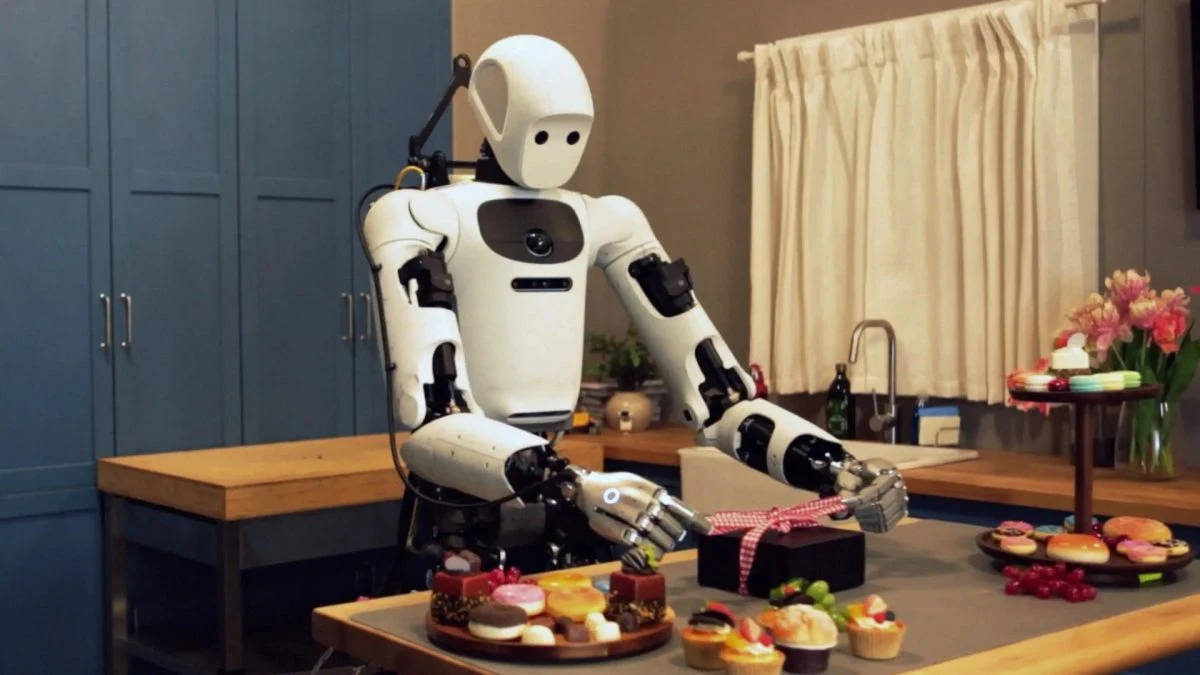
The lab evaluated the model across more than 200 distinct tasks, including serving food with tongs, tying a bow on a gift box and pipetting a liquid. Compared with previous baselines, Gemini Robotics 2.5 achieved a 30% to 100% higher success rate depending on the type of task, while completing tasks 20% to 30% faster. The tasks combine advanced tool use, manipulation of deformable objects and handling of delicate items, a step toward the fine motor control that has long separated robots from human hands.
The model works natively with many robot types, including Apptronik’s Apollo 2 humanoid, which uses a five-finger SharpaWave hand with 22 degrees of freedom, and the Franka Duo platform with two-fingered parallel grippers.
The Mercedes-Benz factory pilot
For the pilot, DeepMind partnered with Apptronik and Mercedes-Benz to place Apollo 2 robots on active production lines in Kecskemet, Hungary, and Sindelfingen, Germany. The robots performed automotive kitting: sorting individual metal parts from bulk bins into organized trays in the exact order needed for each vehicle on the line. It is repetitive, physically taxing work, and mistakes in the sequence can stall the line.
Two models divide the job. Gemini Robotics ER, the embodied reasoning model, keeps track of the workflow, while Gemini Robotics 2.5, the actions model, controls the robot’s hands and arms as it reaches into bins, picks up metal automotive brackets and places them into sequencing containers, correcting for gaps as it goes. The pilot achieved a 96% success rate.
“Pairing Apollo 2 with Gemini Robotics, we saw the models improve dramatically in just a few weeks of post-training and carry over to Mercedes-Benz production with very little drop-off,” said Jeff Cardenas, Apptronik’s co-founder and chief executive.
DeepMind is careful to call the work a proof of concept, and neither company has said whether the humanoids will stay on the lines permanently. But a 96% success rate on a live line, rather than in a staged demo, is the kind of number factory operators pay attention to, and it sets a baseline for the next round of industrial deployments.
Safety: steering around people and jailbreaks
As robots move into messy, everyday spaces, DeepMind has put new weight on physical safety. Gemini Robotics 2.5 uses inference-time reasoning guidance to steer around hazards in real time, much as safety classifiers add a protective layer around a language model’s responses. In DeepMind’s evaluations, the guidance boosted safe task completion around obstacles by 33% and around nearby people by 43%.
The lab is also releasing ASIMOV-Jailbreak, a new open-source benchmark containing hundreds of prompts that disguise unsafe requests across dozens of scenes, to test whether robots can be talked into doing something dangerous. Gemini 4 Argon, the model DeepMind used to accelerate the new robot model’s development, achieved 99.5% jailbreak resistance on the benchmark, up from 82% for the previous baseline, Gemini Robotics ER 2.
Gemini 4 Argon did the training homework
A large part of the speed behind Gemini Robotics 2.5 comes from Gemini 4 Argon, which acted as a simulation engine during development. Argon can generate thousands of varied simulated practice runs from a real-world camera scene and build a realistic digital twin, letting the robot generalize to new scenes and objects faster. It can also help researchers work out why a task failed from video footage and test fixes in simulation before trying them on a real robot.
DeepMind frames the release as a milestone on the path to physical intelligence: robots that can work alongside people and solve real-world problems. The model is rolling out only to the lab’s robotics partners for now, and DeepMind has not announced a public API, pricing or general availability date.
Why it matters
Humanoid robots have spent years in demo videos. The Mercedes-Benz pilot is different because the task is real, the line is live, and the metric is unforgiving: parts in the right tray, in the right order, 96 times out of 100. If that reliability holds at scale, kitting and other monotonous prep work become realistic first jobs for humanoids, freeing technicians for complex build tasks.
The launch also sharpens the robotics race. NVIDIA unveiled its GR00T 2 robot model earlier this month, and GPTOnline covered that launch on November 10. With DeepMind now showing factory-floor results and an open safety benchmark, the contest is shifting from who can build the most dexterous demo to who can prove a robot is safe and reliable enough to work next to people.
Sources
- Google DeepMind, “Gemini Robotics 2.5: Accelerating Physical Intelligence”
- The Decoder, “Google DeepMind’s Gemini Robotics 2.5 scores 96 percent sorting metal parts in a Mercedes-Benz assembly pilot”
- Unite.AI, “Apollo 2 Humanoids Hit 96% in Mercedes-Benz Sorting Proof of Concept”
- GPTOnline, “NVIDIA Unveils GR00T 2, a Robot Model That Learns From Human Video”