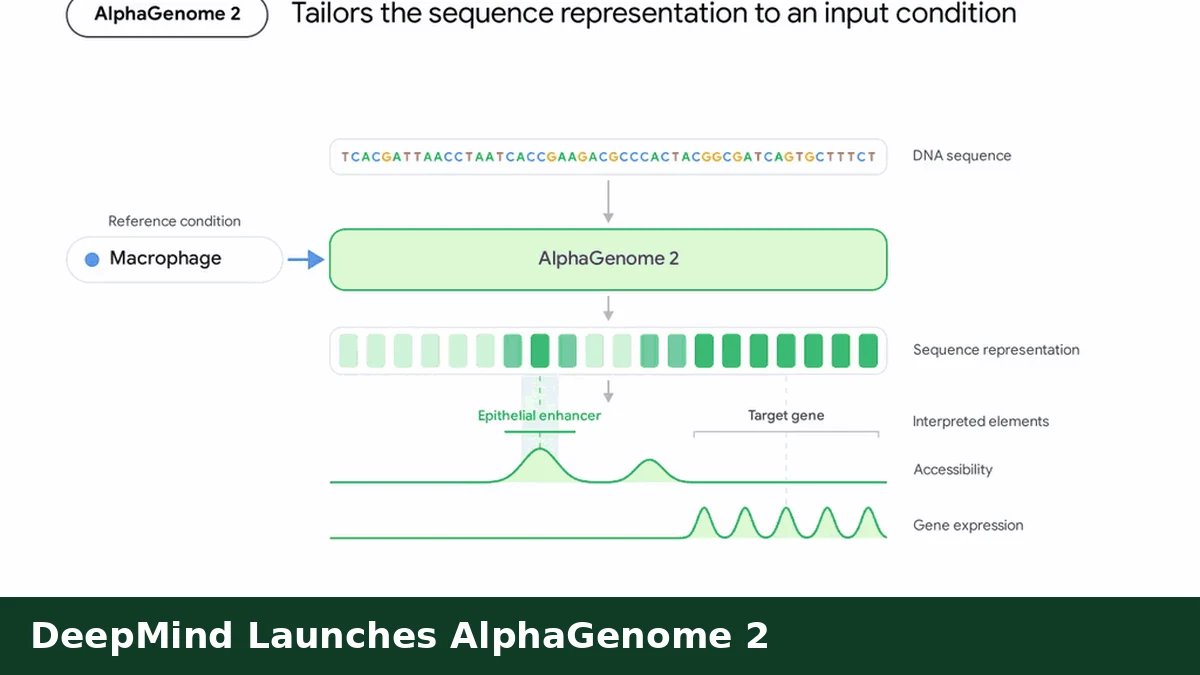
Google DeepMind has launched AlphaGenome 2, a next generation DNA model that predicts how genetic variants affect hundreds of individual human cell types. The model, announced on November 11, is trained on more than 107 million individual cell profiles across 68 tissues, and DeepMind says it identifies nearly twice as many variants that change gene expression in cells as its previous state of the art model.
The launch follows the original AlphaGenome, which DeepMind released last year to predict how DNA variants affect molecular activity across broad tissues. AlphaGenome 2 zooms in further, from tissue averages to individual cell types and cell states, so researchers can find disease relevant variants that broader models would miss. DeepMind said in its announcement that the model “turns static cell atlases into a predictive engine for human genetics.”
What AlphaGenome 2 Does Differently
The first AlphaGenome model took a DNA sequence of up to one million letters and predicted properties across thousands of experiments from many tissues at once. That parallel approach was efficient, DeepMind said, but it spread the model’s capacity thin and made it hard to capture subtle differences between closely related cell types.
AlphaGenome 2 is a conditional model. It takes a specific biological condition, a tissue, cell type or state, alongside the DNA sequence at every stage of its architecture, and predicts DNA effects for that one condition at a time. That lets the model learn how the same stretch of DNA is read differently across cell types, and it can also fill in missing data: given just one measurement, such as single cell gene activity, it can predict unmeasured properties such as chromatin accessibility.
The model predicts the same core readouts as its predecessor, gene expression, histone modifications and chromatin accessibility, and adds DNA methylation, a widely requested readout. It was trained on bulk and single cell data from human and mouse samples.
Nearly Twice the Variant Recall
On genome regions outside its training data, AlphaGenome 2 explains significantly more of how gene expression differs across cell types within a tissue, tracking continuous changes such as human blood stem cells maturing into red blood cells and immune lineages.
On the TenK10K dataset, a large single cell map of 28 primary immune cell types, the model reliably identified nearly twice as many causal variants, 30 percent versus 16 percent, and directional gene effects, 43 percent versus 23 percent, as the original AlphaGenome fine tuned on single cell data and other specialized tools. That precision, DeepMind said, helps researchers find overlooked candidate variants for new discoveries.
The model also reproduced a recent landmark finding computationally. A study published in Nature showed that a variant in a distant regulatory switch drives inflammatory bowel disease by overactivating the ETS2 gene in gut immune cells called macrophages. Making predictions across immune cell types in the gut, AlphaGenome 2 singled out the causal variant and showed that it selectively boosts ETS2 in gut macrophages, leaving other cell types and genes largely unaffected.
New Cell States Without Retraining
AlphaGenome 2 can generalize to entirely new single cell experiments without being retrained. Scientists can upload a single cell RNA sequencing snapshot of gene activity from just a few dozen cells, and the model compresses that activity into a cell state representation, then uses it to condition predictions on unseen states.
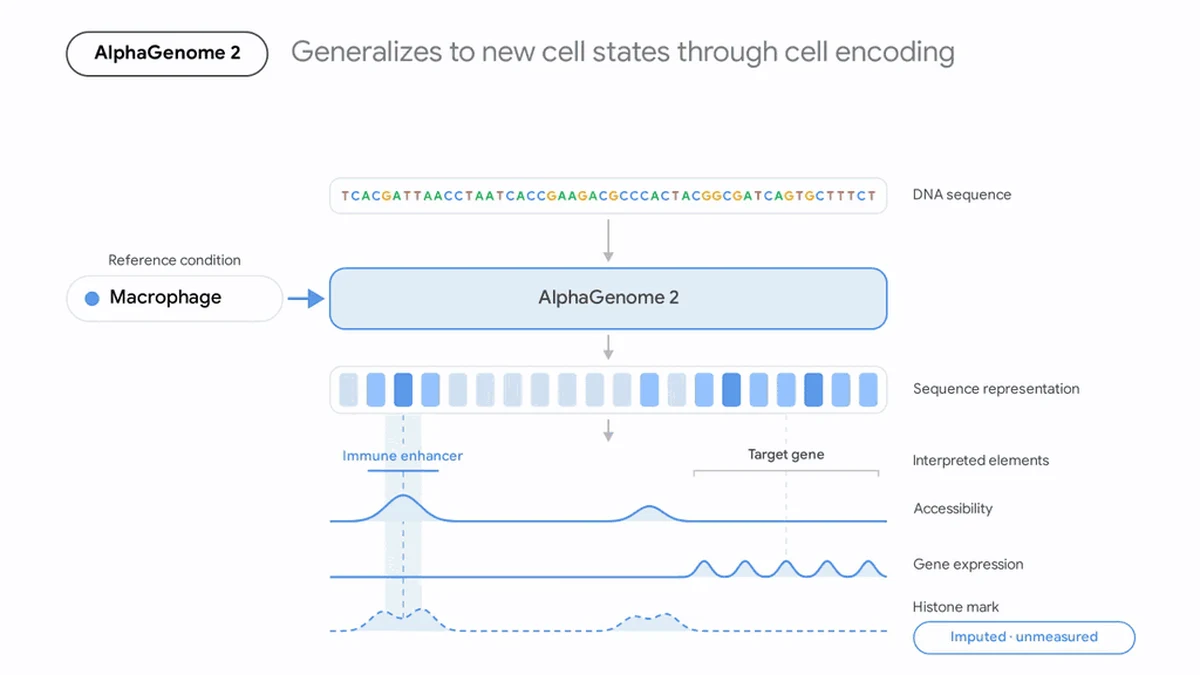
AlphaGenome 2 generalizes to new cell states through cell encoding, imputing unmeasured readouts such as histone marks. Image: Google DeepMind
In one example, given unseen single cell data from a COVID-19 mRNA vaccine study, the model distinguished vaccine activated immune T cells from resting ones. It also revealed that a variant linked to severe COVID-19 disrupts gene activity more strongly in the activated state, an effect that would be missed in unactivated cells.
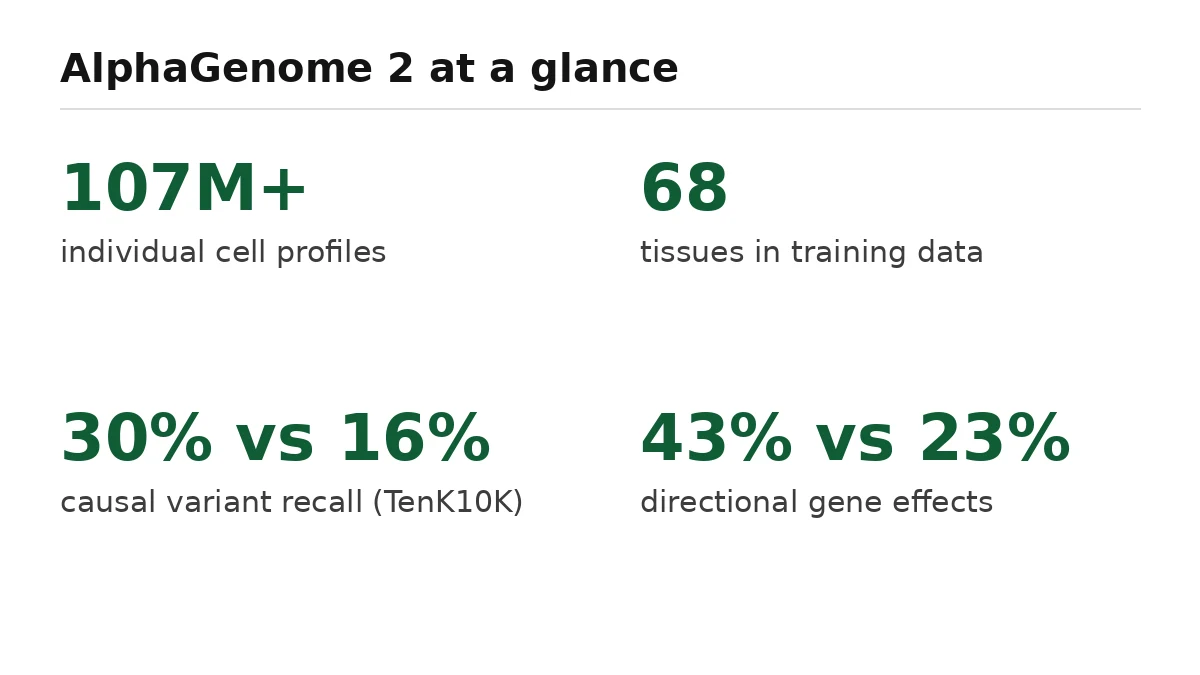
AlphaGenome 2 was trained on more than 107 million individual cell profiles across 68 tissues. Graphic: GPTOnline
Connecting Genetics to Cell Biology
To help researchers link the thousands of trait and disease associated variants found in genome wide association studies to the growing single cell maps of the human body, DeepMind precomputed AlphaGenome 2 predictions for trait associated variants across hundreds of human cell and tissue conditions.
That work covers two hard problems. First, mapping enhancer gene links in real human cell types: many disease linked variants sit in distant regulatory switches called enhancers, and AlphaGenome 2 extends that mapping to primary human cell types such as brain astrocytes. Second, pinpointing causal variants and the cells where they act: across complex traits from height to type 2 diabetes, the scores help identify the variants and cell types most likely involved, and the model also predicts whether a variant turns a gene’s activity up or down.
Availability and Limits
AlphaGenome 2 is available today for non-commercial research via the AlphaGenome API, and in private preview for commercial research, with interactive Colab tutorials for expression conditioning. DeepMind said it will soon release AlphaGenome 2 Skills in Google Antigravity, pairing the model with Gemini 4 agents for scientists.
DeepMind also set out the limits: AlphaGenome and AlphaGenome 2 are intended for research use only and have not been validated or approved for clinical or diagnostic purposes. The work was done with collaborators including researchers at the Wellcome Sanger Institute, and DeepMind is inviting use cases through a form open until November 30.
Why It Matters
AlphaGenome 2 extends a pattern DeepMind has set this year, with Gemini Robotics 2.5 putting humanoid robots on Mercedes-Benz production lines and AlphaProof Code formally verifying Signal’s encryption protocol. It lets researchers test, in software, which DNA changes matter in which cells before running costly experiments. For drug development, where therapies target proteins in particular cell types, that precision is the difference between a plausible variant and a real target.