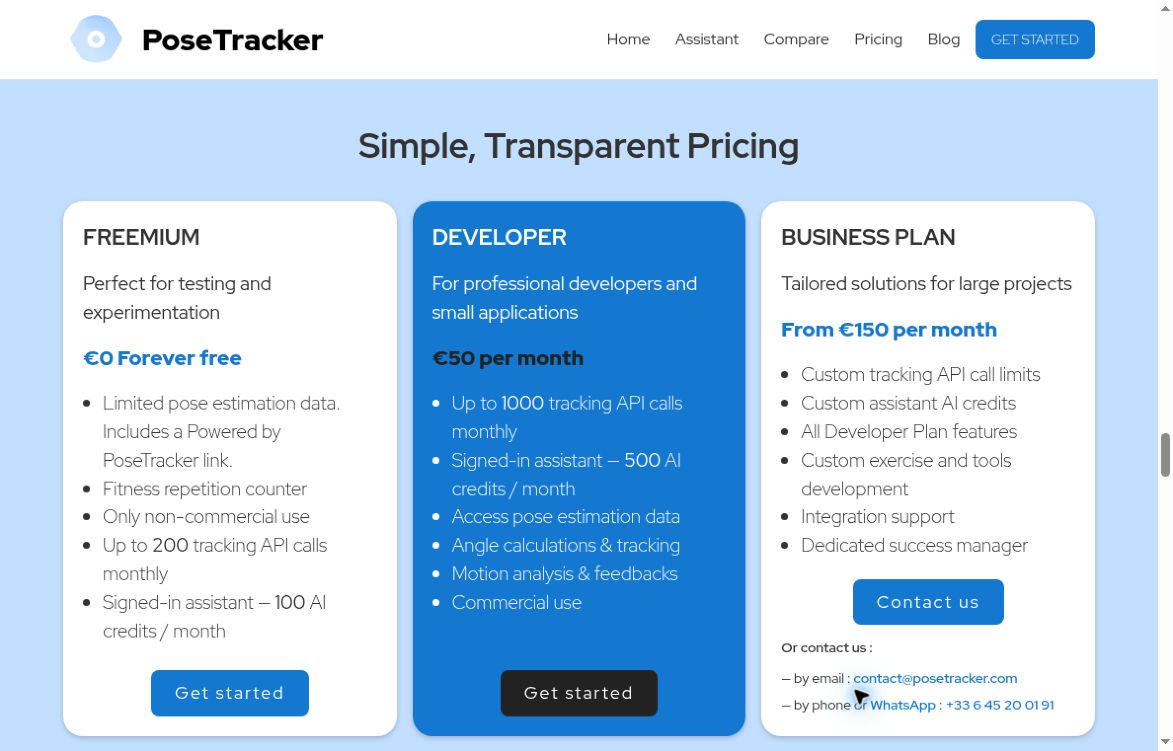
PoseTracker pricing page showing Freemium, Developer and Business plans
Image Scanning

PoseTracker API

Visit website

Compare PoseTracker’s SDK and WebView routes, free and paid limits, movement-analysis features and data considerations before building an integration.

PoseTracker pricing page showing Freemium, Developer and Business plans

Updated October 28, 2026

PoseTracker’s public pricing page, captured October 28, 2026. The “Forever free” wording is the provider’s label, not a guarantee of future terms. Published terms and limits can change; this is not a checkout or performance test.

Name PoseTracker API
Overview PoseTracker is a developer platform from Movelytics for camera-based body-pose analysis. The current product offers both SDK integrations and a hosted WebView/iframe route—not only an API that avoids an SDK. Its documentation describes on-device MoveNet keypoints, with an optional API-key exercise layer for repetition counts, joint angles and form scores. These are model estimates, not guaranteed measurements or clinical assessments.
Key features & benefits
  • React Native/Expo and web integration options, alongside the hosted WebView approach.
  • Keypoints-only SDK use without an API key; the exercise layer uses an API key and plan limits.
  • Offline and light React Native packages: the latter downloads its model/runtime resources.
  • Exercise tracking and an integration-focused assistant; generated snippets still require developer review.
Use cases and applications
  • Prototype a repetition counter in a fitness application, then validate it on intended devices and camera positions.
  • Explore joint-angle or reference-pose displays without treating their output as a diagnosis or personalized exercise prescription.
  • Evaluate a movement interface for a game or sports-analysis prototype. Performance depends on framing, lighting and hardware.
Who uses? Fitness-app developers, product teams, sports-analysis developers and game developers. Clinicians considering a rehabilitation application remain responsible for its clinical suitability and validation; PoseTracker is not a medical device.
Pricing
  • Freemium: €0, non-commercial only, up to 200 tracking API calls and 100 assistant AI credits per month; a provider attribution link is displayed.
  • Developer: €50/month, up to 1,000 tracking API calls and 500 assistant AI credits; commercial use permitted.
  • Business: from €150/month, with agreed tracking/AI limits and additional support.

These are the published offers checked October 28, 2026, not checkout-tested quotes. Tracking and assistant credits are separate. Daily assistant limits also apply. Existing unchanged paid subscriptions may retain earlier terms under the October 9 terms.

Tags Pose estimation, motion tracking, fitness technology, SDK, API integration.
App available? Developer SDKs support mobile and web integrations; this is not a claim that every named platform has a separately verified consumer app. No app was installed for this review.

Practical evaluation and data limits

For example, test a prototype with consented sample footage, compare its reported repetitions with a manual count, and document missed or ambiguous movements. This is an evaluation plan, not a test performed in this review. Do not use a form score as proof that an exercise is safe for a particular person.

The privacy policy distinguishes local pose processing from account, billing and assistant data. Assistant text and user-confirmed video stills can be sent to a model provider; “on-device” does not mean that every product interaction stays on the device. Review your integration’s data flows before collecting camera or health-related information.

Sources and review scope

Checked October 28, 2026: official product and pricing, SDK quickstart, terms and privacy policy. No camera session, SDK execution, account, API call or payment was tested. Provider speed benchmarks are not independent results from this review.

KEEP EXPLORING

More tools to discover.

Earlier Imagetomp3 interface with an empty image-upload area and Convert to text button

Read the earlier GPTOnline description of Imagetomp3’s image-to-text workflow, with current access, starting-credit and privacy verification limits.

Image ScanningExplore

Read PIXMO’s earlier image-monitoring description and the original address’s unrelated destination, with current service and enforcement limits.

Image ScanningExplore
campedia

Campedia’s earlier photo-question workflow, identification and recipe uses, with current availability, pricing and verification limits explained.

Image ScanningExplore
Earlier Thing Translator experiment page with Launch experiment and Get the code controls

Learn what Thing Translator’s camera-based language experiment did, its current inactive status, and how its public source code fits.

Image ScanningExplore
MagiScan official homepage with its 3D and AR description and App Store and Google Play links

Explore MagiScan’s iOS and Android scanning workflow, export formats, paid-access limits and model-use terms before capturing objects.

Image ScanningExplore
Pixlyze image-selection interface with an empty upload area and supported image formats

Learn how Pixlyze’s image-upload interface is presented, what detector results cannot prove, and the pricing and privacy limits to check.

Image ScanningExplore
Find your next starting point