OpenAI says its internal AI models have produced three landmark results in mathematics, computer science and physics, including a claimed disproof of a longstanding conjecture that hundreds of research papers rely on. The company announced the results on October 26, while stressing that none of them has yet been independently verified and that the AI-written manuscripts should be treated as raw research data, not finished science.
The OpenAI three science discoveries were handed to outside experts, who will organize independent checks and decide how each one should be released and explained. The company said it does not seek academic credit for discoveries produced by its internal models, and the experts taking part are unpaid volunteers who sign no nondisclosure agreements.
What OpenAI Announced
According to the company’s announcement, its models produced a proof of the local smoothing conjecture in every dimension, a disproof of the Exponential Time Hypothesis in computer science, and a mathematically rigorous existence proof for certain interacting quantum field theories in four dimensions, including quantum chromodynamics (QCD) and a unified completion of the Standard Model of particle physics.
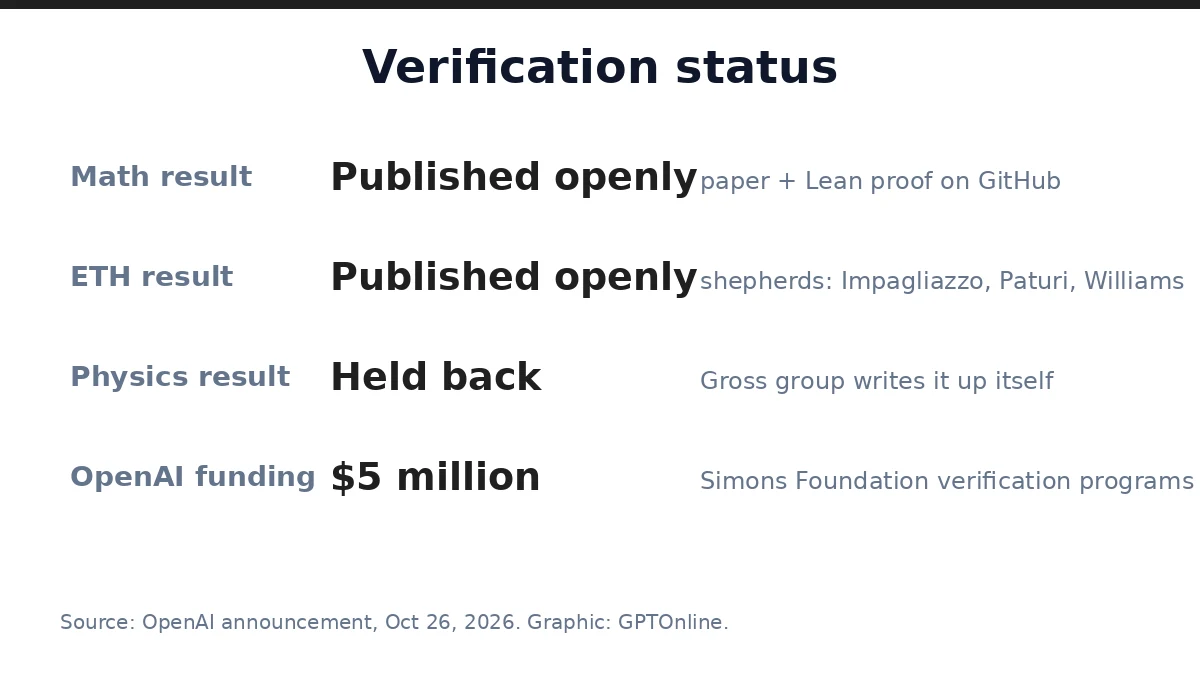
The mathematics and computer science results have been published openly, with natural language writeups and Lean formalizations posted in OpenAI’s public GitHub repository. The physics result is being held back at the request of the physicists overseeing it, who plan to write it up themselves.
The Three Results
Graphic: GPTOnline, using OpenAI assets
Mathematics: local smoothing in every dimension
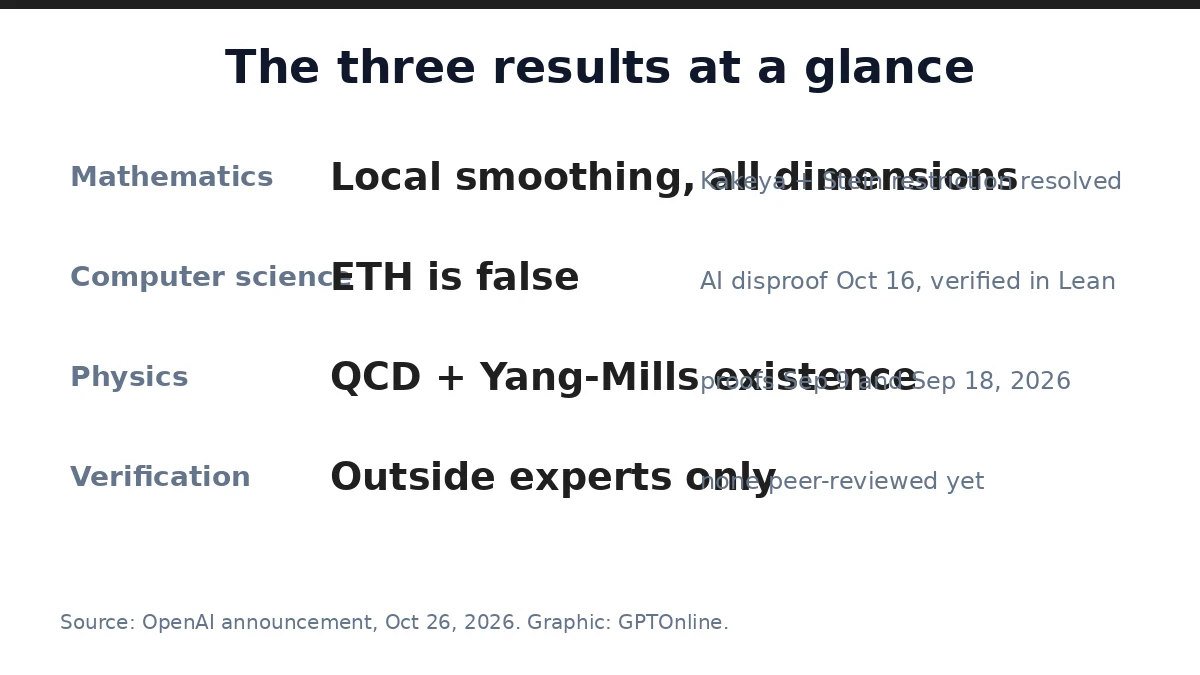
OpenAI says its models proved the local smoothing conjecture, proposed by Christopher Sogge in 1991, in every dimension. The conjecture concerns how waves behave as they become focused, holding that the most extreme focusing must be short lived. If the proof holds, it also resolves the Kakeya conjecture and Stein’s restriction conjecture in all dimensions.
Guth, Wang and Zhang proved the local smoothing conjecture in two spatial dimensions in 2019, and Wang and Zahl proved the Kakeya conjecture in three dimensions in 2025. OpenAI says its proof rests on a novel auxiliary partial differential equation, with the AI output obtained on October 18 and formalized in Lean the following day.
Computer science: the Exponential Time Hypothesis is false
The most striking claim concerns the Exponential Time Hypothesis (ETH), a conjecture about the complexity of determining whether a Boolean formula can be satisfied, a problem closely related to P versus NP. The hypothesis has been widely believed to be true and has been used in hundreds of papers to derive conditional hardness results across fields from graph theory to computational biology.
“Surprisingly, our system has recently proved that the ETH is false, a result that was subsequently verified in Lean,” OpenAI said. The company says its system found the natural language disproof on October 16, with the Lean formalization completed on October 17. A group led by Russell Impagliazzo and Ramamohan Paturi of UC San Diego, who originally proposed the hypothesis, and Ryan Williams of MIT will verify and explain the result. OpenAI has agreed to make all raw data behind the result public and to fund a conference on its implications.
Physics: existence of QCD and Yang-Mills theory
OpenAI says its models produced a mathematically rigorous existence proof for certain interacting quantum field theories in four dimensions, including QCD, which describes how quarks and gluons interact through the strong force, and a unified completion of the Standard Model. As a subproblem, the work includes a proof of the existence of pure Yang-Mills theory, part of the Clay Mathematics Institute’s Millennium Prize problem on quantum Yang-Mills theory.
The company says its models produced the Yang-Mills proof on September 9 and the QCD proof on September 18, building on Balaban’s approach in constructive quantum field theory. The Lean formalization of the Yang-Mills proof was finished on October 16. A group led by Nobel laureate David Gross, including Michael Douglas, Arthur Jaffe, Igor Klebanov and Nikita Nekrasov, will shepherd the work and has asked that the AI-produced artifacts be held back while it writes up the result itself.
How Verification Will Work
Graphic: GPTOnline, using OpenAI assets
OpenAI describes the AI-generated manuscripts as “a form of raw research data” that still has to be converted into scientific understanding. The three outside groups will work under four principles set out by the company: transparency, with no nondisclosure agreements; no academic credit, meaning OpenAI seeks none for the discoveries; recognition for the groups that develop the understanding and writeups; and independence, with participation voluntary and unpaid and each group’s conclusions its own.
The collaborations complement a recently announced $5 million contribution from OpenAI to the Simons Foundation, which will fund workshops, conferences and special programs on AI-produced results. OpenAI said it welcomes feedback on which of the three release approaches, direct publication, publication with an external working group, or holding materials back for the experts to write up, proves most useful.
What the Claims Do Not Prove Yet
None of the three results has been peer reviewed, and independent verification is only beginning.
Even if the ETH disproof holds, it would not settle P versus NP or make everyday software faster. It would reopen questions about how much faster certain tasks could become, but OpenAI itself cautioned that turning theoretical advances into practical improvements “will require significant further research.” Similarly, the pure Yang-Mills existence result alone would not complete the Clay Millennium Prize problem, which also requires a proof of a positive mass gap.
That caution is the real story here. OpenAI is not asking the world to take its models’ word for it. It is publishing the raw output, funding the checking, and letting outside experts, including the very people who proposed the hypothesis its model claims to have refuted, decide whether the proofs stand.