Moonshot AI apologized on Monday for rate limiting and unnecessary quota consumption after the launch of its Kimi K3.1 Pro model, and said it would reset part of every subscriber’s monthly quota to make up for the disruption. The Moonshot Kimi quota reset gives subscribers back 25% of their monthly allowance, which the company said equals one week’s usage, according to Reuters.
The apology came three days after Kimi K3.1 Pro launched on October 23, 2026, when heavy demand and the model’s agentic behavior strained Moonshot’s systems. Moonshot announced the remedy on its Kimi account on X, saying it had also adjusted the model’s settings to cut down on wasted work.
What Moonshot Announced
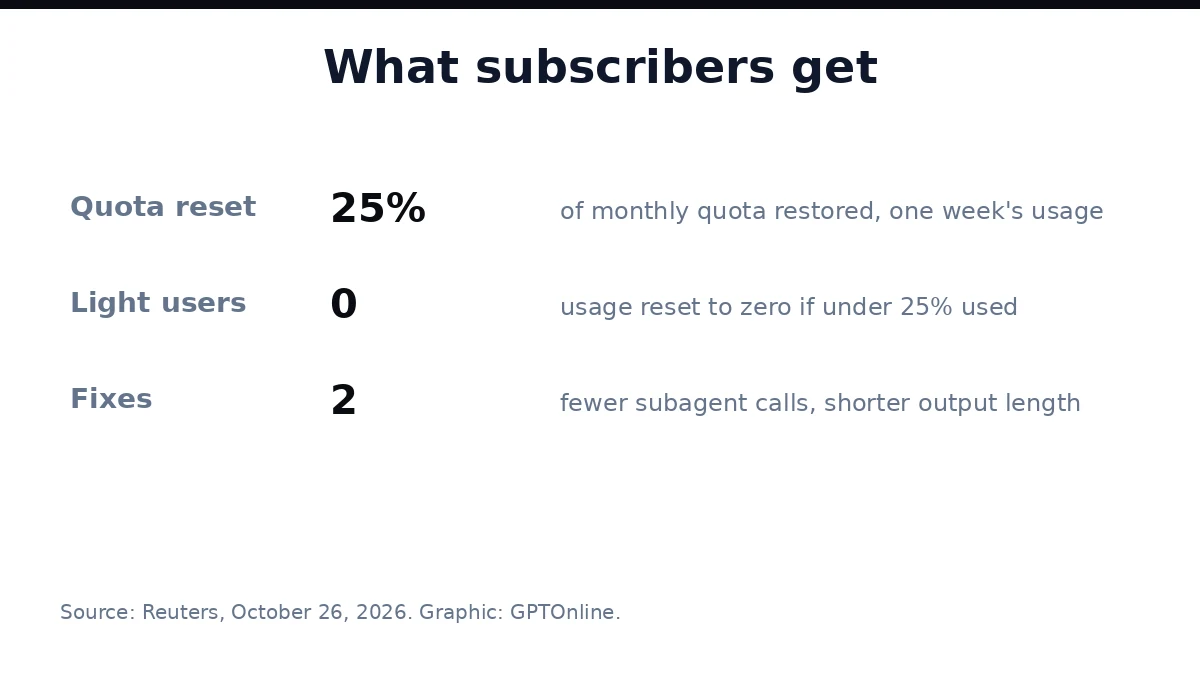
Moonshot said it would reset 25% of the monthly quota for all subscribers. Subscribers who had used less than 25% of their quota would have their usage reset to zero, effectively restoring their full allowance for the month.
The company also said it adjusted parameters to reduce unnecessary subagent calls and output length. Subagents are the helper agents a model spawns to split up a task, and each one consumes tokens. When a model calls more subagents than a task needs, or writes longer answers than necessary, subscribers burn through their quotas faster. Moonshot’s fix targets both problems at once.
What subscribers get from the quota reset. Graphic: GPTOnline. Data: Reuters.
Why the Launch Strained Capacity
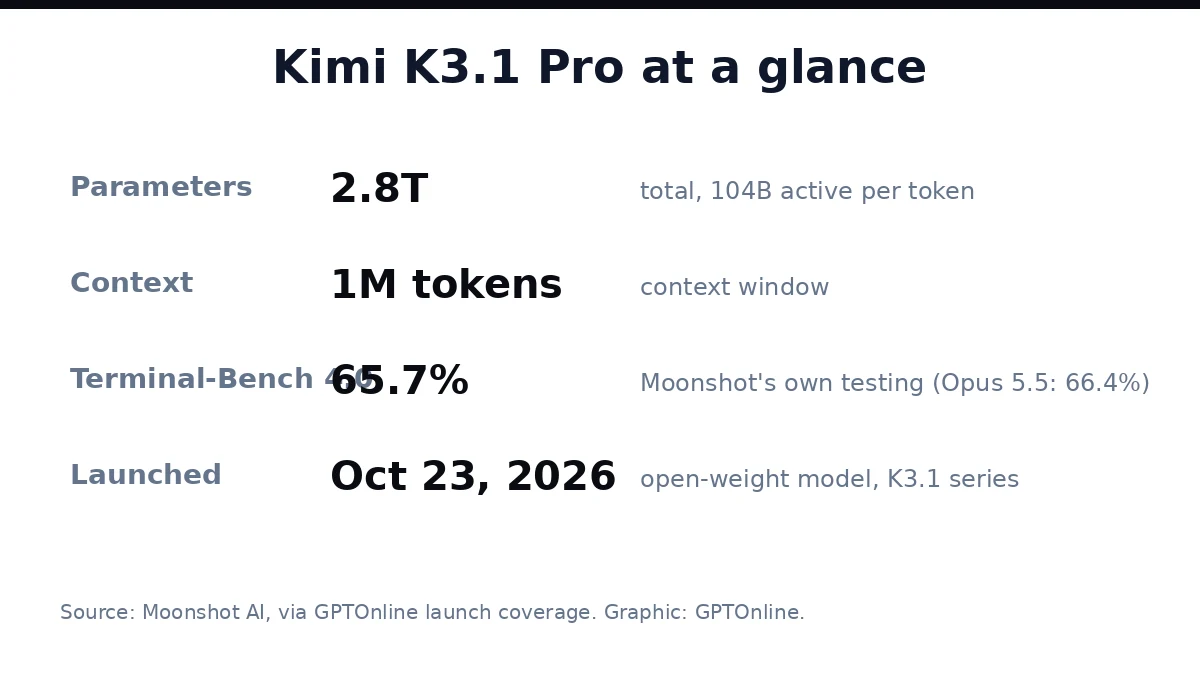
Kimi K3.1 Pro is a large model: 2.8 trillion total parameters with 104 billion active per token, and a 1-million-token context window. Moonshot describes it as a post-trained version of Kimi K3, tuned with significantly more reinforcement learning compute. On its own tests, the model scored 65.7% on Terminal-Bench 4.0, close to Anthropic’s Claude Opus 5.5 at 66.4%, as GPTOnline reported at launch.
That combination of scale and strong early demand hit Moonshot’s infrastructure hard. The company had already run into computing capacity problems after the original K3 launch, and the same pressure returned with K3.1 Pro. Chinese AI labs are also dealing with broader computing shortages following US chip export controls, according to Reuters.
The quota problem is specific to how agentic models work. Kimi K3.1 Pro is built for tasks that involve planning, calling tools and delegating work to subagents, and every one of those steps costs tokens. When the model’s default settings are too eager, the extra work lands on the subscriber’s quota even when it adds little value.
Kimi K3.1 Pro at a glance. Graphic: GPTOnline. Data: Moonshot AI, via GPTOnline launch coverage.
Why It Matters
The apology is a reminder that launching a capable model is only half the job. For subscription services, the experience that matters is not the benchmark score but whether the model runs reliably and whether the quota lasts the month. A 25% reset is a concrete gesture, and it signals that Moonshot heard the complaints quickly rather than waiting them out.
It also shows the cost side of the agentic AI race. Models that do more on their own consume more compute per task, and labs have to tune that behavior carefully or pass the cost to users. Moonshot’s parameter changes suggest it is learning that lesson in public, three days after launch.
What to watch next is whether the fixes hold as demand settles. If rate limiting and excess quota use stop, the launch story ends as a brief stumble. If they return with the next usage spike, Moonshot will face the same questions about whether its infrastructure can keep up with its models.