Meta is bringing the memory and persistence of its frontier model Muse Wonder to everyone who uses Muse and Meta AI. The company announced on November 6 that it is rolling out specialized versions of its existing models, trained with learnings from Muse Wonder, across both products, alongside a new way to personalize the Muse app called Spaces.
The update puts two capabilities first introduced with Muse Wonder in October, Active Memory and Active Focus, into the hands of all Muse and Meta AI users. Meta said the full Wonder model itself remains reserved for paid subscribers tackling harder tasks, while the distilled versions bring its behavior to everyday use.
What Was Announced?
Meta launched Muse Wonder and a larger edition, Wonder Full, on October 12, describing them as the company’s first frontier-class models for personal and professional agent work. Wonder is available on the Meta Model API at $4 per million input tokens and $20 per million output tokens, with a 1 million token context window, while Wonder Full is limited to the top tiers of the Muse Code developer tool.
The new specialized models are different. They are not new API models and Meta has given them no formal public names. Instead, Meta says it trained them to distill behaviors from the larger frontier system into lighter models suited to everyday consumer interactions, and is rolling them out to Muse and Meta AI, including Meta AI on WhatsApp, Instagram, Facebook and Messenger.
Meta has published no model card, parameter counts or benchmarks for the specialized models, so the update is best understood as a consumer product change rather than a new model release.
Active Memory and Active Focus
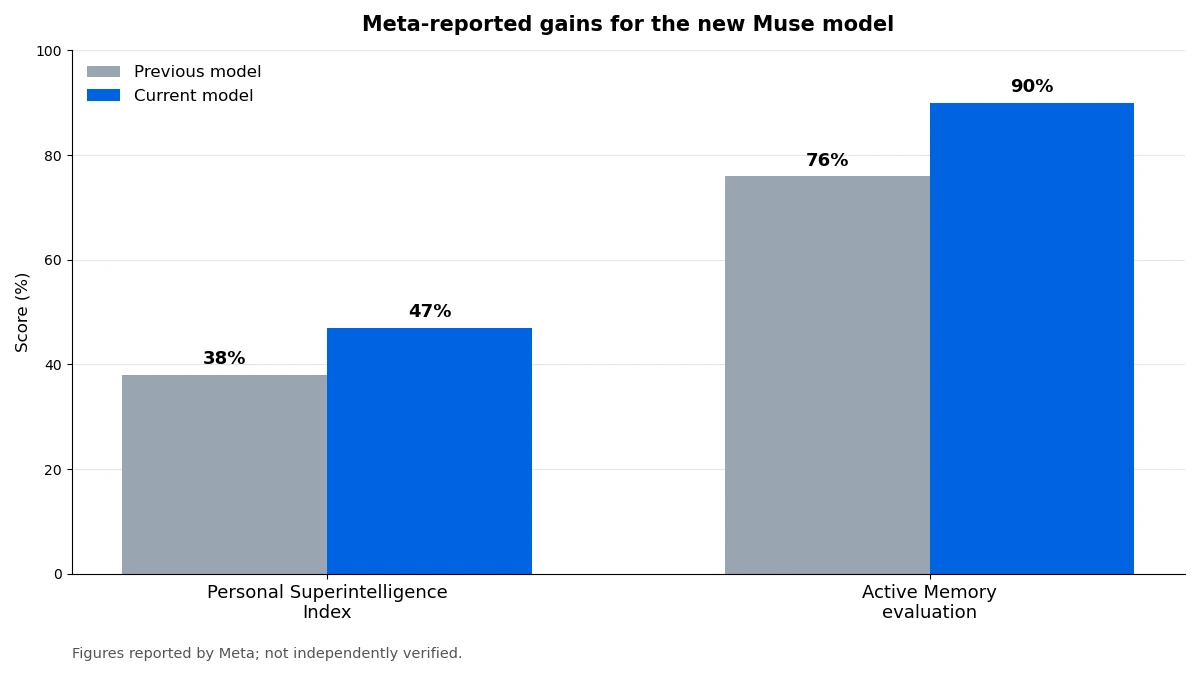
Active Memory is designed to carry important context across conversations. Meta says the models can retain relevant details from earlier interactions, tell permanent details apart from temporary notes, and recognize when an earlier topic becomes relevant again. The company reports that the current Muse model used critical context correctly in 90% of tasks on its Active Memory evaluation, up from 76% for the previous model, and that it forgets information needed to reach a goal 2.4 times less often.
Active Focus addresses the other half of long tasks: finishing them. Meta says the models were trained on simulated real-world bottlenecks so they keep working toward a goal when something goes wrong, try alternative paths, recover from errors, or ask for clarification. The company reports a 67% improvement in completing everyday tasks when unexpected issues arise.
Meta also reports that the current Muse model scores 47% on its Personal Superintelligence Index, compared with 38% for the previous model. All of these figures are Meta’s own claims, reported by the company without independent verification.
Spaces: A Custom Corner of the Muse App
The same announcement introduces Spaces, a way to build custom experiences inside Muse by describing an idea. Meta’s examples include a holiday gift tracker, a daily word game, a planning board for a home project, a shopping hub that pulls in Instagram saves and Marketplace listings, a school dashboard that finds events in school emails, and a trip planner with reservations and a day-by-day itinerary.
Each space becomes a saved part of the app. Users can place spaces in the sidebar or main tabs, hide the ones they do not need, and schedule when particular spaces appear, keeping a weekly planner prominent during the workweek and swapping it for weekend plans on Saturday. Connecting apps lets spaces update in the background, so new concert dates, price changes or savings progress show up without being asked for.
“Today, we’re introducing spaces, an interactive way to build a more personalized Muse,” Meta said in its announcement. “We’re also rolling out specialized versions of our models to Muse, trained with learnings from Muse Wonder, to make your overall experience even better.”
Spaces are available everywhere Muse is available starting today, Meta said. Sharing spaces with others is still under exploration.

Why It Matters
Meta is in a race to make its personal assistant stick, and it is now pushing its flagship model’s signature skills, memory across conversations and persistence through setbacks, to its entire audience rather than keeping them behind a paywall. If the improvements hold up in everyday use, they address the two complaints that most often push people away from AI assistants: forgetting what was already discussed, and stalling at the first obstacle.
The rollout also shows how Meta plans to use its frontier models. Rather than selling Wonder only as a premium API product, the company is using it as a teacher, distilling its behavior into the smaller models that serve its consumer apps. The open question is how much of Wonder’s ability survives that distillation, and Meta has given outside observers little to check that with, since it published no technical documentation for the specialized models.
For now, the practical change is simple: Muse and Meta AI should remember more, and give up less easily. Users will find out quickly whether the new models live up to Meta’s numbers.
Sources
- Meta: Design the Muse App, Just for You
- Meta AI Research: Specialized models for Muse and Meta AI
- Unite.AI: Meta Adds Custom Spaces to Personalize the Muse App Experience
- Silicon Report: Meta rolls out specialized AI models trained using Muse Wonder
- Technobezz: Meta Brings Active Memory and Active Focus to Muse and Meta AI
- GPTOnline: Meta Muse Real-Time Voice and Expressive Avatars