

NEW YORK and STOCKHOLM, October 21, 2026: Legora, the Stockholm-founded startup building an agentic operating system for legal professionals, announced on Wednesday that it has raised a $550 million Series E at an $8.8 billion post-money valuation, one of the largest AI funding rounds of the year and a sign of how quickly legal teams are moving from AI assistants to agents that carry out multi-step legal work.
The round was led by Atreides Management, with new investors including Baron Capital, Capital Group, Fidelity Management & Research Company, Glade Brook Capital Partners, and J.P. Morgan. Every major existing investor, among them Accel, Benchmark, Bessemer Venture Partners, General Catalyst, ICONIQ, Insight Venture Partners, Menlo Ventures, Redpoint Ventures, Salesforce Ventures, and Sands Capital, also participated, according to the company’s official announcement.
What Was Announced?
Legora says the capital will support continued expansion in North America, where it has offices in New York, Denver, Chicago, Houston, San Francisco, Toronto, and Mexico City, as well as its markets across Europe and Asia-Pacific. The company also plans deeper investment in the Legora aOS, the agentic operating system that lawyers and their agents work in, bringing new products such as agentic in-take, horizon scanning, and legal research to life.
Legora describes its strategy as building the round around investors with a long time horizon, pairing established long-term holders with strategic investors that work with law firms and in-house legal teams every day.
Key Facts and Figures
The growth figures Legora reports put it among the fastest-scaling enterprise software companies in recent years:
- Annual recurring revenue now stands at more than $200 million. Legora says it went from $1 million to $100 million in ARR in less than 18 months, and the next $100 million took less than six months.
- The new valuation compares with $5.6 billion at the company’s previous round.
- Legora is used by more than 140,000 legal professionals at more than 2,400 leading law firms and in-house legal teams across over 80 markets, and now employs more than 1,000 people across 18 offices.
- In-house legal teams, only a small fraction of the customer base a year ago, made up more than 40 percent of new customers in the third quarter. The United States, where Legora opened its first office only in spring 2025, is now its largest market by revenue, and more than half of the AmLaw 50 are customers.
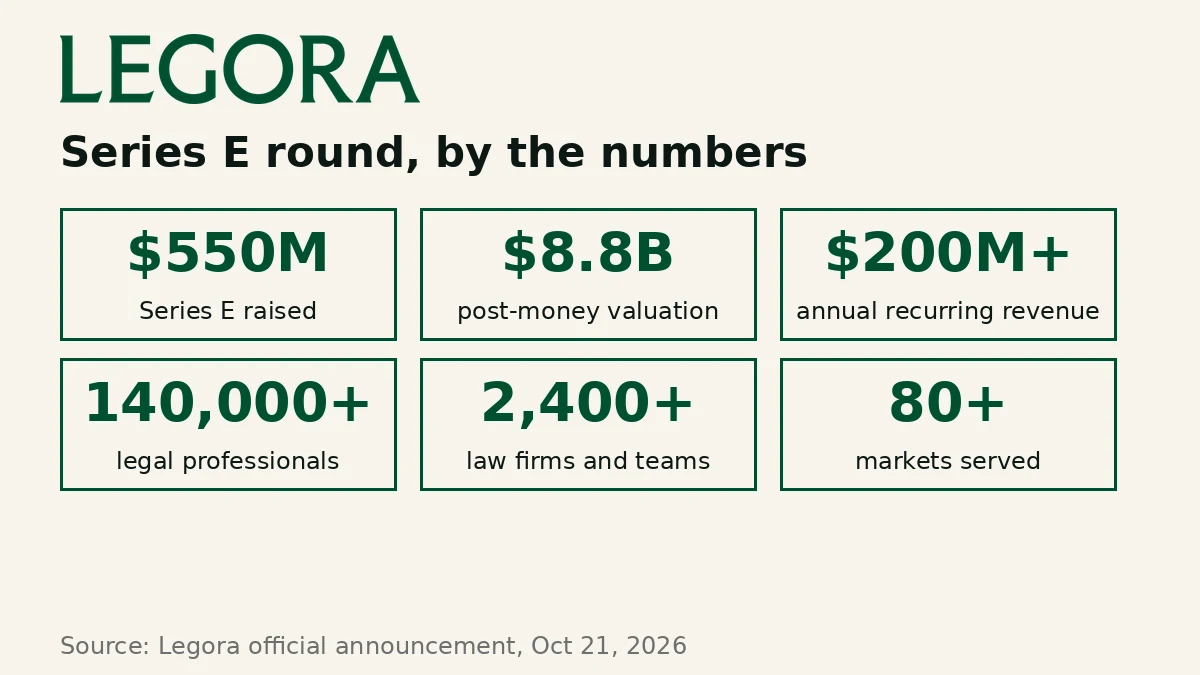
Legora’s Series E round, by the numbers. Graphic: GPTOnline, using Legora assets
A Legal AI Arms Race
The raise comes just a month after Harvey, Legora’s biggest competitor, announced its own $550 million raise at a $15.5 billion valuation, TechCrunch reported. The back-to-back rounds make legal AI one of the most aggressively funded corners of the AI application market.
Founded in 2023, Legora launched its platform in October 2024. Its pitch to investors is that legal teams are moving beyond AI assistants toward agents that handle multi-step work, and that its offering and geographic footprint are expanding to meet that shift.
What the Executives Said
“The opportunity in legal is enormous and we are still early. AI is changing the role of the lawyer, with more time for judgment and advice, and it is reshaping how law firms and in-house legal teams are organized and how their work gets done. We intend to lead that shift in the US and globally,” said Max Junestrand, CEO and co-founder of Legora.
Max Junestrand, CEO and co-founder of Legora. Graphic: GPTOnline, using Legora assets
“Growth only counts if the business underneath it holds up. We have passed $200 million in ARR, and we want every dollar of it to be a durable one. That means healthy gross margins, high retention, and a cost structure that gets stronger as we scale,” said CFO David Eckstein.
Gavin Baker, managing partner and CIO at Atreides, added: “Legal is a sophisticated market with demanding buyers, and the bar for software is high. Legora has become the platform that law firms and in-house legal teams adopt and then expand across their organizations, and it has done so while growing at remarkable speed.”
Why It Matters
Two things stand out about this round beyond its size. First, the customer mix: in-house legal departments, historically slow adopters of new software, are now Legora’s fastest-growing buyer segment, which suggests agentic AI is crossing from experimentation into everyday legal workflows. Second, the investor roster: with long-horizon and strategic backers on both sides of the Atlantic, Legora is positioning itself for a sustained push in the United States, where it now earns most of its revenue.
The legal AI contest is still young, and valuations like these assume that agents will eventually take over large parts of document review, diligence, and legal research. Whether that assumption holds will determine whether $8.8 billion looks like a bargain or a bet. For now, the money is speaking clearly.