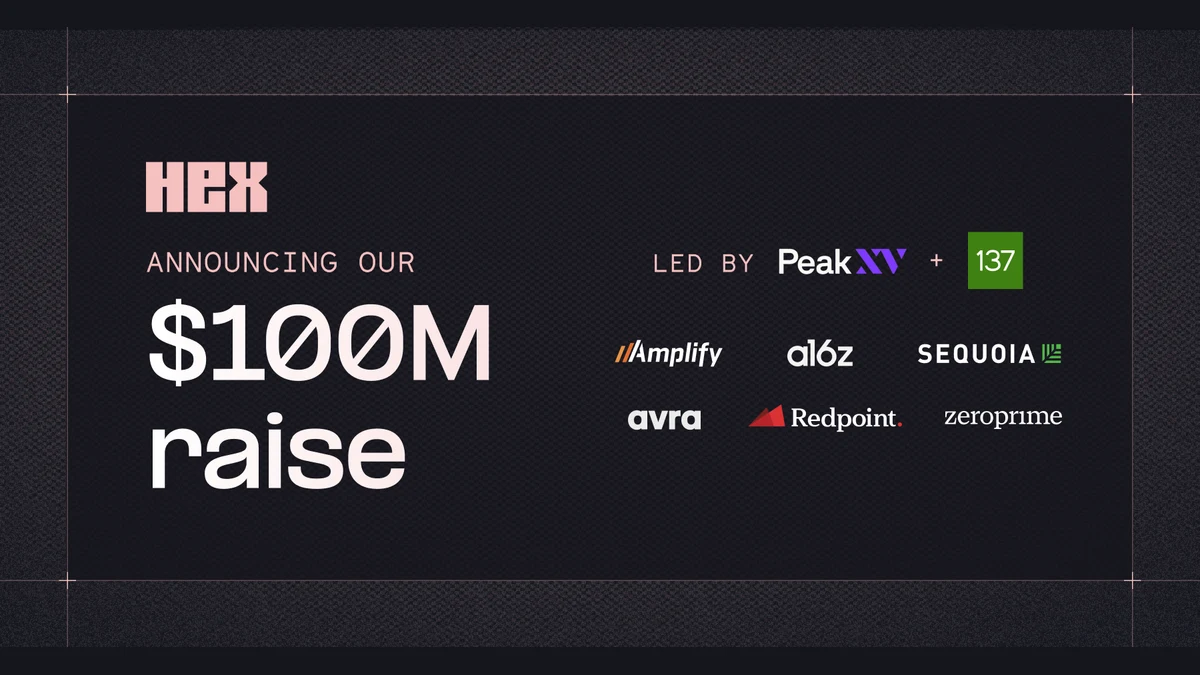
Data analytics startup Hex has closed a $100 million financing round at a $1.2 billion valuation, the company announced on October 27, 2026, alongside Hex 4.0, a from-scratch rewrite of its platform built for the era of AI agents. The Hex $100M round was led by Peak XV and 137 Ventures, with participation from Amplify, Avra, Andreessen Horowitz, Next Legacy, Redpoint, Sequoia and Zero Prime.
The raise is a Series D, Dealroom reported, and nearly doubles the $70 million Series C Hex raised in May 2025. Crunchbase ranked it among the week’s largest US funding rounds. The company says it now serves more than 2,500 customers globally and had just closed its best-ever quarter when it decided to rebuild.
Why Hex Rebuilt Everything
Hex was founded in 2019 by ex-Palantir engineers Barry McCardel, Caitlin Colgrove and Glen Takahashi, making it, in McCardel’s words, “a pre-AI company (ew!).” The team had spent four years bolting AI onto the product, including a text-to-SQL prototype using GPT-3 before ChatGPT, Magic features in February 2023 and a data agent last year. But McCardel wrote that the company was “far from ‘agent native’, no matter how much we liked saying it.”
The problems were concrete. The agent harness had become bloated with hundreds of tools needed to teach agents how to use Hex. External agent workflows felt clunky, forced through “a keyhole via MCP” instead of working natively. And the compute engine was not built for the high-speed, high-concurrency, iterative workflows agents prefer. Meanwhile customers were “vibe coding” dashboards in Cursor, Codex, Cognition and Claude and sharing results as HTML files, working without permissions, provenance, context or observability.
So after its best quarter ever, Hex did something radical: it started over. “Hex 4.0 is truly a from-scratch rewrite for the era of agents,” McCardel wrote, adding that the rebuild was itself “greatly accelerated by using agents to write all of the code.”
What Hex 4.0 Changes
The core assumption of 4.0 is that everything is code. Instead of a proprietary format, the platform uses plain code so AI agents can read, write and modify analyses directly. Users can pull Hex projects into Cursor, Claude or Codex and send results back into Hex for sharing and governance. The design leans into the idea that data work now happens in many places, and adds the context, controls and guardrails needed to make agent-generated analysis trusted.
“We believe the next chapter of data work is rooted in code, with the context and controls needed to establish trust, governance, and guardrails,” McCardel wrote.
Why It Matters
Hex’s bet lands in the middle of the industry’s “SaaSpocalypse” debate over whether AI agents will kill traditional software. McCardel gives the thesis partial credit: many software categories “will effectively die over the next couple of years,” but he argues they will “combine and be reborn into new shapes.” His claim is that bolting a chatbot sidebar onto legacy BI cannot survive agents that “don’t want to use the bespoke UI you wrote, and they don’t care about your esoteric data model.”
The financing gives Hex, in McCardel’s phrasing, “a bunch more runway to keep building this thing, and take more bold bets into the future.” With Peak XV and 137 Ventures leading and a16z and Sequoia both participating, investors are betting that a model-independent, agent-native analytics platform has a bright future even as the old BI paradigm fades.