

Flapping Airplanes, a year-old AI research lab betting that frontier models can be trained with far less data and compute, has raised a $1 billion Series A at a $6 billion post-money valuation, quadrupling its valuation since January. The round, announced on October 21, 2026, was led by Index Ventures and Lux Capital, with Sequoia Capital, Alphabet’s GV and Kleiner Perkins also participating, according to Bloomberg.
Index Ventures confirmed the investment in its own announcement, saying partner Mark Xu is joining the company’s board alongside the new financing.
What Was Announced?
The Flapping Airplanes Series A is one of the largest early-stage deep tech rounds on record in the US, ranking in the top 1% by amount across nearly 3,500 comparable deals, per Dealroom’s analysis. Bloomberg reported that the new valuation, which includes the money raised, has quadrupled from a prior round in January, when the company publicly launched with a $180 million seed round backed by GV, Sequoia Capital and Index Ventures.
Flapping Airplanes was founded in late 2025 by brothers Ben and Asher Spector together with Aidan Smith, a Thiel Fellow and former Neuralink employee. The San Francisco lab has no commercial product and no revenue yet, placing it in the growing group of research-first “neolabs” that investors are backing on the strength of their teams and theses rather than traction. Nvidia is also among the company’s backers, according to reporting on the round.
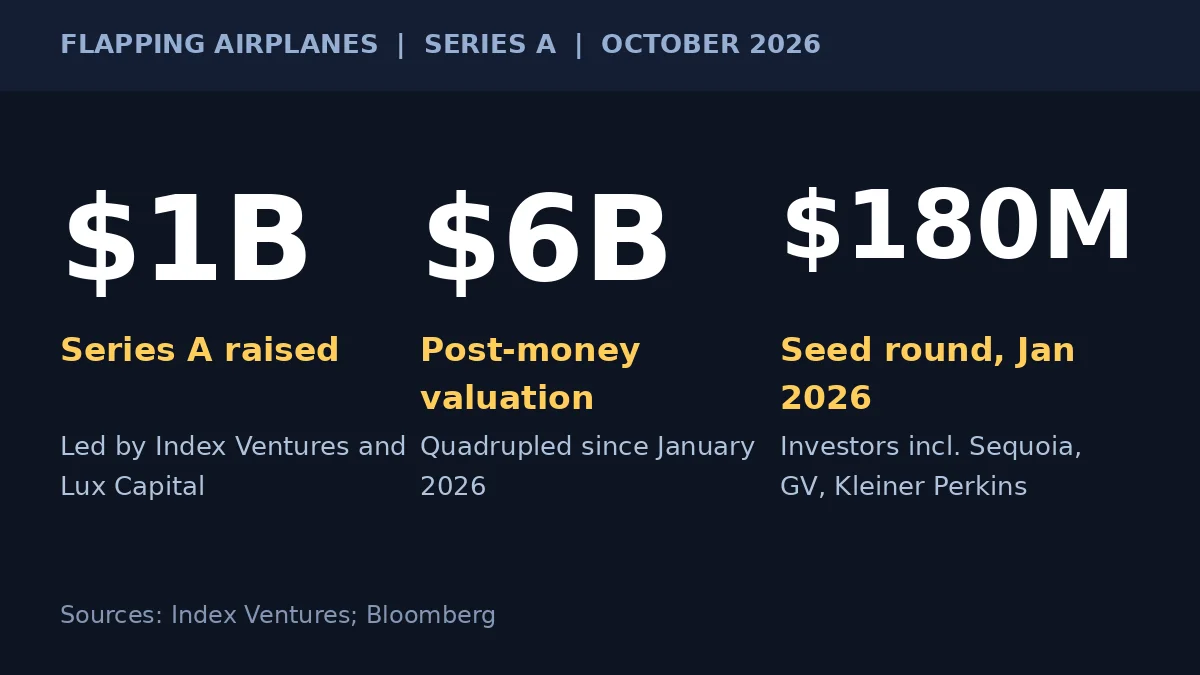
Graphic: GPTOnline. Sources: Index Ventures; Bloomberg.
Key Details
The lab’s central bet runs counter to the industry’s dominant playbook of ever-larger datasets and ever-more compute. Flapping Airplanes is researching ways to train AI models with less data and less computing power, while also extracting more performance from the chips that run them. Co-founder Asher Spector told Bloomberg the company’s core view is that demand for AI will outpace chip and data supply, and that even a 10% performance gain from each chip would be tremendously valuable given current infrastructure spending.
Index Ventures offered a technical glimpse of the approach, describing the company’s “megakernels,” which run an entire program on a GPU as a single kernel to eliminate wasted time between steps. “The winners in AI will be the companies that get the most out of every dollar, every megawatt, and every byte of data,” Index wrote in its announcement. “If the future of AI depends on getting more from less, we can’t think of a better team to shape it.”
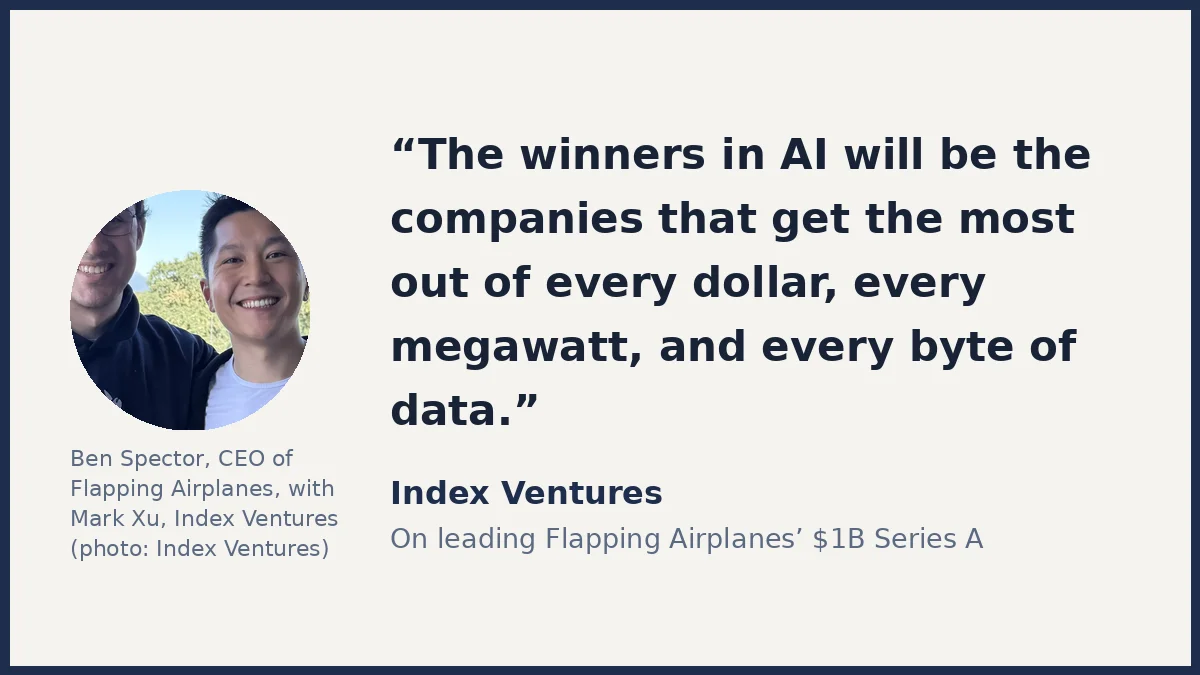
Graphic: GPTOnline, using Index Ventures photo.
The firm also noted that with “just a couple dozen people, all working in person in San Francisco,” Flapping Airplanes may be “the most vertically integrated company per capita in AI,” with the team working across the stack from GPU kernels through pre-training, post-training and inference.
Why It Matters
The raise lands during a record quarter for billion-dollar AI rounds, with AI accounting for 64% of global venture funding in the third quarter, according to Dealroom. Investors are pouring capital into research-first labs pursuing fundamental breakthroughs ahead of revenue, a cohort that includes Safe Superintelligence’s reported $5 billion raise and TypeSafe AI’s $870 million Series B at a $7.5 billion valuation.
For the broader industry, the deal is a high-profile wager that efficiency, not just scale, will define the next rung of AI capability. If Flapping Airplanes can deliver materially better performance per GPU and per byte of data, the payoff would ripple through data center economics at a moment when chip supply, power and financing costs are all under scrutiny. The risk is symmetric: with no product and a $6 billion price tag, the valuation leaves little room for the research to disappoint.
Sources
- Index Ventures: “Toward More Efficient AI: Leading Flapping Airplanes’ $1B Series A” (official announcement, October 21, 2026)
- Bloomberg: “AI Startup Flapping Airplanes Valued at $6 Billion in New Round” (Rachel Metz, October 21, 2026)
- Dealroom: “Flapping Airplanes raises $1B for AI research, hitting $6B valuation”