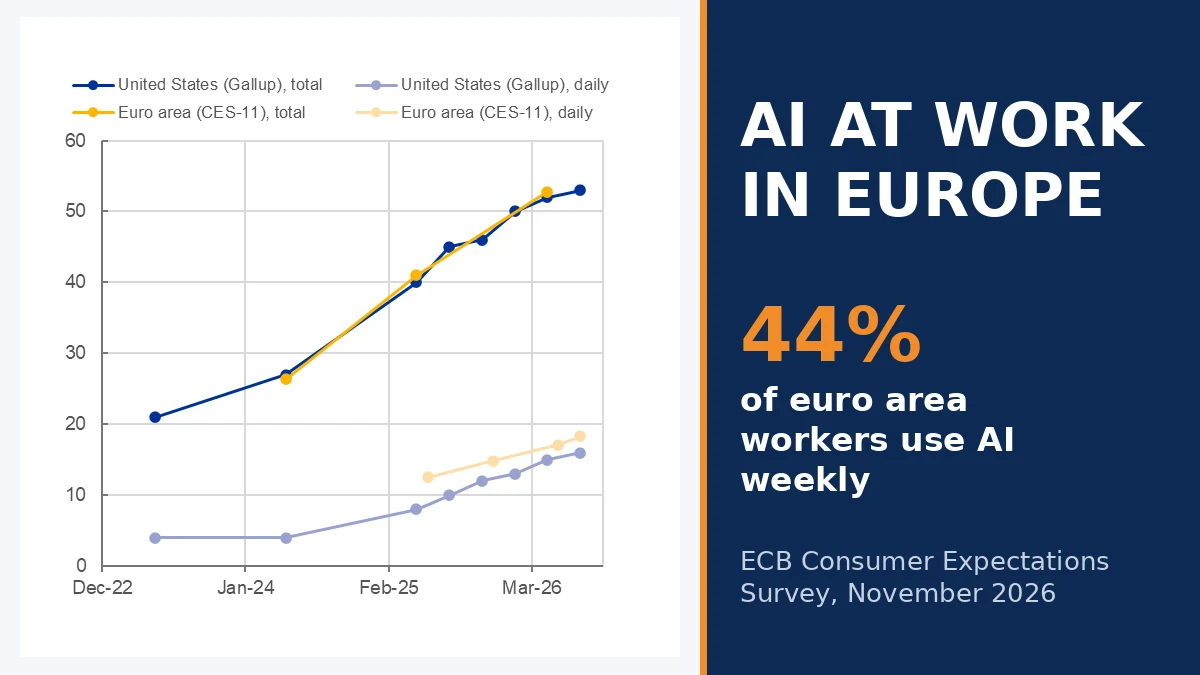
European workers are using artificial intelligence at work almost as often as their American peers, and a larger share of them use it every day, according to new research published by the European Central Bank on Friday.
The ECB blog post, based on the bank’s Consumer Expectations Survey, found that 44% of employed euro area consumers used AI at least weekly at work in August 2026, while around 18% used it daily. More than half of workers reported using AI at work in May 2026, and the ECB notes adoption has risen substantially as AI moved from experimentation to regular use. The findings come from the ECB’s monthly survey of consumers in 11 euro area countries, written up by economists Dimitris Georgarakos, Geoff Kenny and Justus Meyer.
Adoption on par with the United States
Overall AI adoption in the euro area is similar to that in the United States, the ECB said, comparing its survey with Gallup data. Strikingly, a larger share of euro area consumers report using AI daily, although the gap is narrowing. The ECB cautions that the two surveys use different questions and samples, so the comparison should be read as indicative of trends rather than a precise match.
Rapid adoption has not been matched by investment at home. The ECB cites an estimate that firm investment will rise by around 40% in the United States between 2021 and the end of 2027, compared with about 12% in the euro area, with AI-related investment contributing significantly to US growth. Combined with high and rising AI use, weaker domestic investment could increase Europe’s dependence on foreign AI technologies and infrastructure, the authors warn.
What AI does for workers
Workers who use AI report real gains. According to the survey, 56% say AI increases the amount of work they complete, while 47% report producing higher-quality output. Among those who complete more work, 62% credit AI with helping them find or process information, and 51% say it reduces the effort their work requires. Generating new ideas, automating repetitive tasks and handling larger workloads were also frequently cited.
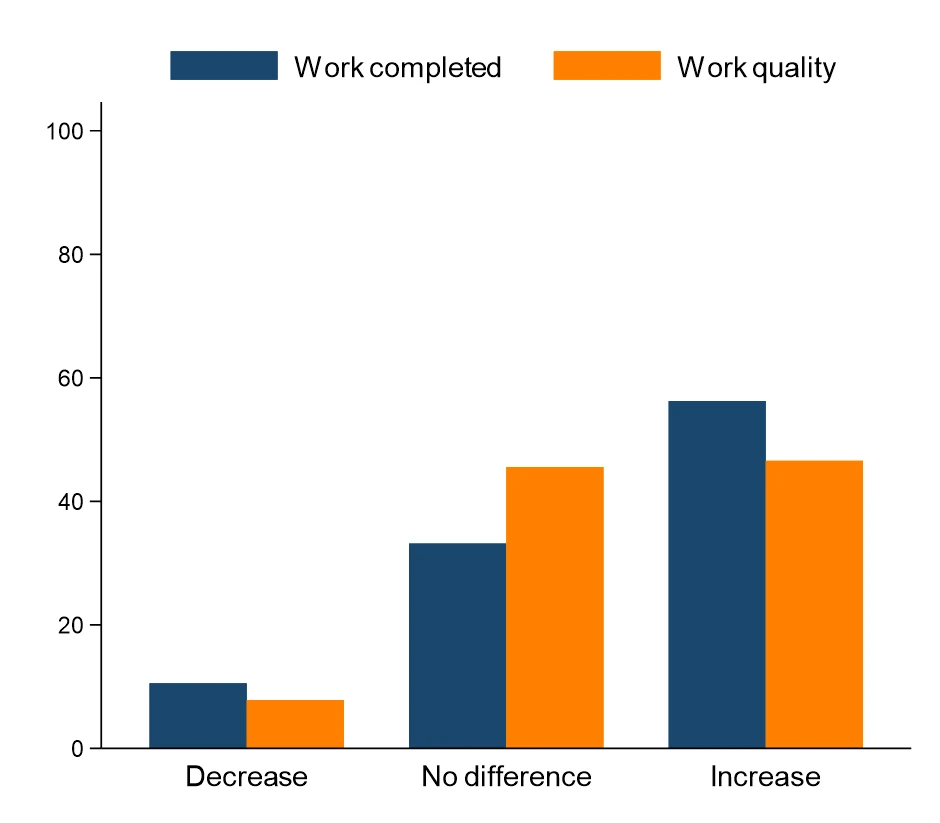
Most AI users say the technology helps them complete more work and produce higher-quality output. Image: European Central Bank.
But the gains are not universal. Among users who reported no increase in output, the most common reason was the time needed to check or correct AI-generated results. Others said AI was not suitable for the task or worried about keeping control of their work.
“However, widespread adoption does not automatically translate into economy-wide productivity gains,” the authors write, noting that firms also need to invest in skills, data, computing capacity and organisational change.
Expectations: more use, more worry
Workers expect AI use to keep spreading. In August 2026, employed respondents expected 46% of workers in their sector to use AI within five years, up from 34% one year earlier.
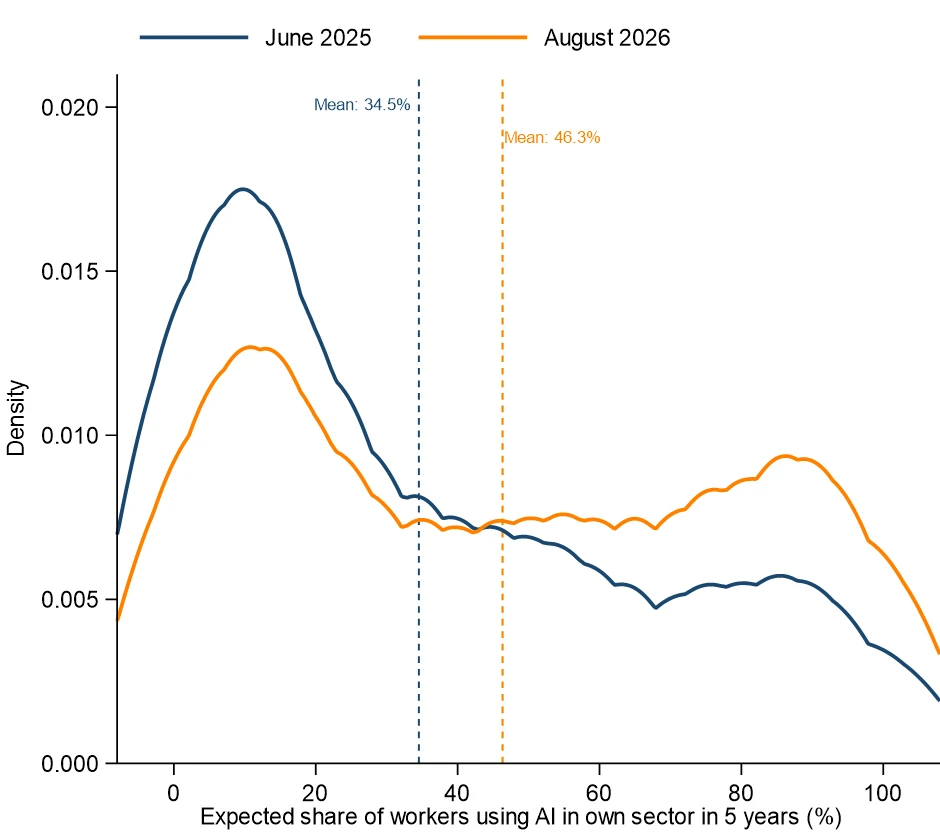
Workers expect 46% of people in their sector to use AI within five years, up from 34% a year earlier. Image: European Central Bank.
At the same time, consumers are more likely to see AI as increasing the risk of job loss than as raising household income or improving job opportunities over the next year. A sizeable share also expects AI to push up prices of goods and services over the same period. Around half of respondents expect AI to save time on everyday tasks or make it easier to find the best prices.
Barriers and the case for safeguards
Many workers still face barriers to using AI at work. Skills and knowledge gaps, together with privacy and security concerns, are among the most frequently reported obstacles, and the pattern is similar across the largest euro area economies. Social norms and existing regulations are less frequently identified as direct barriers.
Support for AI regulation is strong among both regular AI users and people who use the technology less often or not at all, the survey found. Demand for regulation also tends to be stronger in countries where workers perceive a greater risk of losing their jobs to AI, although the ECB notes the relationship is descriptive and does not establish causality.
For policymakers, the authors argue, the task is to combine safeguards with support for adoption, including training to close skills gaps, clear employer policies on safe AI use and better access to approved tools. “The challenge for Europe is to put those safeguards in place without unnecessarily slowing the investment and innovation needed to realise AI’s productivity potential,” they write.
Why It Matters
The ECB’s numbers sketch a European workforce that has embraced AI tools quickly, even as domestic investment in the technology lags the United States. The survey suggests the next phase of the AI transition will be decided less by whether workers use the tools and more by whether employers and governments close the skills, trust and investment gaps that still limit what the tools deliver.