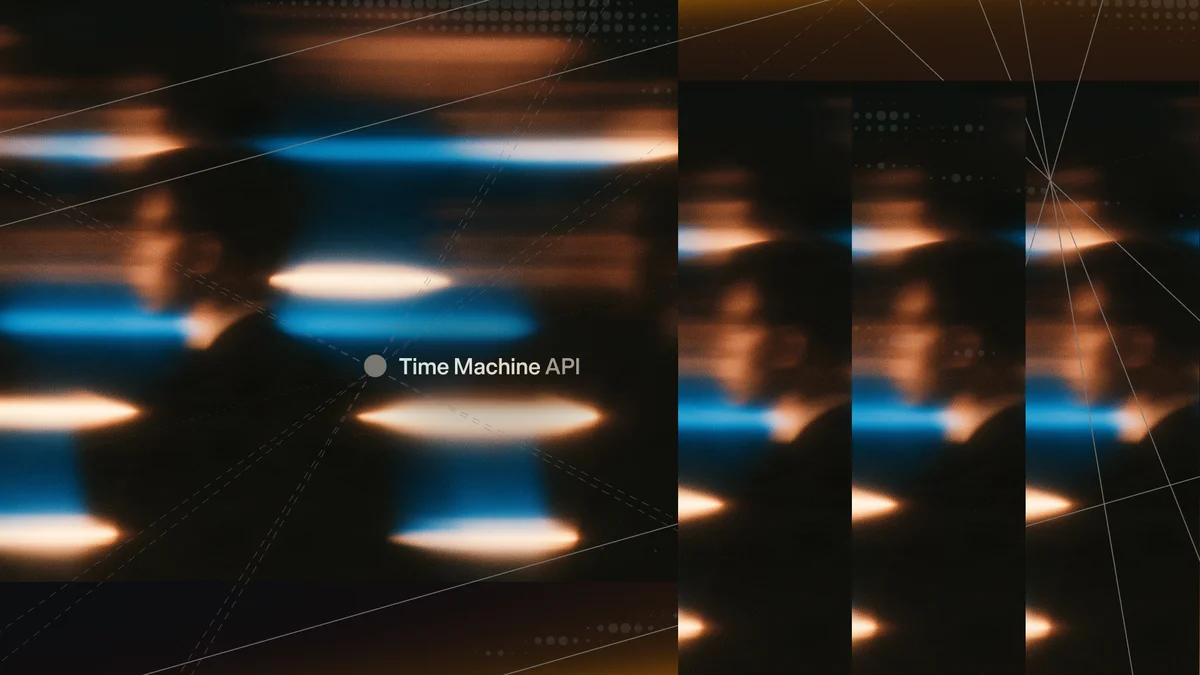
Perplexity has launched Time Machine, a feature that lets developers and AI agents search the web as it existed on a chosen date in the past. Announced on November 25, the tool is available now in the company’s Search API and Context API, with no price surcharge.
“The live web always knows how things turned out,” Perplexity wrote in its announcement. Time Machine exists to fix that problem for anyone training or testing AI systems. When an agent is asked to predict an event, searching the live web can quietly hand it the answer, because the web already contains what happened next. Time Machine freezes the web at a chosen moment, so a question can be answered as it stood then and scored fairly against what happened after.
How Time Machine Works
Every time Perplexity crawls a page, it saves a dated copy. Over time, each URL builds up a version history, and Time Machine answers from that history instead of the live web. Developers add one parameter, snapshot_as_of, to a request they already make, and it becomes a cutoff reaching back up to 365 days. The window keeps growing as the archive does.
On the Search API, only pages published or first crawled by the cutoff are considered, and each result’s title, date, and snippet come from the page’s stored copy at that time. On the Context API, the full text of the page’s copy at the cutoff is returned, and the live site is never contacted. The cutoff is an RFC 3339 timestamp with a time zone, and it cannot be set in the future or more than 365 days in the past.
Why Forecasting Needs a Frozen Web
The main use case is prediction. Training an agent to forecast events requires data that stops before the outcome, but a normal web search leaks the future into the training set. Perplexity tested Time Machine by training a model, GLM-5.3 Flash, on resolved political prediction questions from Polymarket. With the live web, about 90% of training groups produced no learning signal, because the model could already see the answers. With Time Machine, that figure fell to about 25%, and the held-out reward beat the live-web baseline, according to Perplexity’s published results.
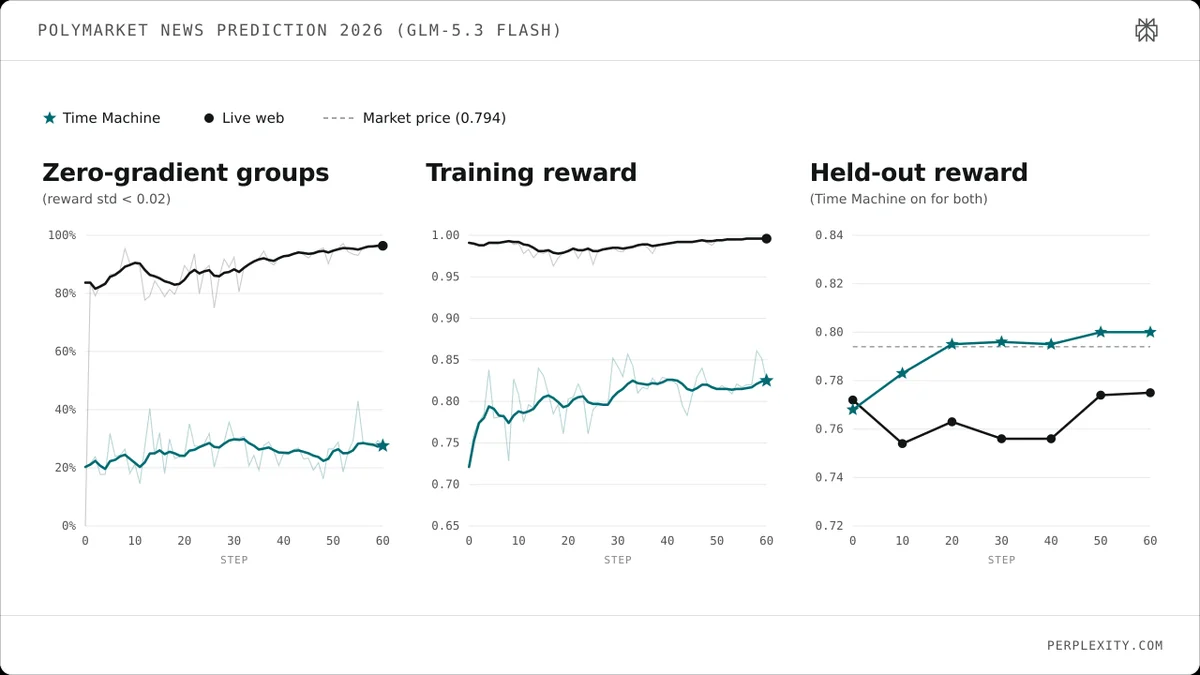
Perplexity’s test results training GLM-5.3 Flash on Polymarket prediction questions: Time Machine cut zero-gradient groups from about 90% to about 25%. Image: Perplexity.
Perplexity CEO Aravind Srinivas announced the feature on X, writing: “We’re building a time machine for the internet. Perplexity Time Machine shows a model the web exactly as it was on any date you pick. This allows you to post-train agents that can be good at predicting the future. Live today in our Search and Context APIs.” The quote was reported by the Times of India.
Pricing and Availability
Time Machine needs no new endpoint or setup. It works today with an existing API key, and it is priced the same as any other Perplexity API call, with no surcharge for historical requests. Search costs $5 per 1,000 requests, and Context costs $1 per 1,000 URLs fetched. A default rate limit applies to requests that include a cutoff, and higher limits are available by contacting the Perplexity API team.
The same point-in-time web works anywhere hindsight would invalidate a result. Beyond forecasting, Perplexity points to backtesting research agents, reproducing past analyses, and evaluating models against archived content without the ground shifting underneath them. For developers building agents that reason about the world, the ability to ask the web a question as it stood on a specific day is a small feature with a large consequence: results that can finally be trusted, because the model could not have peeked at the answer.
Sources
- Perplexity, “Freeze the web with Perplexity Time Machine” (November 25, 2026)
- Times of India, “Perplexity CEO Aravind Srinivas says AI can predict the future with its new ‘Time Machine'” (November 26, 2026)
- Moneycontrol, “Perplexity CEO Aravind Srinivas announces Time Machine AI feature that lets developers train models to predict future events” (November 26, 2026)