Apple has removed MiniMax Talkie, the AI companion app from Chinese AI company MiniMax, from the App Store worldwide after a joint investigation reported that its AI characters subjected children to sexual and degrading conversations. Apple confirmed the removal in a statement, saying the app included sexual content, though it did not say whether that content had been served to minors.
The removal followed a joint investigation by the UK nonprofit The Bureau of Investigative Journalism and Australian public broadcaster ABC News, published on November 25. The outlets reported that Talkie characters subjected minors to degrading language, possessive behaviour and romantic role play, and presented internal company documents describing how MiniMax engineered the app to deepen users’ emotional bonds. MiniMax, which operates Talkie through a Singaporean subsidiary called Subsup, declined to comment when contacted by the South China Morning Post.
What the Investigation Found
The investigation drew on accounts from parents in several countries. In Brisbane, a mother found sexual and abusive exchanges between her 12-year-old daughter and a Talkie character, and a mother in the United States documented more than 40 exchanges involving her daughters, aged 13 and 10. According to a survey by Australia’s eSafety Commissioner, around 50,000 Australian children aged 10 to 17 said they had used Talkie, even though the app was rated 18+ and required age verification on both Apple App Store and Google Play.
Company documents cited by the investigation show MiniMax treated emotional attachment as a design goal. Users of Talkie and its Chinese version Xingye spend on average more than 70 minutes a day on the apps, and engineers found that users talked longer when they felt a stable emotional connection with a character. One company document put it plainly: “We continuously deepen emotional bonds while providing new stimuli through exploration.” The investigation reported that engineers penalised chatbots in testing if they could not keep conversations alive.
The investigation also raised questions about training data. Talkie’s FAQ section stated that conversations with its AI characters were kept private, but the outlets reported that two companies working closely with MiniMax had publicly claimed its models were trained on Talkie conversation data. Both companies denied the claim when asked and removed it from their promotional material. MiniMax shareholder presentations and engineering documents indicate the company uses its own data to train models, according to the investigation.
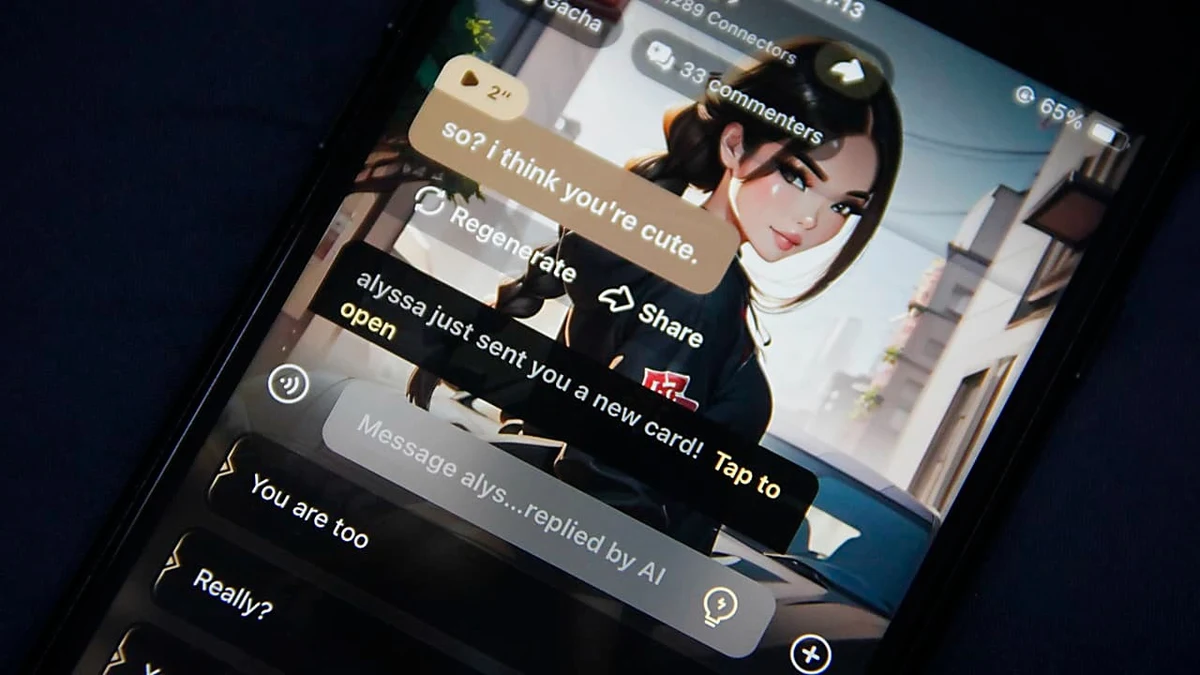
Talkie running on a phone, showing a chat with an AI character. Image: Techie.vn
Talkie and MiniMax
Launched in 2023, Talkie quickly became MiniMax’s main revenue driver. Together with Xingye, it accounted for 63.7 percent of MiniMax revenue in 2024. That share has fallen as the company expanded into enterprise AI and video generation, and in the first half of 2026 AI consumer apps, a category that includes Talkie, brought in US$42.6 million, or 36.6 percent of total revenue.
Talkie had almost 11 million monthly active users across its website and app as of October, according to Chinese research firm Unique Research cited by the South China Morning Post. New downloads fell 32.2 percent from the previous month, amid complaints about stricter age verification measures such as photo identification. The app remains available on Google Play, where it has more than 50 million downloads, and can also be accessed from a desktop browser, where it asks for a user age but does not verify it.
This is not the first time Apple has removed Talkie. In 2024, Apple pulled the app for including objectionable user generated content, before MiniMax released a new version in 2025. In July 2026, China’s first regulations covering AI companion apps came into effect, barring platforms from offering virtual partners or relatives to minors. MiniMax shares closed down almost 14 percent on Wednesday, amid a global sell-off in technology stocks.
The MiniMax logo. Image: MiniMax, via Wikimedia Commons
Why It Matters
The removal lands in a week of fast moving action against AI companion products. On November 24, New York Governor Kathy Hochul signed a bill banning AI chatbot toys for five years, and 42 state attorneys general asked a court to block Character.ai from auctioning off private chat data from more than 21 million US accounts. Australia is also set to pass a Digital Duty of Care law that would penalise makers of AI companion apps that fail to prevent harm to young people.
For MiniMax, the timing is awkward. The company unveiled its H3 family of video and image models this week and its Talkie app has been one of the most downloaded AI companion products in the world. Losing distribution on the App Store cuts off its main storefront in Western markets, and the investigation findings put the whole companion app category under sharper regulatory scrutiny. What happens next will depend on whether MiniMax responds to the allegations and whether Google follows Apple’s lead on Google Play.