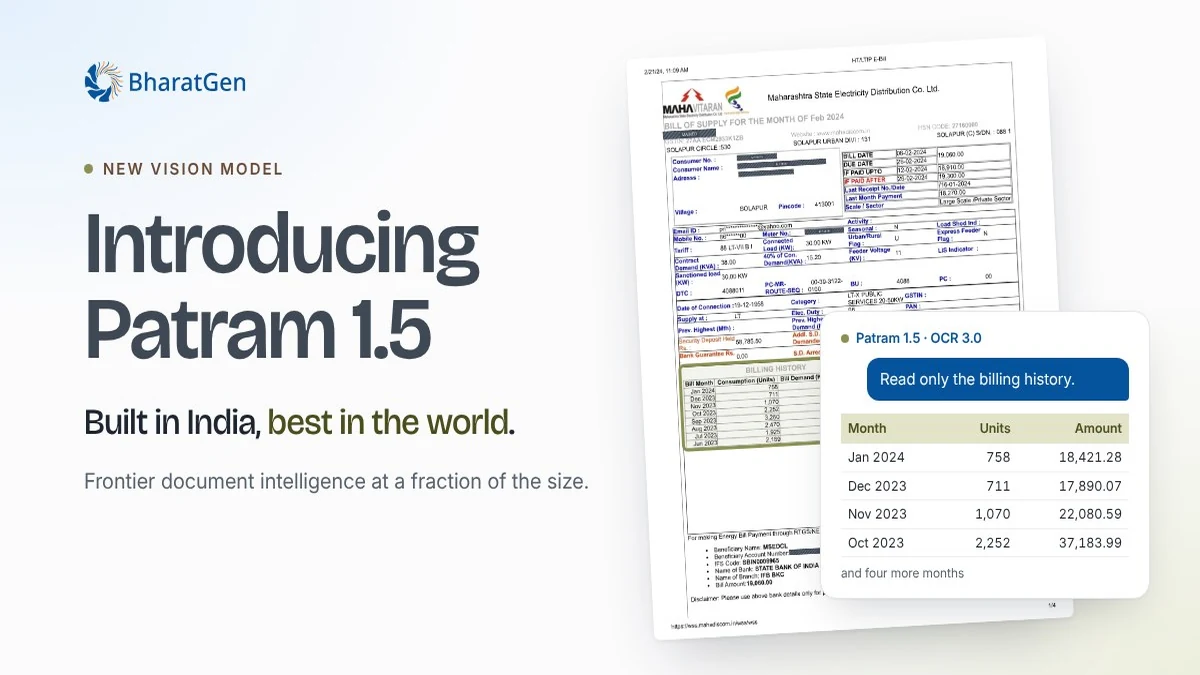
BharatGen has launched Patram 1.5, a 7-billion-parameter open-weight vision-language model built in India to read the documents that run the country’s banks, hospitals, and government offices. Announced on November 26, the model treats each page as an image and reads, parses, extracts information, and answers questions in a single pass.
BharatGen, a government-backed consortium led by IIT Bombay and supported by the Department of Science and Technology and the IndiaAI Mission, released the weights under Apache 2.0 on Hugging Face and opened a Playground where users can try the model on their own pages. At 7 billion parameters, it runs on a single GPU, so organizations can process sensitive documents on their own servers instead of sending them to an outside service.
OCR 3.0 and the ability to say “I don’t know”
Patram 1.5 introduces two capabilities BharatGen calls new. The first is OCR 3.0, a promptable way to read a page: instead of dumping the whole page as text, users ask for only the part they need, in the format their system takes, with personal data masked as the page is read. In BharatGen’s launch example, the model reads only the billing history from an electricity bill and returns it as a table.
The second is abstention. Where a page is blank, blurred, or does not hold the answer, Patram 1.5 says “I don’t know” and explains why, instead of guessing. For regulated work, that matters: a blank field stays blank, and a made-up account number never enters the system of record. BharatGen says the model gives a reason and a confidence for each value, so only the doubtful ones reach a person for review.
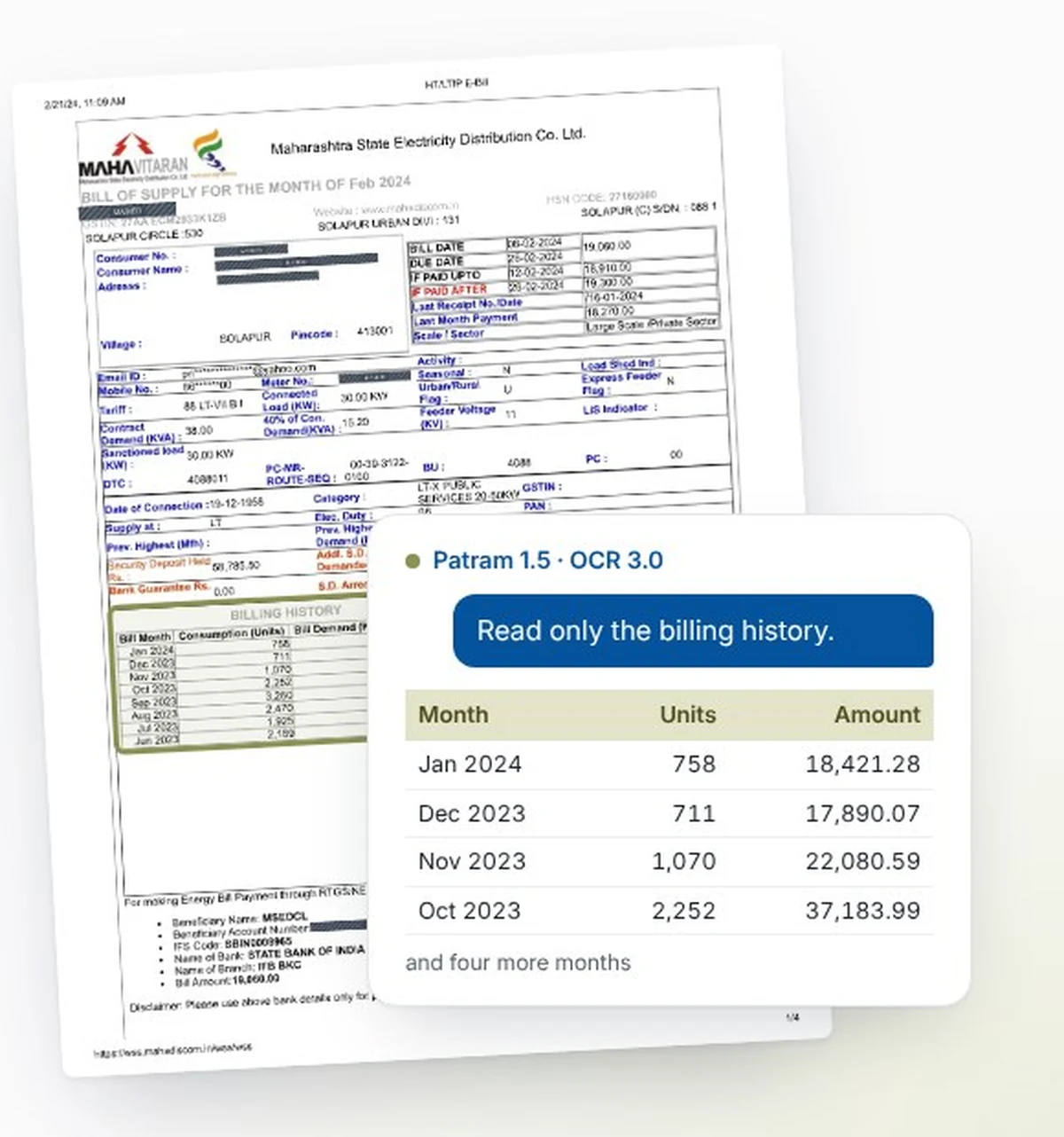
Patram 1.5 with OCR 3.0: asked to read only the billing history from an electricity bill, it returns just that table. Image: BharatGen
The evaluation numbers
BharatGen tested Patram 1.5 on 49 tests: 34 public benchmarks and 15 tasks from PatramBench, its own benchmark built from 8,773 pages of Indian documents. Across all 21 vision-language models assessed, no model scored higher than Patram 1.5, at 83 overall. Only two models matched it, and both are far larger: Qwen3.5-397B, at 51 times its size, and DeepSeek-V4.1-Flash, at 97 times.
Against models of its own size, Patram 1.5 came first on PatramBench with 85 and tied Qwen3.5-9B at 81 on the public benchmarks. Against seven specialist OCR systems, it scored 88 on PatramBench and 83 on public benchmarks, against 77 and 76 for the next best system. On the abstention task it scored 87 out of 100, against 84 for the next model. And it used about 21 times fewer output tokens than Qwen3.5-9B with thinking on, while both scored 85 on the same ten question-answering tests.
All of these figures are BharatGen’s own measurements, and PatramBench itself is due to be released on Hugging Face in the coming days, so independent checks will have to wait for the benchmark’s release. Ravi Kiran Sarvadevabhatla, a BharatGen consortium member and professor at IIIT Hyderabad, said the launch “marks a new capability frontier for sovereign vision models and document understanding workflows.”
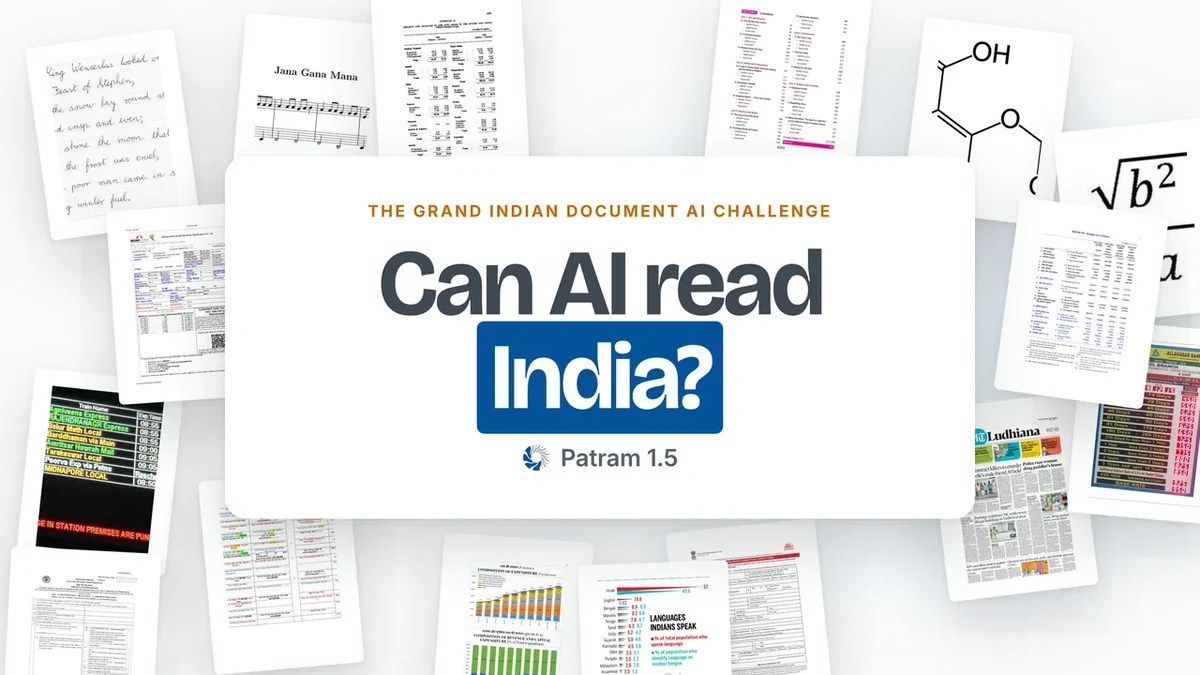
‘Can AI read India?’ BharatGen’s launch poster for Patram 1.5. Image: BharatGen
Why it matters
Patram 1.5 landed on the same day as India’s Chariot-1 foundation models, and the two launches tell the same story from different directions. India is building sovereign AI that is small and deployable, not just large: Chariot-1 pairs an 11-billion-parameter language model with speech models for ten Indian languages, while Patram 1.5 takes on the paper trail that still runs much of the country’s economy.
The model is the fourth in a family that began with Patram 1 in June 2025, followed by Patram 1.1 in August 2025 and Patram 1.2 in February 2026. Each step added capability, and this one adds the two things enterprises ask for first: a way to read exactly what they ask for, and a model that admits what it cannot read.
Sources
- BharatGen, “Introducing Patram 1.5,” November 26, 2026
- BharatGen, “Patram 1.5 and vision models”
- Patram 1.5 model card, Hugging Face
- Economic Times, “BharatGen’s 7-billion-parameter Patram 1.5 is trained to hold back rather than guess,” November 26, 2026
- Moneycontrol, “BharatGen launches Patram 1.5, a 7-billion-parameter AI model to read Indian documents,” November 26, 2026