Ant Group has released the weights for Ling-3.2-air, a 124 billion parameter multimodal model that activates only 5.5 billion parameters per token. The model went live on Hugging Face on November 23, 2026, under the permissive MIT license, from inclusionAI, the lab behind Ant Group’s AGI work. It is built for office workflows rather than chat: automating multi-step tasks, reading long professional documents, and handling terminal work.
Ling-3.2-air shares the native multimodal architecture of its predecessor, Ling-3.0-flash-VL, and accepts text, image, and video input in the same conversation. Announcing the release, the Ant Ling team wrote: “Introducing Ling-3.2-air, an open-weight model that shares Ling-3.0-flash-VL’s native multimodal architecture. 124B total, 5.5B active. Stronger workflow automation and professional document reasoning. AutomationBench-AA rises from 15.7% to 61%.”
A hybrid linear MoE that stays small at inference time
The model is a hybrid-linear mixture of experts. Its language component totals 124 billion parameters with 5.5 billion activated per token, using 512 routed experts with eight activated per token plus one shared expert. The 42 transformer layers mix 35 Kimi Delta Attention layers with seven gated multi-head latent attention layers, a 5 to 1 ratio that keeps memory use low over long contexts. The native context window is 262,144 tokens.
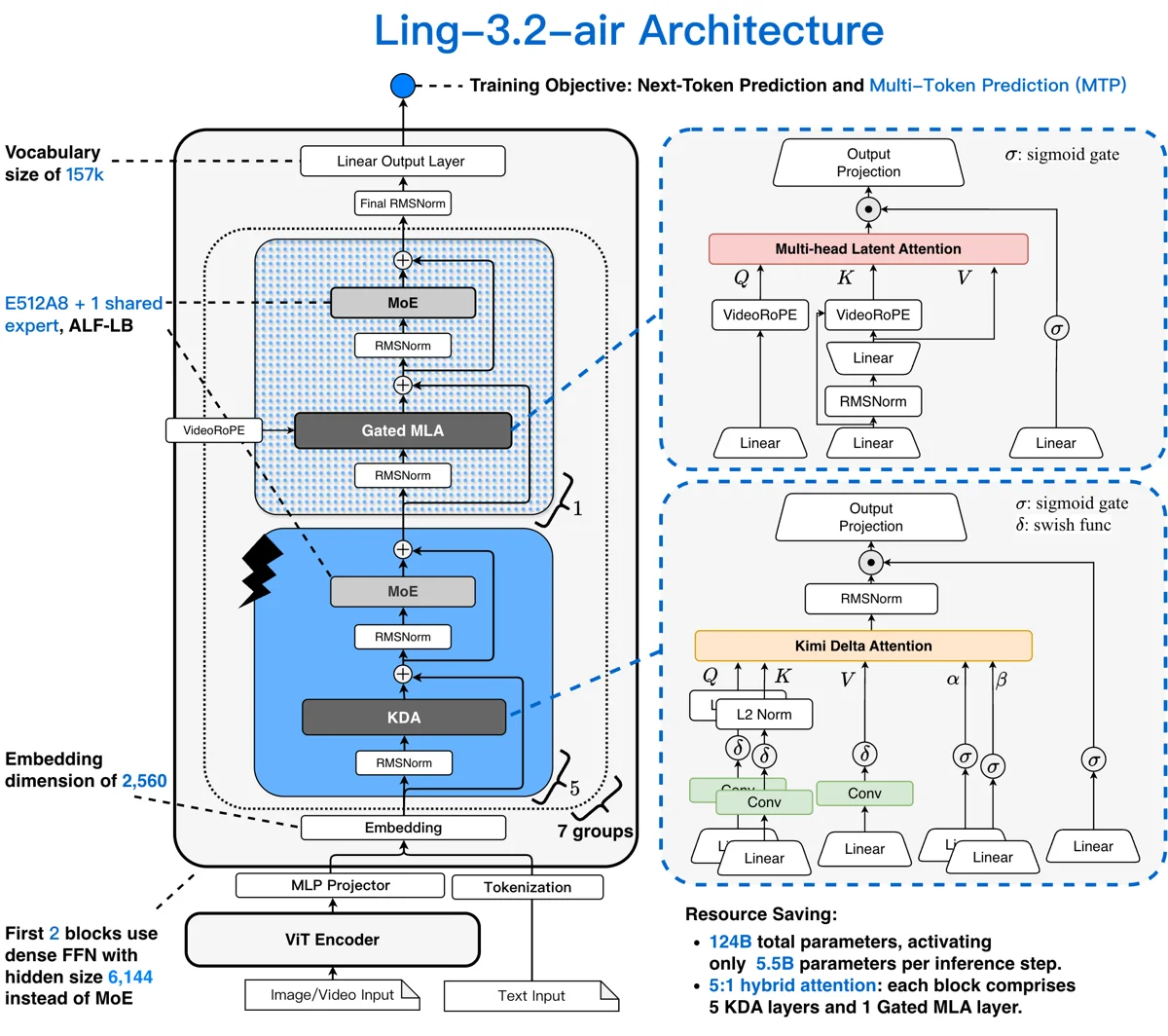
Ling-3.2-air’s hybrid architecture mixes 35 Kimi Delta Attention layers with 7 gated MLA layers. Image: Ant Group / inclusionAI
Benchmarks: automation jumps, legal work stays hard
Every improvement Ant reports is measured against Ling-3.0-flash-VL, and the gains are largest where the model is aimed. On AutomationBench-AA, which tests agentic workflow automation, the score rises from 15.7% to 61%. On AA-Briefcase v1.1, its Elo rating rises from 987 to 1340, a gain of 353 points. On Terminal-Bench 4.0, its pass rate on terminal tasks rises from 0% to 27%. On GDP.pdf, a document intelligence benchmark, the all-pass rate doubles from 8.4% to 16%. Overall, the model scores 23 on the Artificial Analysis Intelligence Index v5.0.1.
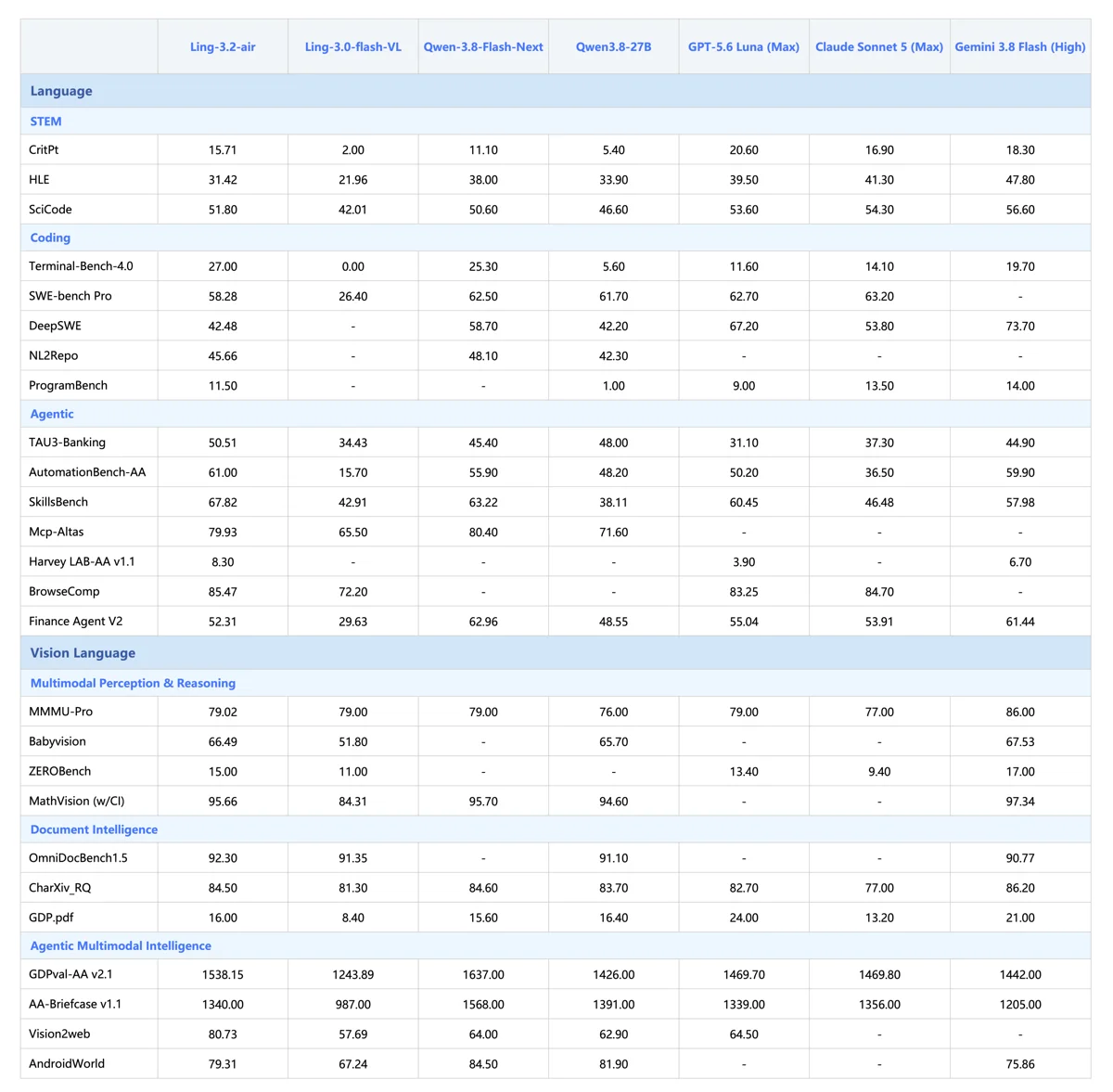
Ling-3.2-air’s full evaluation table, compared with Ling-3.0-flash-VL, Qwen, GPT-5.6 Luna, Claude Sonnet 5, and Gemini 3.8 Flash. Image: Ant Group / inclusionAI
The model card is unusually candid about one result. On Harvey’s legal benchmark LAB-AA v1.1, Ling-3.2-air meets 87.7% of individual grading criteria, but its all-pass rate, where every criterion on a task must be right, is 8.3%, and only 0.8% after a check for material hallucinations. That is a reminder that a strong criterion score is not the same as reliable legal work, and Ant publishes the weaker number alongside the strong ones.
Free weights, serious hardware
The weights are free to download under MIT, which allows commercial use and modification. The download is about 129 GB across 13 FP8 safetensors shards, with BF16 and F32 components for the vision tower and sensitive layers. There is no hosted inference option yet: the model card notes it is not deployed by any inference provider, so self-hosting is the only path today.
Ant ships day-zero serving support in SGLang and vLLM. Its recommended recipe for the full 256K context runs on four 141 GB class GPUs, such as H200 or H20-3e cards, or a four-GPU Blackwell node; on 80 GB cards such as H100 or H800, it scales out to tensor parallel 8. That puts the model in reach of teams with serious GPU hardware, not a laptop download, which is the trade-off for a 124B model that runs at 5.5B active.
Why it matters
Ling-3.2-air is part of a wider pattern in open models: very large total parameter counts with a small active slice, aimed at specific work rather than general chat. Ant is targeting the unglamorous middle of office AI, the long documents, the multi-step workflows, the terminal commands, where a model that can read a PDF, reason over it, and act on it is worth more than a higher chat benchmark. The MIT license removes the usual friction for commercial self-hosting, and the automation benchmark jump, from 15.7% to 61%, is the number to watch: if it holds up outside Ant’s own tests, it makes the model a serious candidate for teams building document and workflow agents on their own hardware.