Anthropic has opened a private beta for self-hosted Claude Managed Agents, letting companies run the company’s full agent service inside their own cloud or on-premise data center instead of on Anthropic’s infrastructure. The announcement, published on November 12, extends a product that previously ran entirely as a hosted service on the Claude Platform, Anthropic said.
“Self-hosted Claude Managed Agents is now available in private beta,” Anthropic wrote. “Developers can build agents that work directly in their company’s code and internal systems, and run those agents in their own environment.”
What Was Announced?
Managed Agents is Anthropic’s suite of composable APIs for building and deploying autonomous agents. It supplies the agent harness, sandboxes, credential handling and session history needed to put long-running agents into production. Anthropic first launched it as a hosted service, then added self-hosted sandboxes for teams that needed agent code to stay in their own environment.
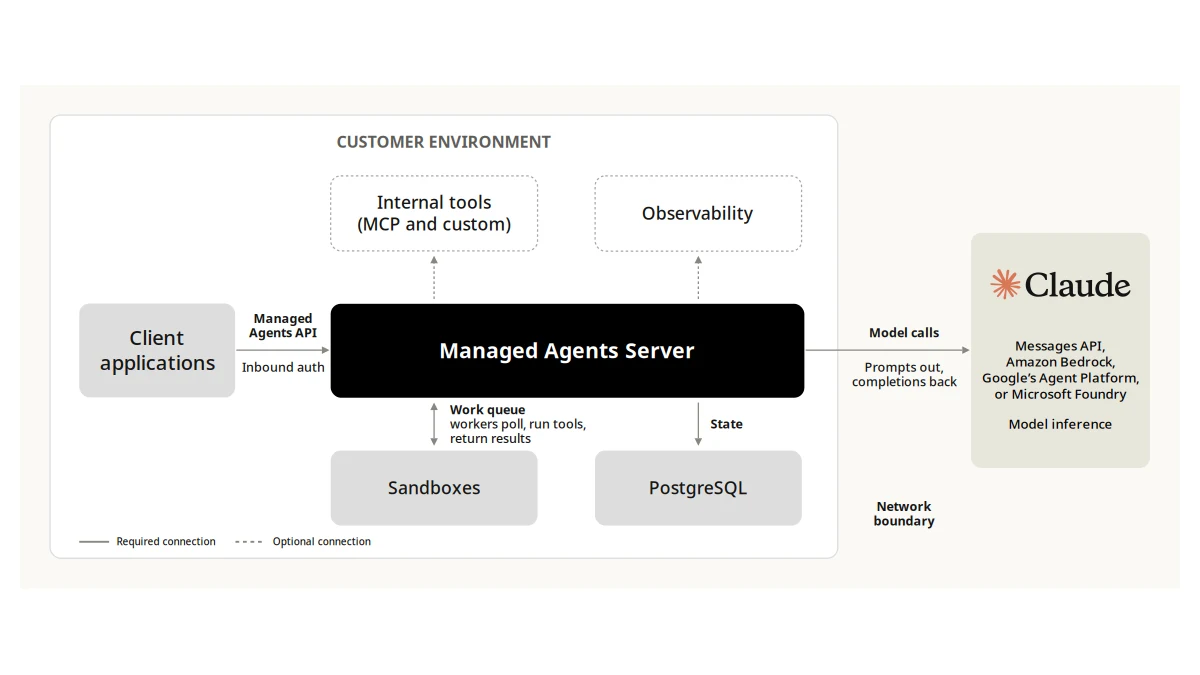
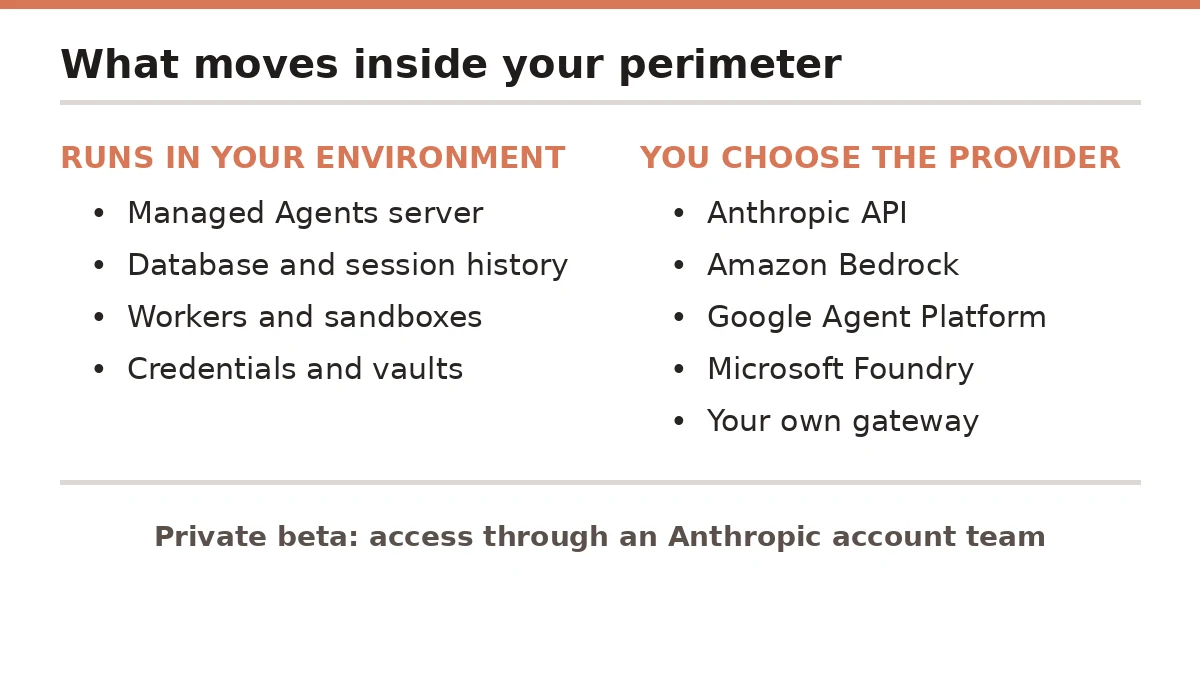
The new option goes further. With self-hosted Managed Agents, every part of the service runs in the customer’s own cloud or on-premise, including the harness, sandboxes, credentials and session history. The customer operates the Managed Agents server, its database and the workers where agents run their shell and file tools. Developers still build agents with the same core APIs as the hosted service, so existing agent code carries over.
Anthropic framed the move as a response to how agents are now used. Agents have grown more capable and now take on critical work such as fixing broken builds, testing releases, triaging alerts and working through bug backlogs, running unattended with access to internal systems. “For agents with that level of access, some teams want the whole service in their own environment, not just the sandbox,” Anthropic wrote.
Where Model Requests Go
Self-hosting the service does not mean the model itself runs inside the customer’s network. Model requests go where the customer chooses: directly to Anthropic, through a cloud provider such as Amazon Bedrock, Google’s Agent Platform or Microsoft Foundry, or through the customer’s own gateway.
Session history stays in the customer’s own database. If an organization has zero data retention in place with Anthropic, Anthropic said it applies to requests sent to Claude in the same way as any other Messages API call. Anthropic also said it has no remote access to a customer-run server or its logs, Unite.AI reported, citing the company’s documentation.
Designed for Agent Security
Anthropic said it designed Managed Agents around four security principles, and that the principles apply whether Anthropic hosts everything, the customer hosts just the sandbox, or the customer hosts the whole service.
First, the brain and the hands are split. The harness calls Claude, while the agent’s code runs in the sandbox, and the agent loop, session history and vault secrets stay outside it. Second, credentials stay out of the sandbox: vaults are built to keep credentials away from agent code, with a proxy outside the sandbox adding credentials to requests, and self-hosted customers can store credentials in their own secrets manager.
Third, network access can be limited. Each environment can be restricted to a list of allowed hosts, so requests to any other host are blocked. For an agent that fixes broken builds, Anthropic said, that list might be just the team’s git host and package registry. Fourth, every session leaves a full record, including the tool calls an agent made and what came back, exported over OpenTelemetry so teams can send it to the monitoring tools they already use.
What It Does Not Change
The self-hosted option is a private beta, and access goes through an Anthropic account team rather than a public signup. Anthropic has not disclosed pricing or a timetable for wider availability.
There are trade-offs. Anthropic’s documentation notes that some hosted-service features, including scheduled runs and webhooks, are not yet available in the self-hosted version, and nothing migrates from the hosted service, so agents, credentials and session history must be rebuilt on the customer’s own server. A persistent deployment also requires a PostgreSQL database, Help Net Security reported.
Why It Matters
The launch lands as enterprises push agents deeper into their own systems, and as Anthropic courts the regulated and security-conscious customers that will not let agent credentials and session history sit on a vendor’s servers. Letting the whole control plane run behind a customer’s firewall removes one of the biggest objections to deploying autonomous agents on production code, even if the model calls still travel to a provider the customer picks.
It also comes in a crowded week for Anthropic. The company is in the middle of its IPO roadshow, with pricing set for November 18 and trading expected to begin November 19, and it announced Claude Sheets, Whiteboards and Meetings for workplace teams earlier in the week. Self-hosted Managed Agents is the enterprise infrastructure piece of that push: not a new model, but a deployment option aimed at the customers most likely to pay for agents at scale.
The limits are real. The beta is gated, pricing is undisclosed, and the self-hosted version still trails the hosted service on features. But for teams that have held agents back over data control, the direction is clear. Anthropic is now willing to hand over the keys to its agent platform, and let customers run it themselves.