OpenAI Backs the Bills
OpenAI is backing a bipartisan effort in Congress to block China’s access to artificial intelligence chips and curb China’s access to chipmaking equipment, Bloomberg Law reported on Thursday. The company confirmed to lawmakers this week that it would support the measures, according to people familiar with the matter, who requested anonymity to describe a position that is not yet public.
The backing adds significant industry weight to export-control legislation that has gained momentum after the scandal that toppled Jensen Huang as Nvidia’s chief executive. Huang, a longtime opponent of stricter export controls, was removed on Thursday, and his departure has shifted the political landscape in Washington.
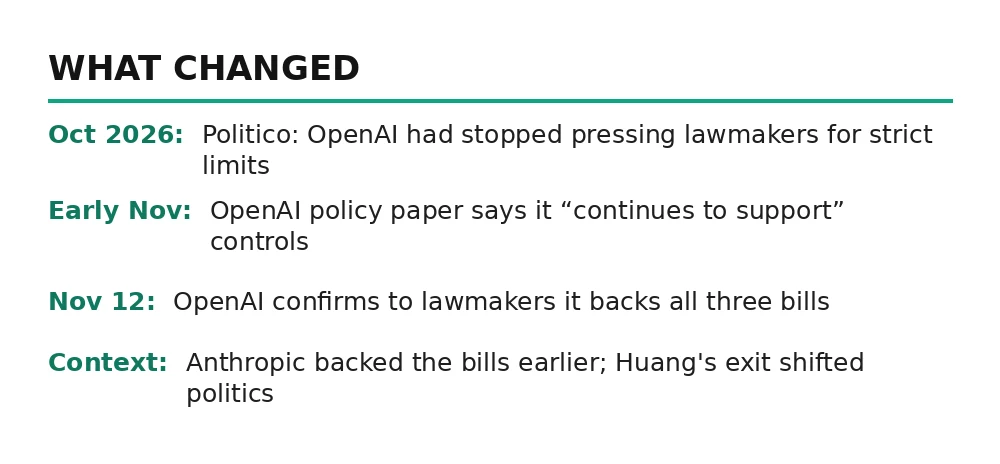
OpenAI had been weighing for months whether to support the package of export-related bills. The company buried its position in a policy document published in early November, stating that it “continues to support” strengthening export controls, Emergent reported.
The Three Bills
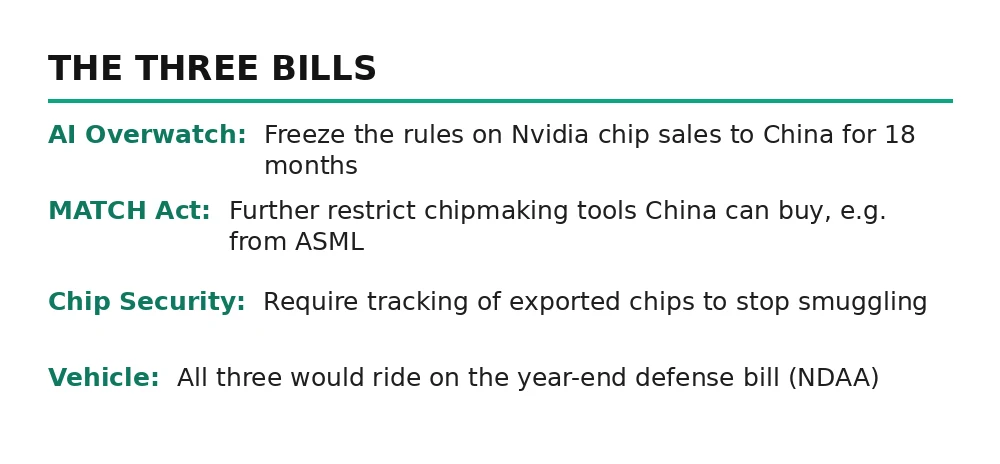
Congress is weighing three distinct proposals that would be attached to the annual defense bill, which must pass before the end of 2026. The AI Overwatch Act, championed by Senator Jim Banks and Senator Elizabeth Warren, would freeze existing rules governing which chips Nvidia can sell to China for at least 18 months.
The MATCH Act seeks to further restrict the chip manufacturing tools China can purchase from companies like ASML Holding. The Chip Security Act would mandate security mechanisms capable of preventing chip smuggling, including verification of a chip’s location after it leaves the United States.
Anthropic, OpenAI’s main rival in frontier AI, had already expressed support for tougher controls on AI chip exports and tighter access to chipmaking equipment. In September, Anthropic quit the Information Technology Industry Council, the trade group whose members include Google, OpenAI and Nvidia, after the group asked Congress to strip the bills from the defense package.
A Shift From October
The backing marks a turn from October, when Politico reported that OpenAI had stopped pressing lawmakers for strict limits on sales of advanced AI chips to China. For much of 2025 the company had openly backed such curbs, but its position grew fuzzier as it moved closer to Nvidia, its main chip supplier.
The change comes as congressional leaders line up behind the measures. Outgoing House Speaker Mike Johnson, expected incoming Speaker Hakeem Jeffries, and Senate Minority Leader Chuck Schumer have all backed the bills. Only Senate Majority Leader John Thune remains publicly undecided among the top four congressional leaders.
Representative Jim Banks said in a November 10 post on X that Congress has a “generational opportunity” to address the pathways through which China accesses U.S. chips in the annual defense bill. Representative John Moolenaar, chairman of the House Select Committee on China, said Nvidia “must now change its corporate practices and appoint leadership that makes national security its top priority,” and that Congress should “act quickly to pass bipartisan export control legislation in the year-end national defense bill.”
What Could Still Stop the Bills
The measures face real obstacles. All three bills carry the risk of aggravating China, which has deployed its own export controls on rare earth minerals to retaliate against escalating U.S. chip restrictions. In April, after the House Foreign Affairs Committee advanced the MATCH Act with bipartisan support, China’s Ministry of Commerce vowed to “take necessary measures” to safeguard its interests.
The Trump administration has expressed wariness about any policy that could imperil the trade truce with China, which expires on January 10, 2027. Industry groups such as the Information Technology Industry Council oppose the bills, arguing they could harm the U.S. tech stack, and lobbyists familiar with the defense bill negotiations said Nvidia’s allies mobilized this week against the provisions. Lawmakers and administration officials are still negotiating the exact terms, and the measures could still be scrapped if President Trump threatens a veto.
Why It Matters
OpenAI’s support aligns the two leading frontier AI labs behind tighter export controls, and it distances the company from Nvidia’s historical resistance to them. With Huang gone and the defense bill deadline approaching, the measures now have their best chance yet of becoming law by December.
If they pass, the AI chip supply chain faces its most consequential regulatory shift since the first export controls took effect. The rules would shape U.S.-China technology competition and the availability of computing resources for training frontier AI models through at least mid-2028, and they would put Congress, not just the Commerce Department, in charge of deciding which chips can be sold to China.