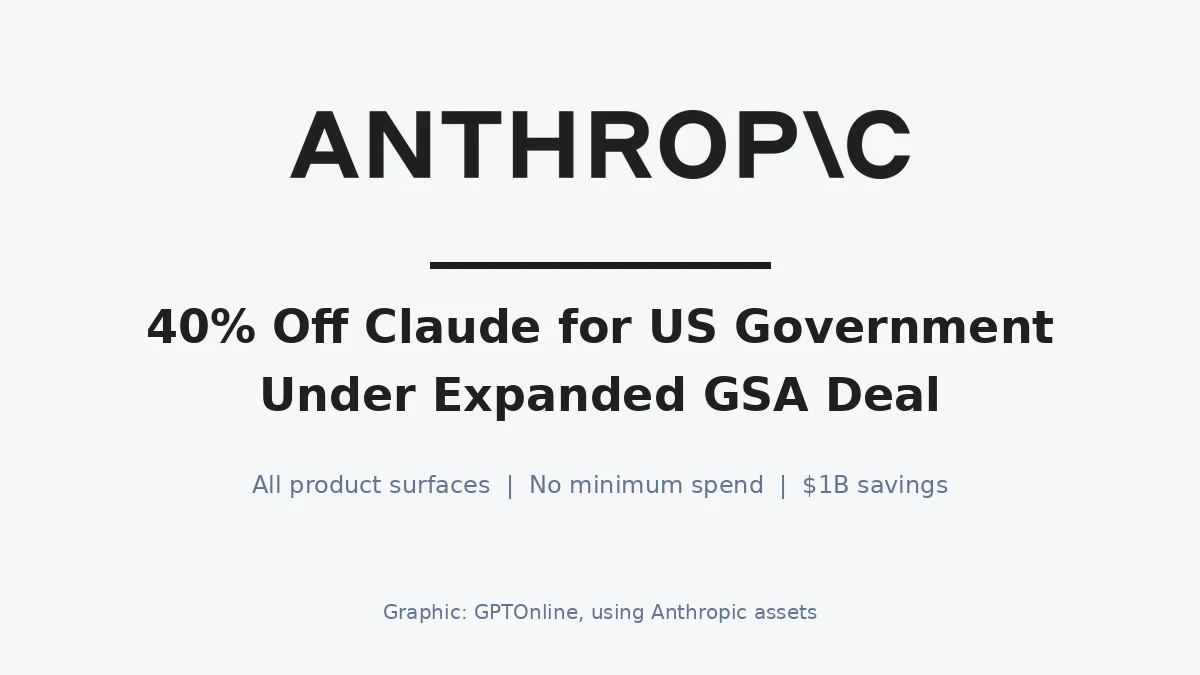
Anthropic has expanded its partnership with the US General Services Administration, giving government buyers a 40% discount on Claude across every product surface for the first time. The Anthropic GSA Deal, announced on October 27, 2026, covers Claude Enterprise, Claude for Government and the Claude API, and extends eligibility beyond federal agencies to state, local, tribal and territorial governments.
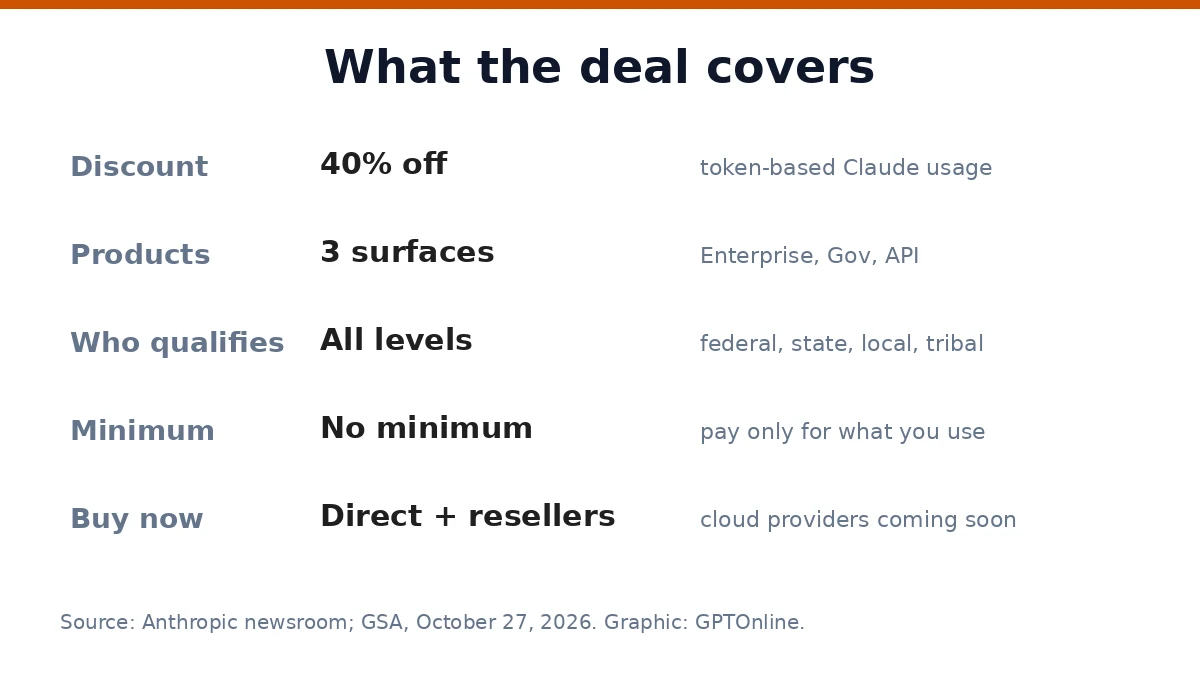
The agreement, signed under GSA’s OneGov program, replaces seat-based pricing with consumption-based pricing. Agencies pay only for the tokens they use, with no minimum spend commitment. Anthropic estimates the discounts will save the government $1 billion.
What Was Announced?
Under the expanded OneGov agreement, government partners receive a 40% discount on token-based usage across all Claude models available to the government, including FedRAMP-authorized environments for sensitive unclassified work, according to the GSA announcement. Agencies can buy directly from Anthropic today, through resellers, and on major cloud platforms, with the same discount coming to cloud purchases in the coming months.
“For the first time, the discount applies across every product surface, including when agencies buy from us directly today and through cloud providers in the coming months,” Anthropic said in its announcement. The company is also launching a dedicated program to help agencies implement Claude, bringing practices commonly used with its private sector customers to public sector partners in the coming weeks.
Eligibility covers federal buyers in the executive, legislative and judicial branches, as well as state, local, tribal and territorial governments. Government agencies can buy Claude at the OneGov discount through GSA’s Multiple Award Schedule today.
Graphic: GPTOnline. Source: Anthropic newsroom; GSA, October 27, 2026.
Adoption Is Already Broad
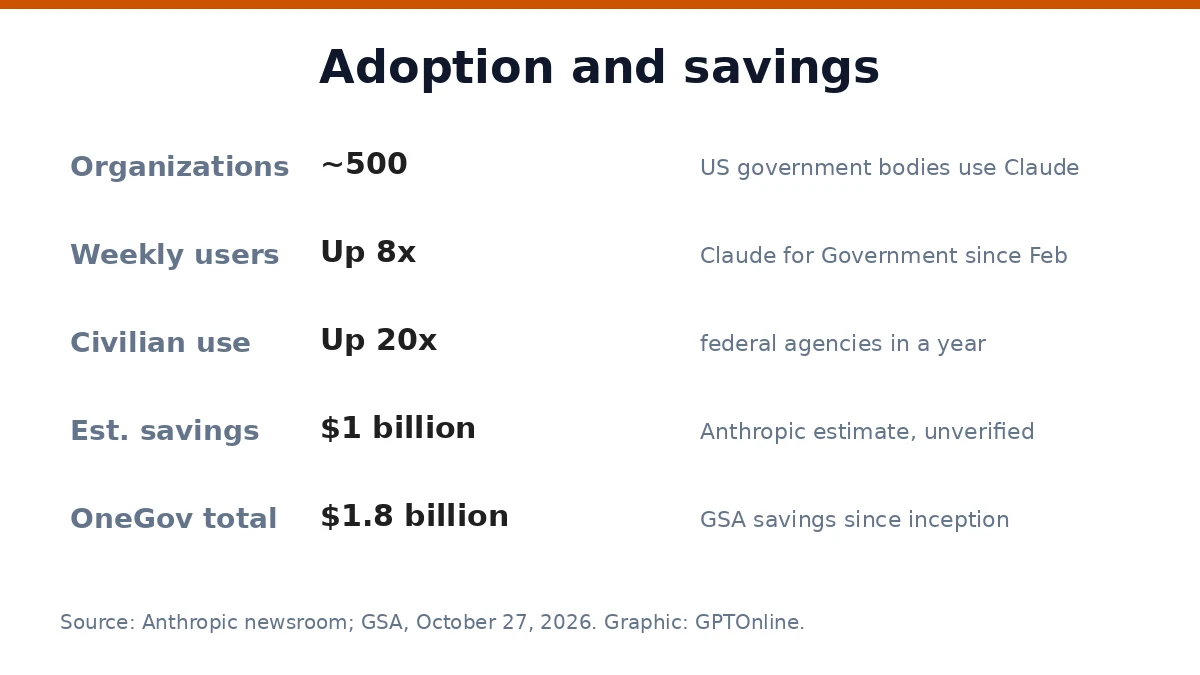
Approximately 500 US federal, state and local government organizations now use Claude, Anthropic said. Weekly active users of Claude for Government are up about eightfold since February, and usage across federal civilian agencies has grown about 20-fold in a year.
Anthropic pointed to early results from agencies already using Claude. In Utah, 34 developers across 10 state agencies received Claude Code in a four-week pilot; 80% had a working environment within 30 minutes, and 71% reported saving at least 20 hours. A US state CIO confirmed that a team responded to a ransomware attack in eight minutes, compared with the usual two to three days, thanks to Claude.
A US federal security team used Claude Mythos to detect and patch a vulnerability that could have allowed the takeover of a critical production system in about two days. A human penetration test the month before had missed it. Elsewhere, a state IT developer moved nearly 900 API methods to a new framework in two days, a project that had been scoped for a month, and a state IT director used Claude Code to document 12 legacy code repositories, mapping 467 database tables and flagging 27 risks.
“Those organizations run some of the most important systems in the country, usually on tight budgets and with long procurement cycles,” Anthropic said. “This agreement is built to support that work, so they can apply Claude to hard problems without a large upfront commitment.”
Graphic: GPTOnline. Source: Anthropic newsroom; GSA, October 27, 2026.
Security and Access
Claude for Government, which delivers Claude’s coding and agentic capabilities at near feature parity with commercial offerings, became generally available on September 30 at a FedRAMP High authorization level. On Amazon Bedrock, Claude is authorized for FedRAMP High, with select models authorized for Department of Defense IL4 and IL5 workloads in AWS GovCloud. On Google Cloud’s Vertex AI, Claude is authorized for FedRAMP High.
Claude Enterprise is in process for FedRAMP Moderate authorization through the FedRAMP 20x program, Anthropic said.
Why It Matters
The Anthropic GSA Deal is part of a wider shift in how the federal government buys AI. GSA said its OneGov strategy has generated more than $1.8 billion in savings for the federal government and taxpayers since its inception, including approximately $1.6 billion through its super intelligence agreements.
Anthropic follows OpenAI, which switched to consumption-based pricing last month as part of its own new OneGov deal, according to FedScoop. No details have been shared about Google’s Gemini OneGov deal, which currently offers access to Gemini for $0.47 per agency with an expiration date of November 15.
The agreement also lands while Anthropic is in an ongoing legal dispute with the Pentagon, FedScoop noted, adding that the company’s relationship with officials elsewhere in the federal government appears solid. The GSA deal, which reaches every level of government rather than only federal agencies, suggests that procurement officials outside the Pentagon see Claude as a practical tool for daily mission work, not only as a technology to evaluate.
For agencies, the practical change is straightforward. A 40% cut on token-based usage, with no minimum order, lowers the cost of running Claude on backlogs, records, forms and legacy code modernization, the use cases Anthropic highlighted. Whether the savings reach the estimated $1 billion will depend on how widely agencies adopt the discounted pricing, a figure that comes from Anthropic and has not been independently verified.
Sources
- Anthropic, “Expanding our partnership with GSA to bring Claude to all levels of government,” October 27, 2026
- GSA, “GSA, Anthropic Reach OneGov Agreement on Discounted, Consumption-Based Pricing for Claude,” October 27, 2026
- FedScoop, “GSA expands OneGov agreement with Anthropic, touting steep discounts”
- GPTOnline, “Anthropic Taps JPMorgan to Lead Retail Offering in Record IPO”
- GPTOnline, “Anthropic Files S-1 for Nasdaq IPO Under Ticker ANT”