
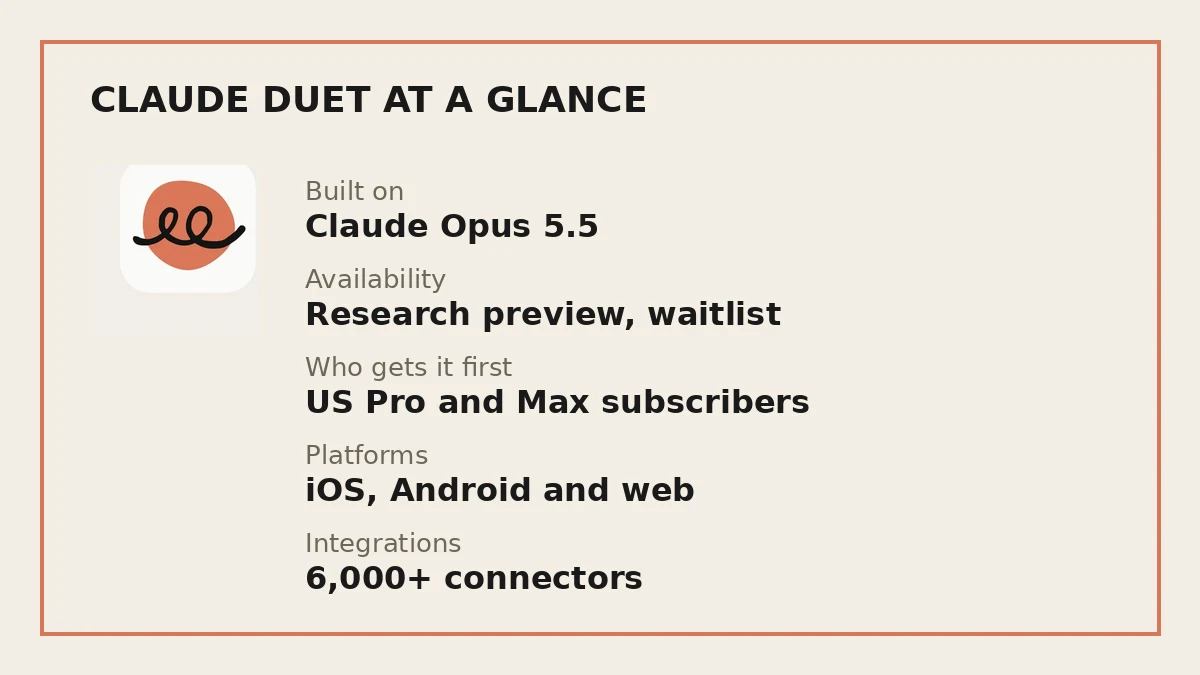
Anthropic has launched Claude Duet, a standalone proactive agent app that messages users first instead of waiting for prompts. Unveiled on October 21 as a research preview on a waitlist, Duet is built around the company’s Opus 5.5 model and is initially available to Claude Pro and Max subscribers in the United States, with standalone apps for iOS and Android plus access on the web at claude.ai, Anthropic announced.
“It comes to you with what needs your attention, completes tasks you ask of it, keeps working even when you step away, and checks with you before it acts on your behalf,” Anthropic says of Duet, positioning the app as a proactive counterpart to the classic Claude chatbot.
What was announced
Claude Duet is Anthropic’s answer to the new generation of always-on AI agents. Each morning, Duet sends the user a short brief on the most important items across their connected apps. Throughout the day, it checks those accounts every few hours and reaches out only when something needs attention, Engadget reported, citing Anthropic’s announcement.
Users can hand Duet tasks of all sizes through text or voice in a single ongoing thread, from simple administrative work such as scheduling meetings to more complex jobs like building dashboards, creating financial or sales forecasts, prototyping, and building web apps. It carries over the user’s memory, skills, and connected apps from their Claude account, so there is little setup involved, and it draws on more than 6,000 connectors in the Claude Marketplace, including Gmail and Slack, according to TestingCatalog.
How it works
Duet runs on its own virtual machine in the cloud with its own browser, so the user’s laptop or phone does not need to stay on. It keeps working in the background and sends a notification when a task is finished or needs review. “Claude Duet briefs you every morning, drafts next steps, then goes quiet until something needs you,” the official product page explains.
For sensitive actions, Duet shows exactly what it is about to do and waits for approval before sending a message, making a payment, signing a document, or deleting a file. Anthropic says Duet never directly sees passwords or sign-in tokens, and a dedicated safety classifier refuses to share the most sensitive information, such as credit card numbers, while health or personal finance details pass through only when the user has explicitly approved them. Purchases go through Stripe’s Link digital wallet, which asks the user to approve the spend and pays with a virtual card so the real card number is not shared, madrobot.blog reported from the announcement.
Pricing and availability
Duet is included in the Pro plan ($20 a month in the US, or $17 a month billed annually) and the Max plan (from $100 a month) at no extra charge, but it shares the plan’s existing usage limits, and its background checks count toward them. Larger tasks, such as building a financial model or a deck, require more model turns and background work, Anthropic says.
The preview starts in the US only. Team and Enterprise plans are not included yet, and Anthropic has not said when the app will reach other regions. During the preview it is a separate app from the main Claude experience.
Safety and limits
Anthropic is unusually direct about what Duet cannot yet do. The company warns that the research preview “may misread a thread or miscalibrate what’s urgent,” and it is less effective at personal tasks such as booking tickets. Duet also cannot yet show the user its browser. Red teams and an outside firm penetration tested the product, and Anthropic built it with a dedicated classifier and safety system prompt that checks each message, MacRumors reported.
Why it matters
Duet lands in the middle of an industry-wide race to turn AI assistants into autonomous agents. OpenAI launched always-on “dots” agents that pursue user goals across apps such as Slack and Microsoft Teams, and Meta’s Muse agent drew millions of downloads and fueled investor interest in autonomous AI services, Reuters and Thurrott noted. Anthropic is late to this particular party, but it is differentiating Duet as a work-first product: unlike Claude Cowork, which turns tasks the user starts into finished files, or Claude Tag, which works in Slack threads for Team and Enterprise customers, Duet is built to come to the user.
“We designed Claude Duet to be a partner you can trust,” Anthropic says. “Professionals of all kinds have to juggle many decisions a day, and we think they’ll find Claude Duet most useful. It helps you prioritize where to spend your time and energy, and to leave room for the ambitious projects that felt impossible or daunting before.”
The real test will be judgment: whether Duet interrupts at the right moments, and whether professionals and small business owners trust it with their inboxes, their calendars, and their money.
Sources
- Anthropic, Claude Duet product page (official)
- Engadget, “Claude Duet is Anthropic’s answer to Meta Muse and OpenAI Dots”
- Thurrott.com, “Anthropic Announces Claude Duet, a Personal AI Agent”
- MacRumors, “Anthropic Launches Claude Duet, a Proactive AI Agent”
- madrobot.blog, “Claude Duet is Anthropic’s new agent app that messages you first”
- TestingCatalog, “Anthropic opens Claude Duet preview for US Pro and Max users”
- Unite.AI, “Anthropic Opens Claude Duet Research Preview to US Pro and Max Users”