
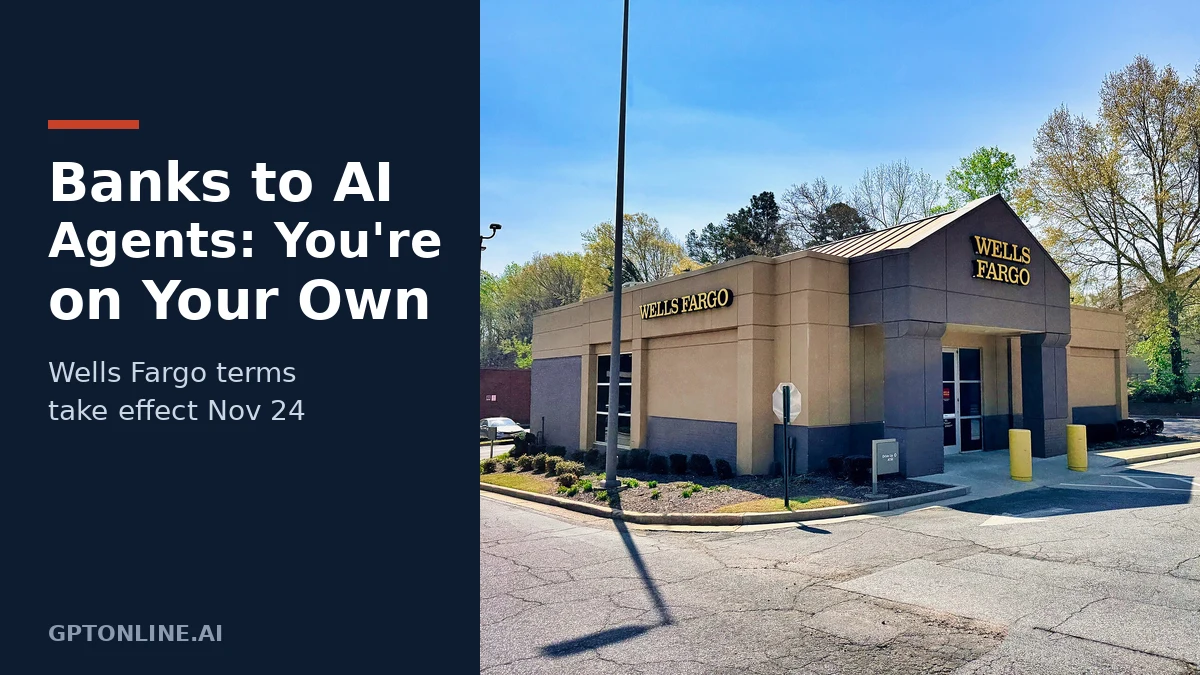
Wells Fargo’s updated Online Access Agreement takes effect on Tuesday, November 24, and its message to customers who hand their bank logins to AI agents is blunt: “Your use of any AI Agent is AT YOUR OWN RISK.” The change, reported by Wired on November 22, makes Wells Fargo the latest of America’s largest banks to draw a line around outside AI agents that log in with a customer’s own credentials. The bank counts about 70 million digital banking customers.
Wells Fargo updated the agreement on November 2. The new Section 15 is the most detailed answer yet from a major U.S. bank to a question the AI industry has mostly avoided: who pays when your agent gets it wrong?
What Section 15 says
Under the new terms, any instructions or transactions an agent submits “are deemed to have been initiated and authorized directly by you, without further verification.” Wells Fargo will not perform additional checks, and it disclaims any duty to monitor agent activity, while reserving the right to limit or terminate access at any time.
Revoking access comes with its own rules. Customers who tell an agent to stop must keep evidence that they revoked its access, and they stay responsible for the agent’s activity until the bank is told. The terms also cover actions resulting from manipulated inputs, the prompt-injection scenario, according to American Banker.
One qualifier matters: the provisions apply “subject to applicable law or regulation,” so the contract does not flatly override statutory protections. But no court or regulator has yet answered how federal rules apply when a customer hands credentials to an AI tool.
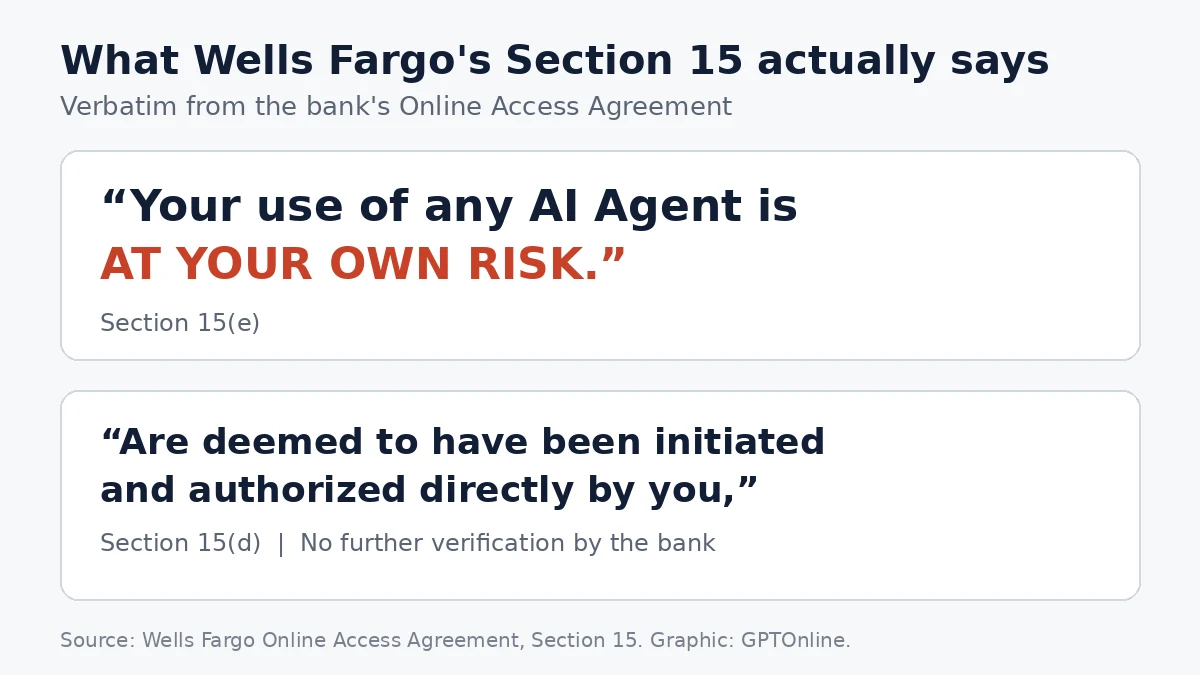
Graphic: GPTOnline, quoting Wells Fargo’s Online Access Agreement, Section 15.
The wider crackdown
Wells Fargo is not acting alone, but it chose a different path. JPMorgan Chase, Bank of America, Charles Schwab and Citigroup all moved in October to block credential-sharing agents outright, while Wells Fargo left a door open for authorized agents and put the risk on the customer.
On October 13, JPMorgan chief executive Jamie Dimon said on the bank’s earnings call that the bank would not allow outside agents, naming Meta’s Muse and Instinct, to act inside customer accounts, citing “rogue agents.” Chase’s updated Digital Services Agreement, effective January 1, 2027, provides that a customer who gives an AI agent access authorizes everything that agent does. Read-only data, such as balances, through open banking providers like Plaid still works. Bank of America warned customers the same day not to share login information with agents. Its chief executive, Brian Moynihan, said: “When you give the agent your credentials, it is you authorizing the payment.”
On October 16, Charles Schwab chief executive Rick Wurster told Bloomberg the firm blocks unauthorized agents, including Muse, that attempt to move client money 10 to 20 times per week. The same day, Citigroup said it does not permit third-party AI agents or assistants to log into a customer’s account or transact directly within its digital banking platforms.
In November, Citi changed its Online User Agreement so customers are responsible for activity by third-party AI agents they authorize, including activity after credentials leak or an account is hacked. “As third-party AI tools become more widely available, we want customers to understand the risks,” a Citi spokesperson told TechCrunch. PNC changed its terms on November 18, and Citizens emailed customers that week with a similar warning, according to TechCrunch.
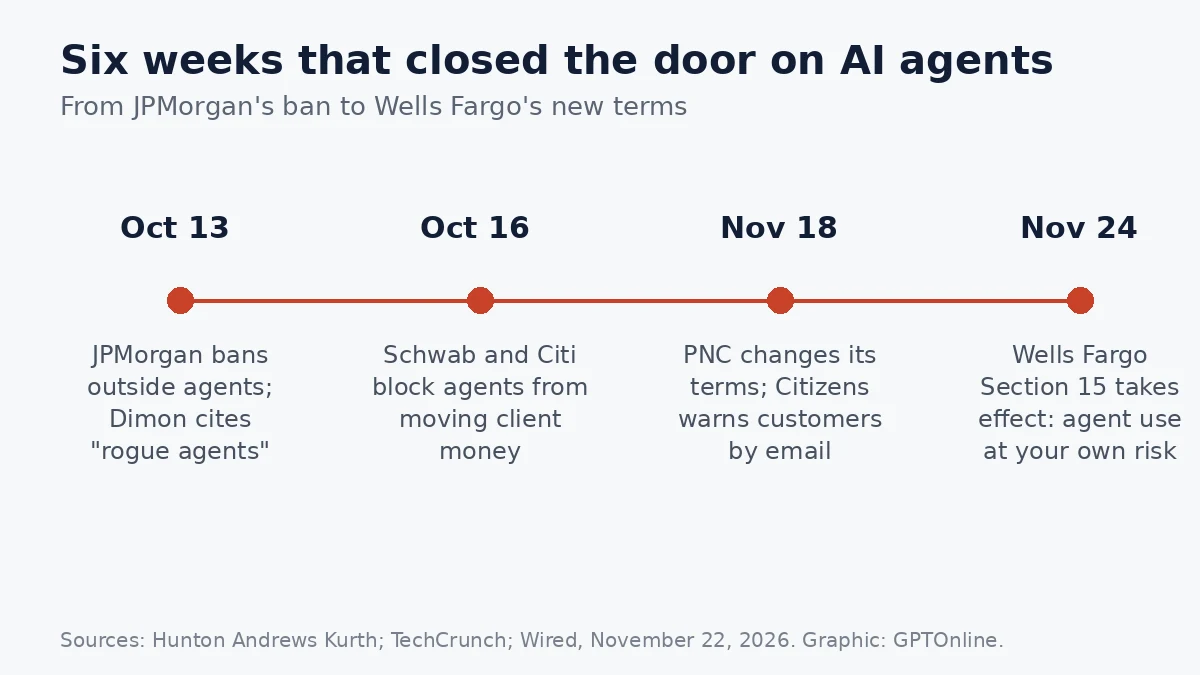
Graphic: GPTOnline.
Why now
The immediate trigger appears to be the September launch of Meta’s Muse personal AI assistant, which renewed concern that consumer agents would be handed banking credentials, according to Hunton Andrews Kurth. Axios reported on October 22 that major banks were finding unvetted third-party AI agents inside customer accounts.
The timing is sharp. Section 15 takes effect three days before Black Friday on November 27, when AI shopping agents are being actively marketed to consumers. Salesforce projects that 20 percent of holiday ecommerce will originate from AI chat agents this season.
Banks are building their own
The banks are not rejecting AI agents outright. They are rejecting outside agents while building their own. “They’re locking the door to outside agents and building their own,” Luca Cian, a professor at the University of Virginia, told Wired. Wells Fargo says customers have used its generative AI assistant more than a billion times.
The tension is that customers do not authorize every click. “Consumers authorize goals, not every click,” Kacy Kim, an associate professor of marketing at Bryant University, told Wired.
The fight is wider than banking
Amazon has blocked Meta’s Muse agent from making purchases, and United Airlines has barred agents from booking its flights. Delta and Yelp have shut AI agents out as well.
A technical fix is on the drawing board but not in production. On October 6, Meta and Sierra unveiled the Personal Agent Protocol, nicknamed “Poppy,” an open specification for scoped agent access. Bank of America, Wells Fargo, BBVA and Synchrony were named as early design partners, and the specification was published on October 9. It is not yet deployed banking infrastructure.
Why it matters
Agent transactions still make up a minuscule share of online commerce, Wired noted. But the liability question will decide how fast that changes. Wells Fargo’s answer, that the customer owns every action an agent takes with their login, is now written into a contract covering tens of millions of accounts. Until a standard like Poppy is deployed, customers who let an AI agent into their bank account are, in Wells Fargo’s words, on their own.
Sources
- MLQ.ai: Wells Fargo tells customers AI agents are used “at your own risk” as big US banks close the door on outside bots (summary of Wired’s November 22 report)
- Crypto Briefing: Wells Fargo warns customers that third-party AI agents are used at their own risk
- Tech Times: Wells Fargo Just Made You Legally Responsible for Every Transaction Your AI Agent Makes
- Hunton Andrews Kurth: Major Banks Move to Block or Limit Customer-Directed AI Agents
- GPTOnline: United Airlines Bars Personal AI Agents From Booking Flights


[…] Wells Fargo Says AI Agent Use Is at Your Own RiskNovember 23, 2026 […]