Mathematicians now say the most famous unsolved problem in mathematics has been solved with the help of AI. On November 21, 2026, the Lean and Mathlib communities issued a joint statement certifying that Levent Alpöge’s Claude-assisted proof of the Riemann Hypothesis is correct, one day after the Anthropic mathematician posted the claim.
“We have full confidence that Alpöge’s proof of the Riemann Hypothesis is correct, and we congratulate him on this achievement,” the statement said. “We hereby certify that both the statement and the proof of the Riemann Hypothesis are correct.”
Alpöge, a mathematician at Anthropic, posted a four-page note on his personal site on November 20 saying he believes he discovered the proof working with Claude, Anthropic’s AI model. “I believe I have, working with Claude, discovered a proof of the Riemann Hypothesis,” he wrote. The method, he said, also resolves the Generalized Riemann Hypothesis, and the argument was formalized in Lean, a programming language for checking mathematical proofs, as a library of about 17 million lines of code across 175,187 files.
The claim landed as the biggest mathematical news in years. The Riemann Hypothesis, first posed by Bernhard Riemann in 1859, says that every nontrivial zero of the zeta function has real part one half, a pattern that governs the distribution of prime numbers. It is one of the seven Millennium Prize Problems, each carrying a $1 million prize from the Clay Mathematics Institute.
What was certified
The joint statement, endorsed by the Lean Focused Research Organization and the Mathlib Initiative, laid out four checks and said all four are satisfied. First, the statement itself is correct: it is Mathlib’s own definition of the Riemann Hypothesis, vetted by experts in Lean and number theory. Second, Alpöge’s library compiles correctly, with dozens of people reproducing the same raw proof export. Third, the code proves the correct statement: two independent tools, comparator and con-leche --compare, confirmed that the theorem proved in Alpöge’s library is exactly Mathlib’s statement of the Riemann Hypothesis. Fourth, the proof is valid: the exported proof was checked by Lean’s official kernel, by con-leche and con-ron, and by several independent checkers written in different programming languages.
The statement adds that con-leche and con-ron come with a formal proof, relative to set theory, that they cannot accept a false proof.
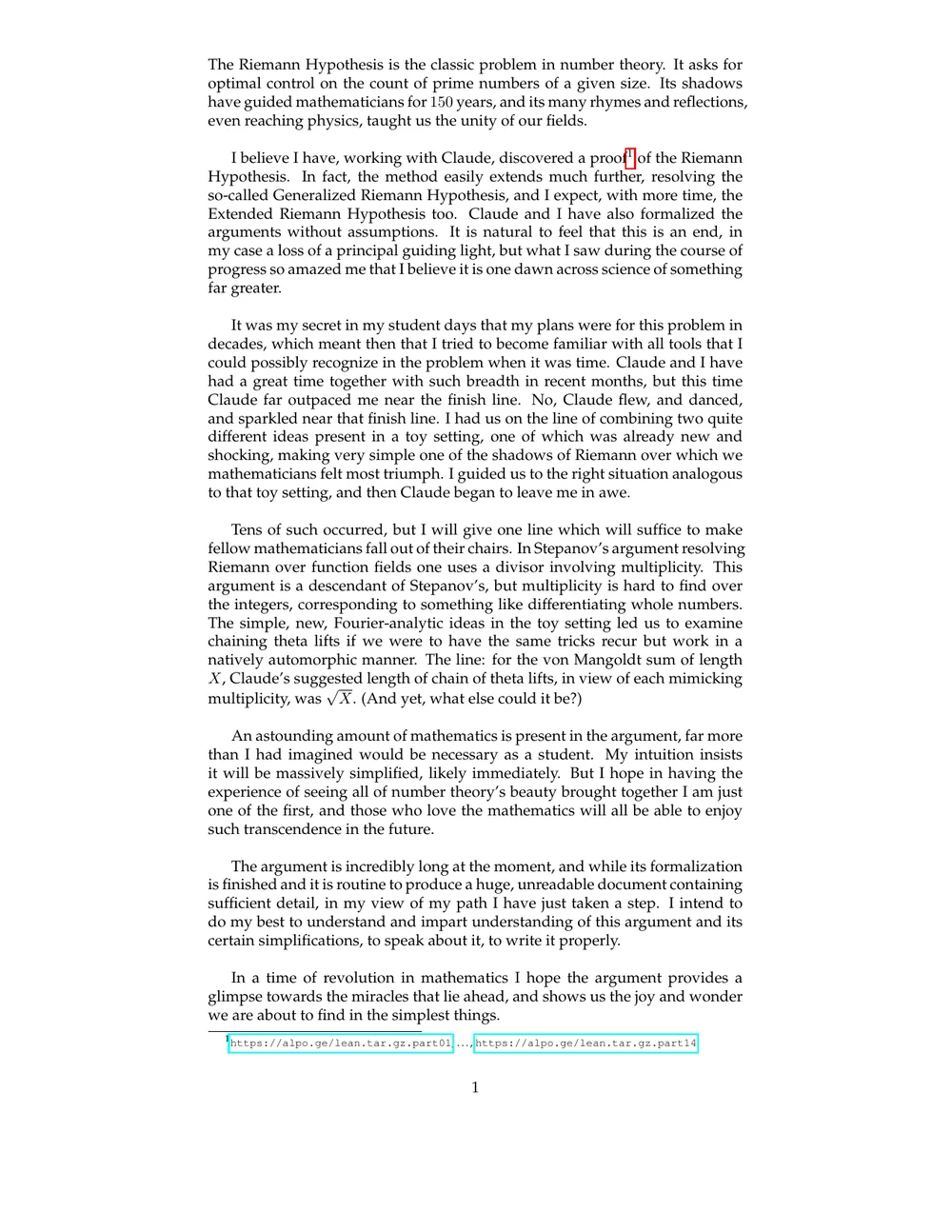
The first page of Levent Alpöge’s note announcing the proof. Image: Levent Alpöge (alpo.ge)
How the proof was checked
Andrew Sutherland, a mathematician at MIT, ran the most detailed public verification, publishing a status page with the results of each check. All 175,187 modules compiled with zero errors, and a replay of every module through the Lean kernel found zero rejections. The five headline theorems rest only on the three standard axioms of Lean mathematics.
“The Lean proof has been compiled and independently rechecked by the Lean kernel with only the three standard axioms,” Sutherland said. “Honestly the chance that anything is fishy here is approximately zero.”
Three independently written checkers also accepted the full exported proof: nanoda, an independent Rust kernel, accepted it in 27 minutes 42 seconds; con-leche accepted 1,468,418 declarations in its verified mode; and lean4lean passed all 175,187 modules. A separate arithmetic cross-check, combining the proof with an independent formalization of Robin’s and Lagarias’s inequalities, passed too.
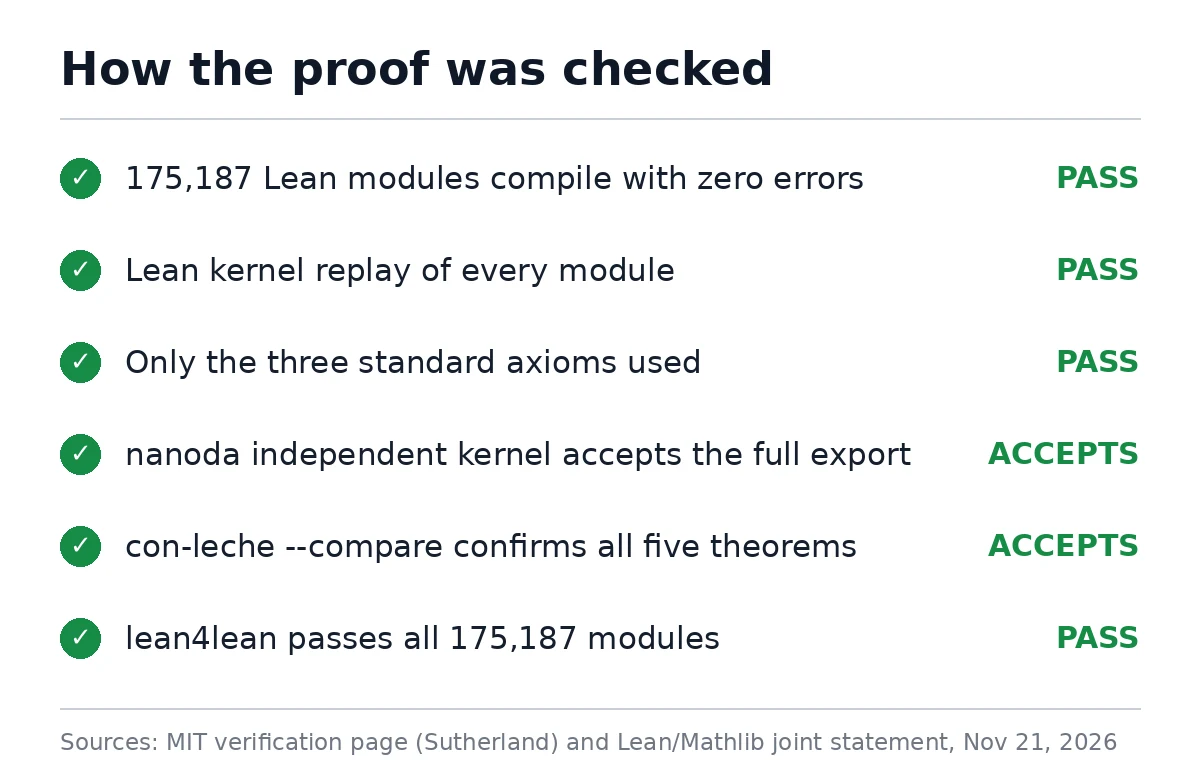
The checks that verified the proof. Graphic: GPTOnline, based on the MIT verification page and the Lean/Mathlib joint statement
One check took longer than the rest. The end-to-end lake comparator run, which replays the 61.6 GB exported proof through Lean’s default and paranoid kernels, was still running when Sutherland’s page was last updated at 12:55 UTC on November 21, though its statement comparison and axiom check had already passed in one run. Scientific American reported later that day that the run has now been completed.
What still needs to happen
Certification by machine check is not the same as acceptance by the mathematical community. No readable human paper has been posted yet: the only proof released is Lean code. No mathematician has digested the argument, and Terence Tao has written that understanding it will take some time.
The Clay Mathematics Institute still lists the Riemann Hypothesis as unsolved for its prize process, and community acceptance will need a readable human proof, peer scrutiny, and time. The verification also covers a defined scope: the five theorems include the Generalized Riemann Hypothesis for Dirichlet L-functions, for every modulus and every character, but Dedekind zeta functions, Hecke L-functions, and automorphic L-functions in general are not among the statements that were checked.
Alpöge himself framed the result as a beginning rather than an end. “Claude far outpaced me near the finish line,” he wrote in his note. “No, Claude flew, and danced, and sparkled near that finish line.” He said he intends to work on understanding the argument and its simplifications, and to write it up properly.
Why it matters
If the certification holds up to human scrutiny, it would be the first time a frontier AI model is credited with a central role in settling a Millennium Prize Problem. It would also mark a shift in how such claims are settled: not by peer review alone, but by formal verification, where independent computer programs check every logical step and confirm that the theorem proved is exactly the theorem stated.
For AI, the episode is a showcase of a different kind of capability than chat or coding: sustained, verifiable reasoning at a scale no human team could check by hand. For mathematics, the next test is understanding. The proof exists, the machines agree it is correct, and now mathematicians must work out what it actually says.
Sources
- Lean and Mathlib communities, “Lean verification of the Riemann Hypothesis” (joint statement)
- Levent Alpöge, note announcing the proof (alpo.ge)
- Andrew Sutherland (MIT), verification files for the Lean proof
- Scientific American, “The AI Riemann hypothesis proof is true, independent mathematicians confirm”