OpenAI has introduced MedChemBench, a benchmark that tests whether AI models can reason through the decisions medicinal chemists make when searching for promising drug candidates. The company announced the benchmark on November 20, and reported that its newest model, GPT-6.2 Astra, earned 84.5% of the available credit at the highest shared reasoning setting.
MedChemBench contains 99 problems drawn from 117 papers and patents and covers 761 distinct molecular structures. The tasks ask a model to connect a molecule’s structure with experimental evidence, explain results, compare compounds and predict their properties, the same tradeoffs chemists weigh when a compound that works well against a disease target is poorly absorbed or breaks down too quickly in the body.
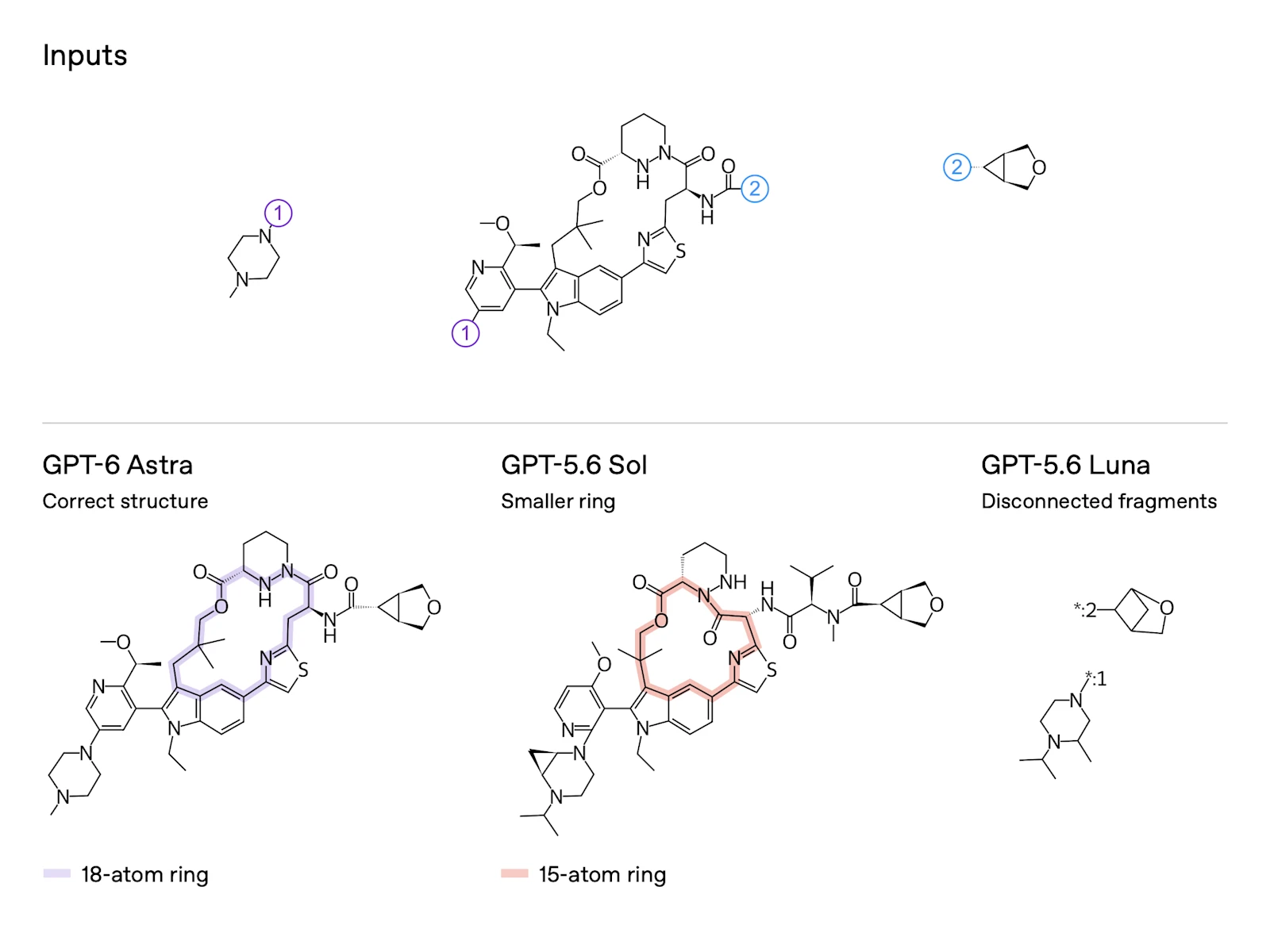
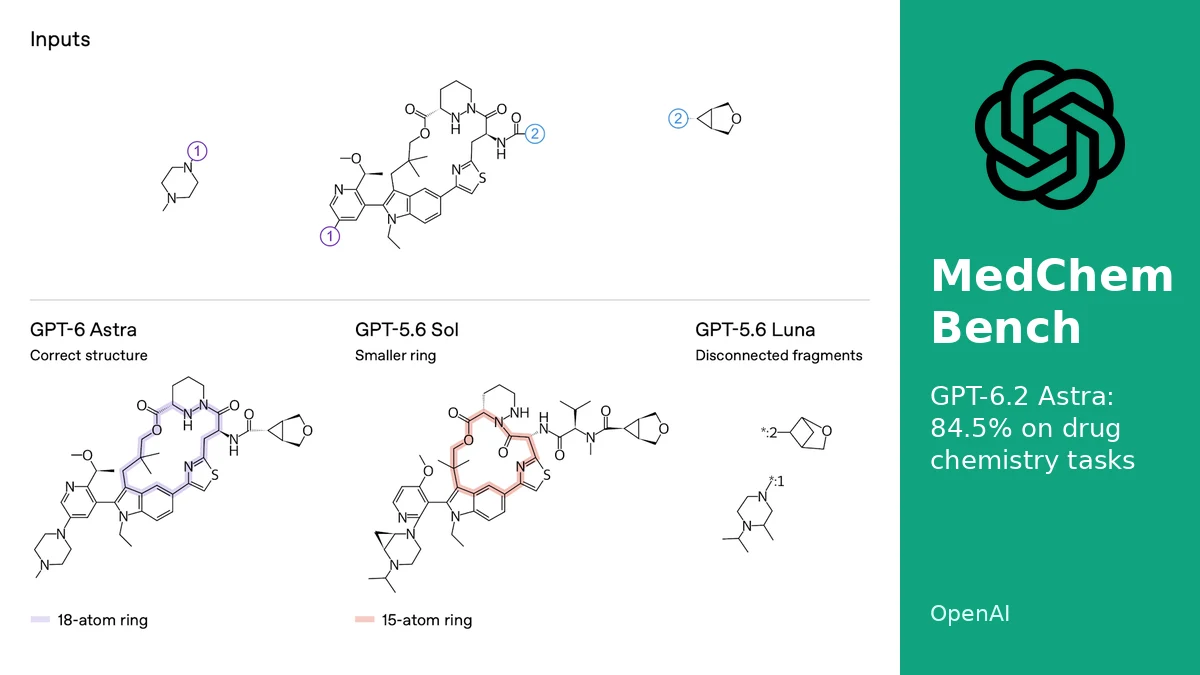
Image: OpenAI. GPT-6 Astra rebuilt the 18-atom ring correctly; GPT-5.6 Sol produced a smaller ring and GPT-5.6 Luna produced disconnected fragments.
What MedChemBench grades
The benchmark evaluates four components: molecular structures, scientific reasoning, ranking and selection, and property predictions. For most problems, the model receives the context available at a chosen point in a research program: the biological target, the researchers’ goals, the compounds studied so far and selected experimental findings.
One problem draws on research into inhibitors of PRMT5, a protein studied in cancer drug discovery. The model must predict how three related compounds will behave: how strongly they block PRMT5 in cells, how readily they cross a cell barrier, and how quickly liver enzymes break them down in a laboratory assay. Later experiments, withheld from the model, showed a tradeoff: one compound blocked PRMT5 at a lower concentration, while another crossed the cell barrier more readily and broke down more slowly.
The scores, and where models still struggle
At the xhigh reasoning setting, GPT-6.2 Astra earned 84.5% of the available credit, ahead of GPT-6 Astra at 83.3%, GPT-6.1 Sol at 82.0% and GPT-5.6 Sol at 58.2%. GPT-6.1 Terra scored 75.1%. At maximum effort, GPT-6 Astra reached 83.8%. OpenAI evaluated 11 GPT models across the benchmark.
The shape of the results matters more than the ranking. GPT-6 Astra earned 95.4% of the available credit for reconstructing molecular structures, and it rebuilt an 18-atom ring correctly in all 10 responses to one problem. GPT-5.6 Sol and GPT-5.6 Luna failed that problem in all 10 responses: Sol produced a 15-atom ring, while Luna split the molecule into two disconnected fragments.
But on the decisions that gate real drug discovery, the same model earned only about half the available credit. Selecting compounds and predicting numerical properties remain difficult, OpenAI says, even though Astra correctly identified structural changes and weighed their possible effects on protein binding, absorption and metabolism in selected examples.
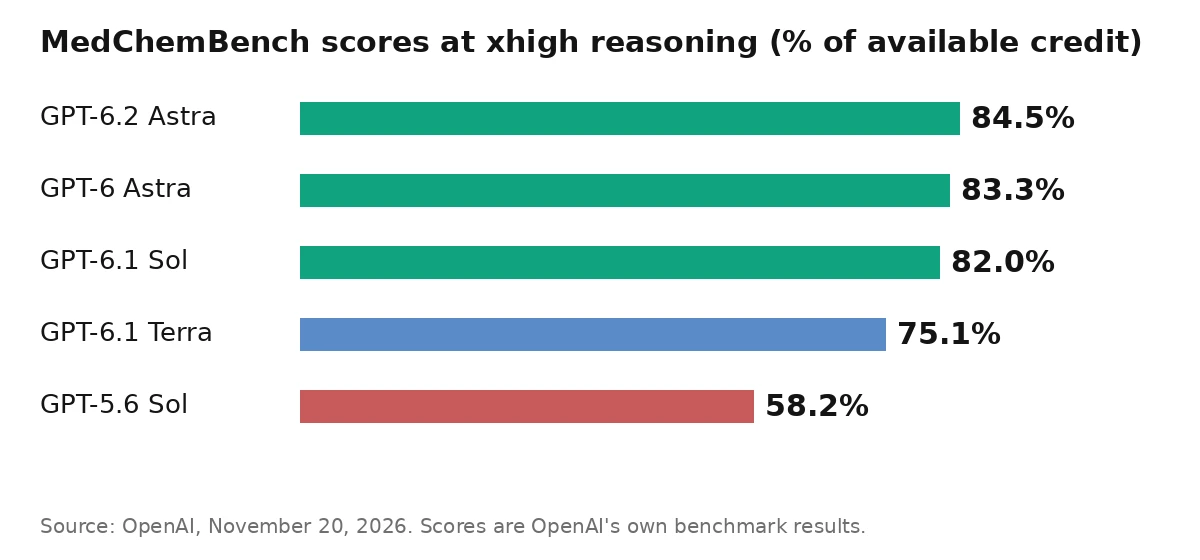
Graphic: GPTOnline, using data from OpenAI. MedChemBench scores at the xhigh reasoning setting.
What the scores do not prove
OpenAI states the limits plainly: “These results do not establish whether models can discover new drugs or improve laboratory decisions.” The benchmark measures reasoning from historical evidence rather than real-world drug discovery, prior exposure to the published sources cannot be ruled out, and each response was a single attempt without tools, feedback or new experiments.
The benchmark also appears close to saturation in its current form, according to the accompanying paper, and open-ended design and synthesis grading remains partly tied to reference answers, which may penalize plausible alternatives. Even so, MedChemBench gives the field a sharper diagnostic than generic science tests: it separates chemical comprehension, where the newest models are strong, from the judgment calls where they still fail about half the time.
Why it matters
Drug discovery is one of the most cited promises for AI in science, and also one of the hardest to measure honestly. A model that can assemble a molecule correctly but cannot pick the right candidate or predict its properties is a useful assistant, not a replacement for a medicinal chemist. By publishing the weak spots alongside the headline score, OpenAI has set a standard other labs will now be measured against, and given researchers a concrete map of where the next gains need to come from.