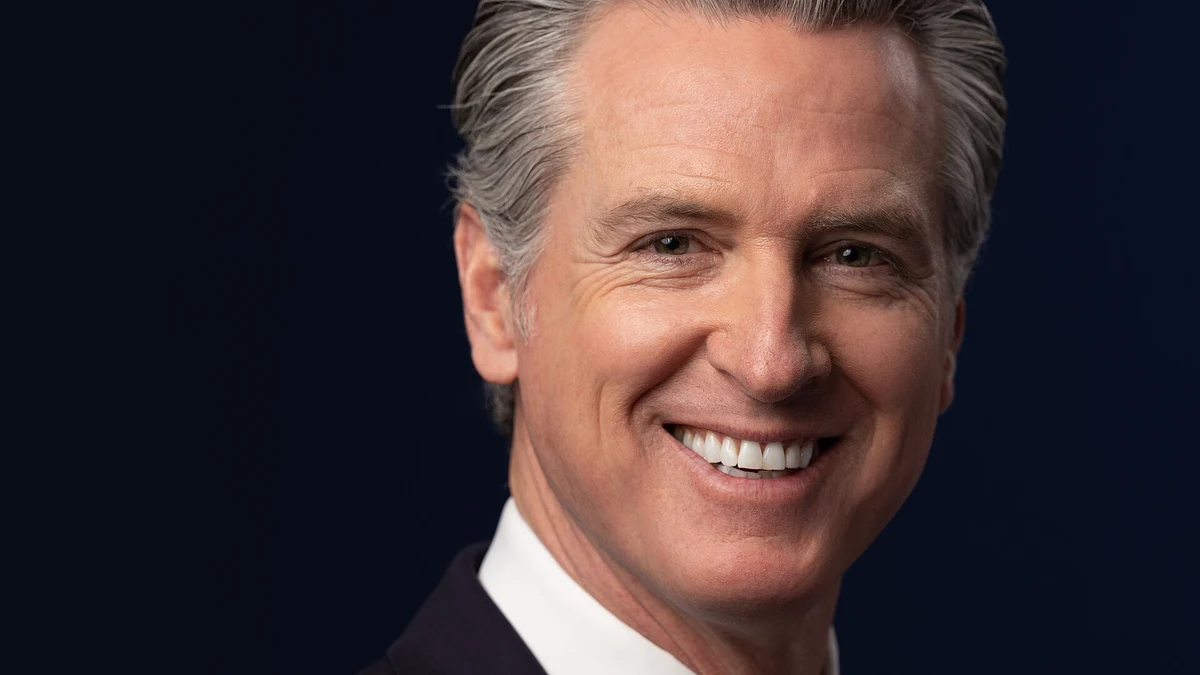
California Governor Gavin Newsom on November 18, 2026 unveiled recommendations that would give the state broad new powers over the AI industry, including the authority to order an emergency shutdown of a dangerous AI model and to cap AI systems that design their own successors. The plan is the most ambitious attempt yet by a US state to replace voluntary AI safety commitments with mandatory rules.
The proposals come in a report titled “AI Safety in 2026 and Beyond,” prepared by the California Government Operations Agency and dated November 16. It answers Newsom’s September 18 executive order, which asked a group of national experts to recommend updates to the state’s AI safety laws and to explore how the state could make sure dangerous models can be shut down before causing harm.
What the Plan Proposes
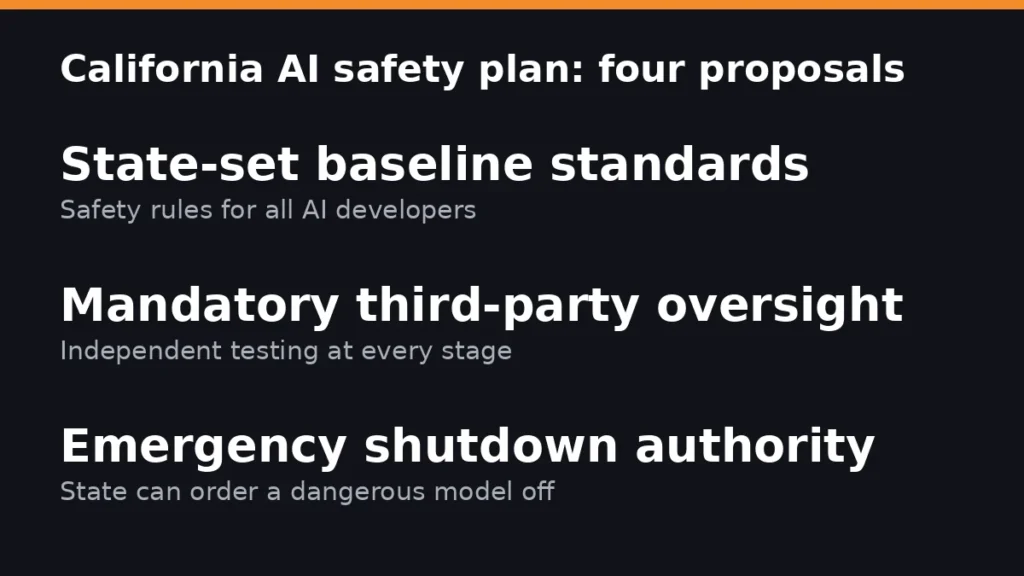
The report’s recommendations fall into four areas. First, the state, not the companies themselves, should set baseline safety, security and transparency standards that all AI developers must follow, and require companies to undergo independent safety testing and verification through all stages of model training, development and deployment. Second, oversight by independent third parties should be mandatory and ongoing, not voluntary.
Third, the state should expand safety incident reporting and require companies to develop verified risk-containment protocols to shut down their models if needed, giving California the authority to order an immediate shutdown in an emergency. Fourth, the state should gain the power to cap the development and use of recursive self-improvement, known as RSI, a potentially dangerous scenario in which an AI model can design its own successor without human input.
“The federal government’s reckless failure to create any form of meaningful AI oversight or accountability should alarm every American,” Newsom said in the announcement. “California isn’t waiting until it is too late. We are updating and strengthening our nation-leading framework to move as quickly as technology evolves.”
Who Wrote It
The expert group advising on the report includes Jason Goldman, a board member of the Center for Shared AI Prosperity and the first White House Chief Digital Officer; Gillian Hadfield, a professor at Johns Hopkins University focused on AI alignment; Alondra Nelson, a professor at the Institute for Advanced Study and former acting director of the White House Office of Science and Technology Policy; and Rob Reich, a Stanford professor and former senior advisor to the US AI Safety Institute.
“Recent events have made it clear that more oversight and transparency are urgently needed,” said Government Operations Agency Secretary Nick Maduros. “We don’t have to choose between safety and innovation; they are two sides of the same coin.”
Nelson was blunter about the industry’s record, saying that “that irresponsible culture cannot continue” and that the public deserves “no experimenting on the public.” Reich added that “today there is more oversight of the cafeteria offering sandwiches to employees at a frontier AI developer than of the AI models they design.”
Building on California’s Existing Laws
The recommendations build on a framework California has assembled over the past three years. In 2025, Newsom signed SB 53, the Transparency in Frontier Artificial Intelligence Act, the nation’s first AI safety law, requiring frontier developers to disclose safety frameworks and report critical incidents. In 2026, he signed SB 813, creating a framework for certifying independent verification organizations, and AB 1405, creating a state registry for AI auditors.
The new plan goes further than any of those laws in one important respect. In 2024, Newsom vetoed SB 1047, a bill that would have mandated kill switches and safety testing for the largest models, arguing that its requirements applied too broadly. The new recommendations revive the shutdown idea, but as a state power to order a shutdown in an emergency, rather than a blanket mandate on every developer.
What Happens Next
None of the recommendations is law yet. The report is pitched as a roadmap for legislation that Newsom wants state lawmakers to pass, and Politico reports the governor is casting the plan as a model for the nation as he prepares for a likely presidential run. The legislature returns next month, and Newsom leaves office in January after two terms, so the window to turn the proposals into law is short. The companies most affected have not publicly responded to the report. Whether California can move from recommendations to enforceable rules before Newsom departs will determine whether the plan becomes a national template or a parting statement.