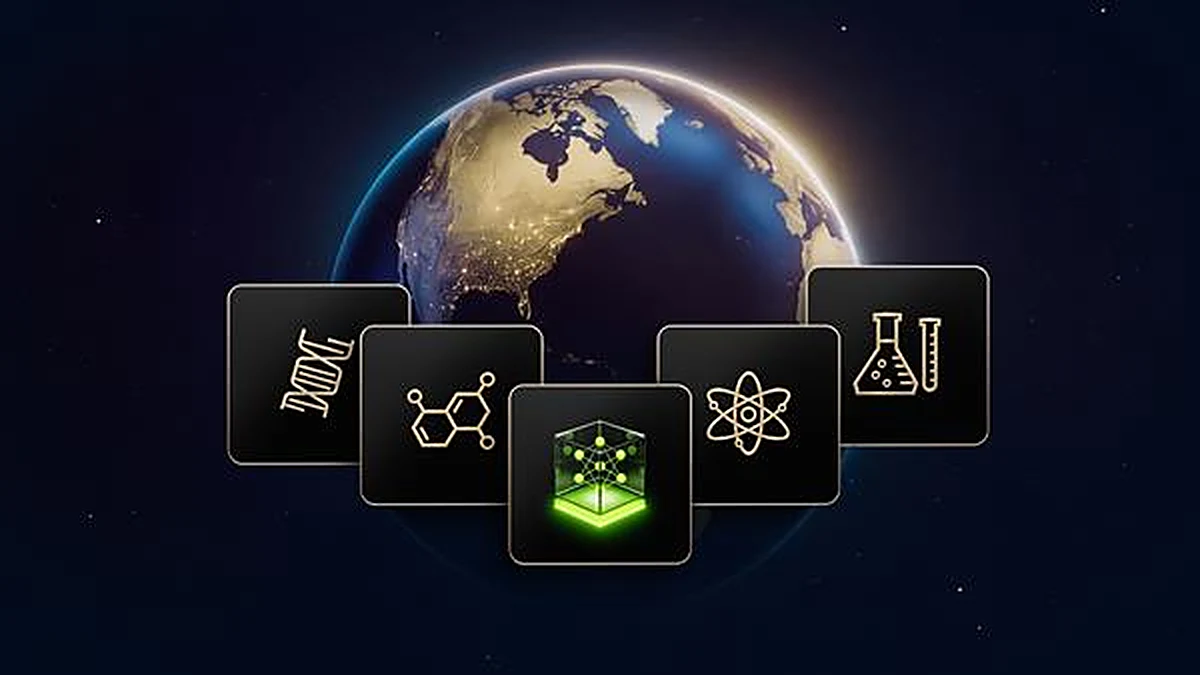
NVIDIA has introduced Nemotron for Science, a package that turns its open Nemotron 3.5 Super VL model into a toolkit for building specialized AI agents for scientific research. Announced on Monday, November 16, at the SC26 supercomputing conference in Chicago, the package pairs the model with scientific evaluations, a new open chemistry dataset called LitmusBench v0.2, and post-training recipes that adapt the model to laboratory work.
The model itself is not new. Nemotron 3.5 Super VL arrived on Hugging Face on October 15, 2026, as a 120-billion-parameter mixture-of-experts model with 12 billion active parameters per token, a context window of up to one million tokens, and text, image, and video inputs. What is new is the science layer around it: the dataset, the evaluations, and the recipes that show researchers how to tune the model for chemistry, protein design, and materials science.
What Was Announced?
Built on Nemotron 3.5 Super VL, Nemotron for Science helps researchers develop agents that reason through scientific problems and put specialized research tools to work, according to NVIDIA. With post-training, scientists can adapt the model to tasks such as conducting chemistry experiments and designing proteins, then plug the result into agent workflows that interpret scientific information, generate code, and call computational tools, including NVIDIA CUDA-X accelerated software.
“Accelerated computing is transforming how scientists tackle the world’s most complex challenges,” said Ian Buck, vice president of hyperscale and high-performance computing at NVIDIA. “Nemotron for Science gives researchers open models, scientific data and post-training recipes to build specialized agents that reason through scientific problems and use CUDA-X accelerated tools to turn ideas into discoveries.”
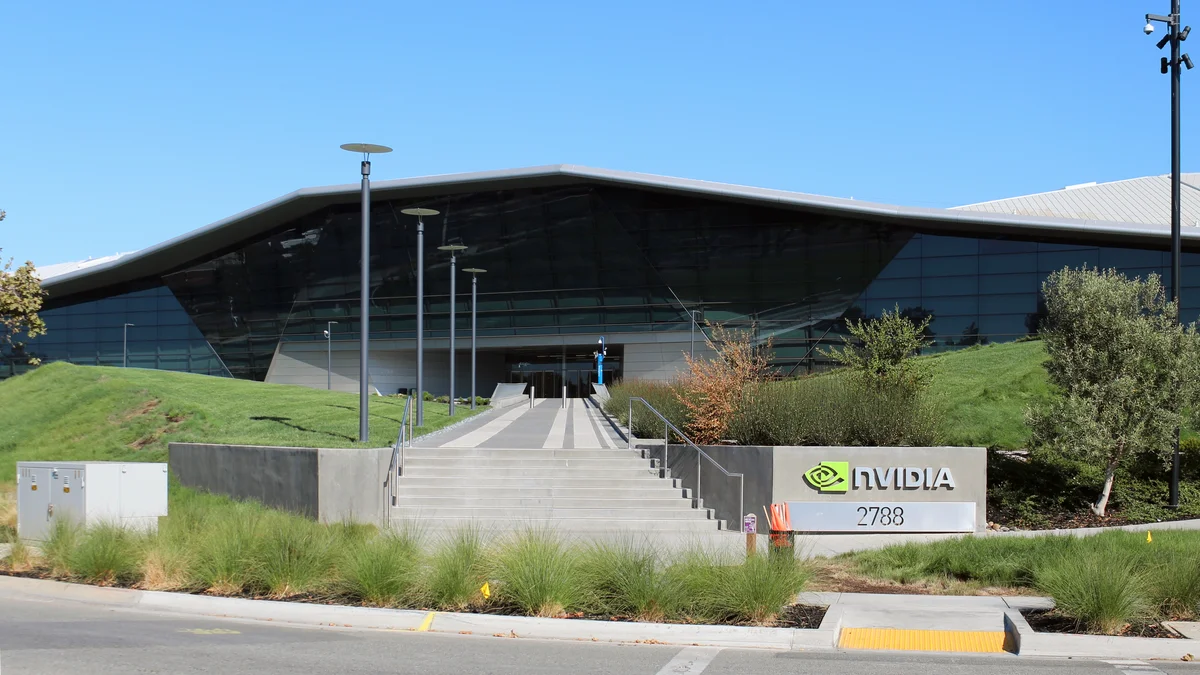
NVIDIA headquarters in Santa Clara, California. Image: Coolcaesar / Wikimedia Commons (CC BY-SA 4.0).
LitmusBench v0.2: Nearly 50,000 Chemistry Questions
At the center of the package is LitmusBench v0.2, a new open dataset with nearly 50,000 questions for training and evaluating language models on chemistry reasoning. Drawing on molecular properties and experimental drug-discovery data, it tests whether models can predict how molecules behave, including their solubility and how the human body processes them.
The dataset supports both evaluation and post-training, so researchers can measure a model’s chemistry skills and then improve them with the same material. That matters because scientific claims need a check that goes beyond a language model’s own confidence: experimental data, laboratory feedback, or domain software can score the model’s answers, turning a general purpose system into one that is tuned for a specific scientific job.
Early Results From Life Sciences Partners
Three life sciences companies are already using and customizing the model, and NVIDIA reported task-specific gains for each of them.
Terray Therapeutics post-trained Nemotron to extract reactants, products, and reaction conditions from scientific diagrams, surpassing previously published results on two benchmarks. On the RxnScribe test, it recovered about 76% of annotated reactions under the benchmark’s matching criteria, helping turn published chemistry into structured data for synthesis planning.
Lila Sciences used Nemotron to design execution-ready laboratory protocols for its automated labs. Post-training with laboratory feedback nearly doubled the model’s accuracy for making quantum dots, nanoscale crystals used in screens and solar panels, to 61%, exceeding GPT-6 Astra’s 54% at 10 to 20 times lower inference cost, according to NVIDIA.
Therna collaborated with NVIDIA to post-train Nemotron for agentic mRNA therapeutic design, nearly doubling accuracy in predicting protein-expression ranges over frontier models. Scientists preferred its explanations over those from the base model in 96% of comparisons, NVIDIA said.
Research Labs Put It to Work
Major research institutions are integrating the model into their own discovery agents. Argonne National Laboratory is building it into StructBioReasoner, a multi-agent system that designs and evaluates protein-based therapeutic candidates for cancer and other diseases. The Julich Supercomputing Centre is integrating it into scientific-discovery agents, and RIKEN has made Nemotron models available on its RIKYU AI supercomputing platform through its RiVault inference gateway.
One of the most concrete demonstrations came from KTH Royal Institute of Technology, which built a Nemotron agent that repairs broken GROMACS molecular-dynamics setups on its own. In one overnight run on a single NVIDIA DGX Spark system, the agent fixed 81% of test cases with reasoning enabled, and every fix was checked independently by GROMACS itself.
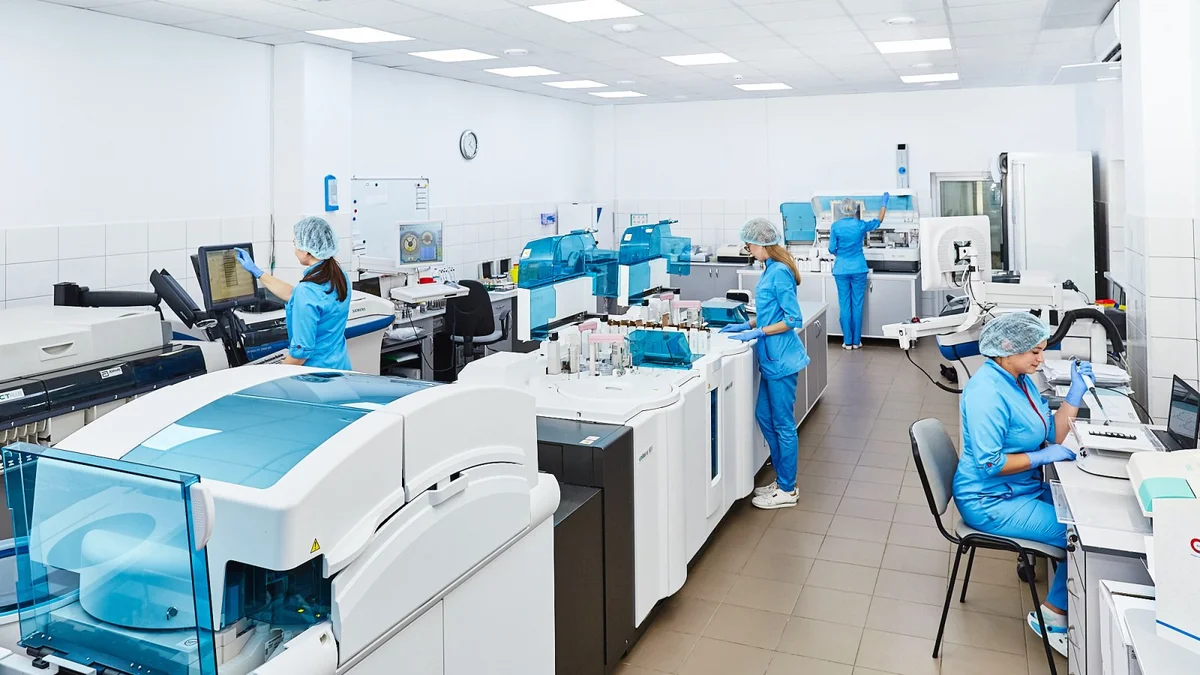
Researchers at work in a laboratory. Image: Wikimedia Commons (CC0).
Availability
Nemotron 3.5 Super VL and the LitmusBench v0.2 chemistry dataset are available now on Hugging Face. The model was also optimized to run locally on a 128GB DGX Spark system, giving research organizations a route to run scientific workflows on infrastructure they control, from individual desktops to supercomputing centers. The model is released under the OpenMDW-1.1 license, which permits commercial and non-commercial use.
Why It Matters
NVIDIA is aiming at a gap between general purpose AI models and the verification that science demands. A chatbot can sound convincing about a molecule; a research agent needs its answers checked against measurements, and Nemotron for Science is built around that check. The dataset, the recipes, and the laboratory feedback loops all point in the same direction: models that are scored by experiments, not by other models.
The results NVIDIA cites are task-specific and vendor-reported, so they show what post-training can do on narrow jobs rather than proving general laboratory autonomy. Even with that limit, the package is a sign of where open models are heading: not just bigger, but packaged with the data and tooling a field needs to use them. NVIDIA has been building out the Nemotron family for months, including an open-weight speech model for 40 languages released in October, and the Science package extends that strategy from general agents into the laboratory.
Sources
- NVIDIA Introduces Nemotron for Science to Accelerate Discoveries With Agents (NVIDIA via GlobeNewswire, November 16, 2026)
- NVIDIA Nemotron 3.5 Super VL model card (Hugging Face)