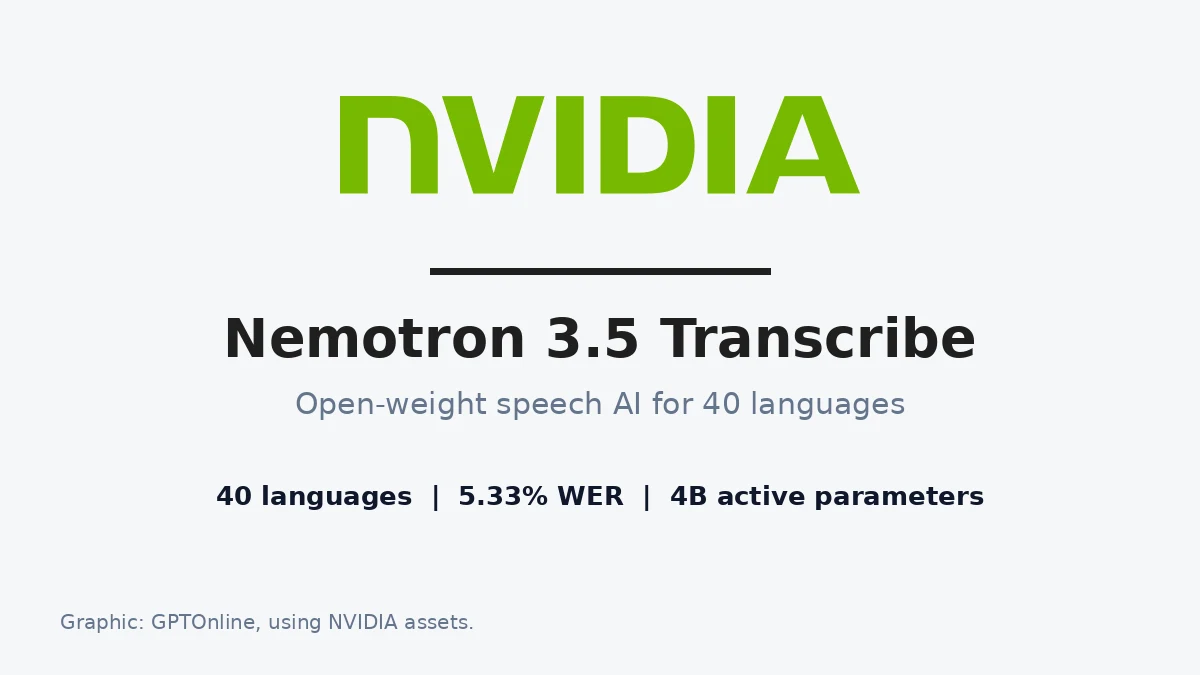
NVIDIA has released Nemotron 3.5 Transcribe, a free, open-weight speech model that folds transcription, translation, speaker attribution and audio question answering into a single checkpoint. Announced on October 28, 2026, the model transcribes 40 languages, translates 31 of them to and from English, and labels up to eight speakers in recordings up to an hour long. NVIDIA’s announcement describes it as “an open-weight, promptable model that turns recorded speech into useful text.”
The release targets developers building meeting transcription and medical dictation tools, two of the most established uses of AI speech in the workplace. Instead of chaining separate models for each step, developers can steer one model with plain-language instructions, asking it to transcribe a call, label each speaker, translate the audio, or answer questions about what was decided.
One Model, Four Jobs
Transcribe is built as a 30-billion-parameter mixture-of-experts model, pairing a speech encoder with a hybrid Mamba-Transformer language model. Only about 4 billion parameters are active per token, which keeps it small enough to run on a single GPU, from a Jetson AGX Thor edge device or a DGX Spark desktop up to Blackwell data center hardware.
Developers can guide the output with natural language and pass in lists of jargon or names so specialized vocabulary is spelled correctly. The model also returns word-level timestamps, and it supports prompt presets for tasks such as reasoning about audio questions. NVIDIA notes that audio question answering is trained in English, and that language support differs by task.
Benchmark Results
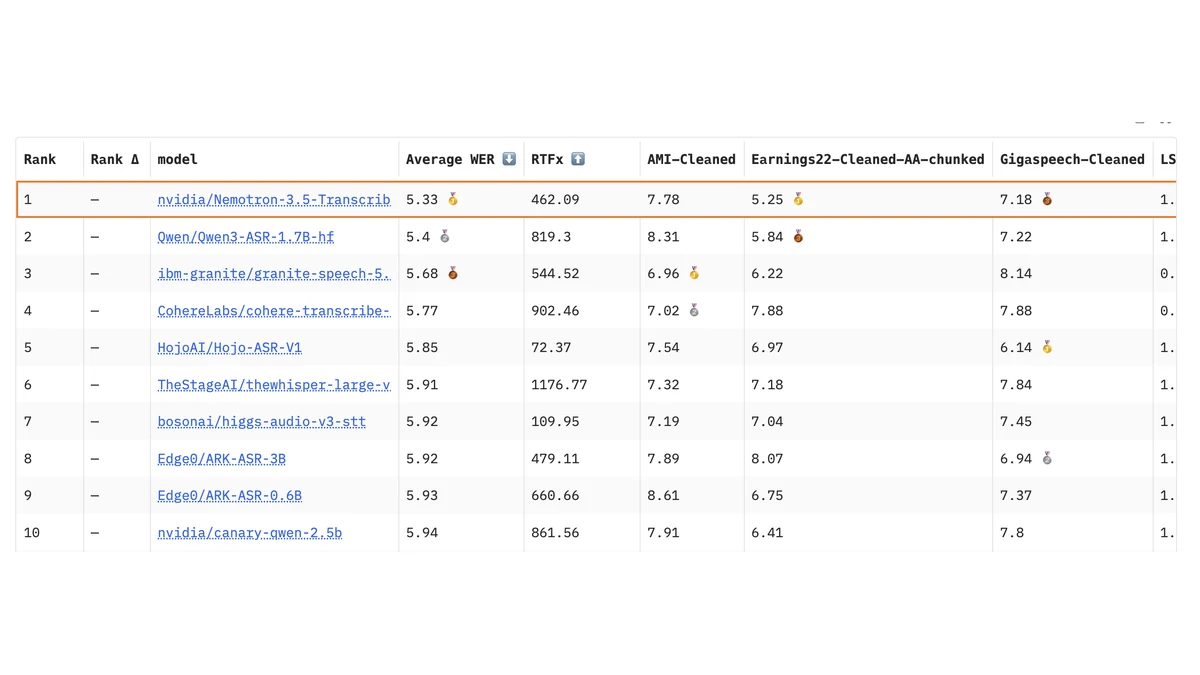
NVIDIA claims Transcribe leads open-weight rivals on several public leaderboards. On the Hugging Face Open ASR Leaderboard for English, it ranks first among open-weight models at 5.33% average word error rate, with 4.62% mean WER across seven languages in the multilingual track and 10.98% in the long-form track.
Artificial Analysis, which ranks speech-to-text models independently, reports that Transcribe ties for first among open-weight models at 2.8% AA-WER, matching Mistral’s Voxtral Small while activating about 4 billion parameters against the rival’s 24 billion. On AA-AgentTalk, a held-out set of voice-agent speech, Transcribe scores 1.8% WER, against 2.3% for the next-best open-weight model.
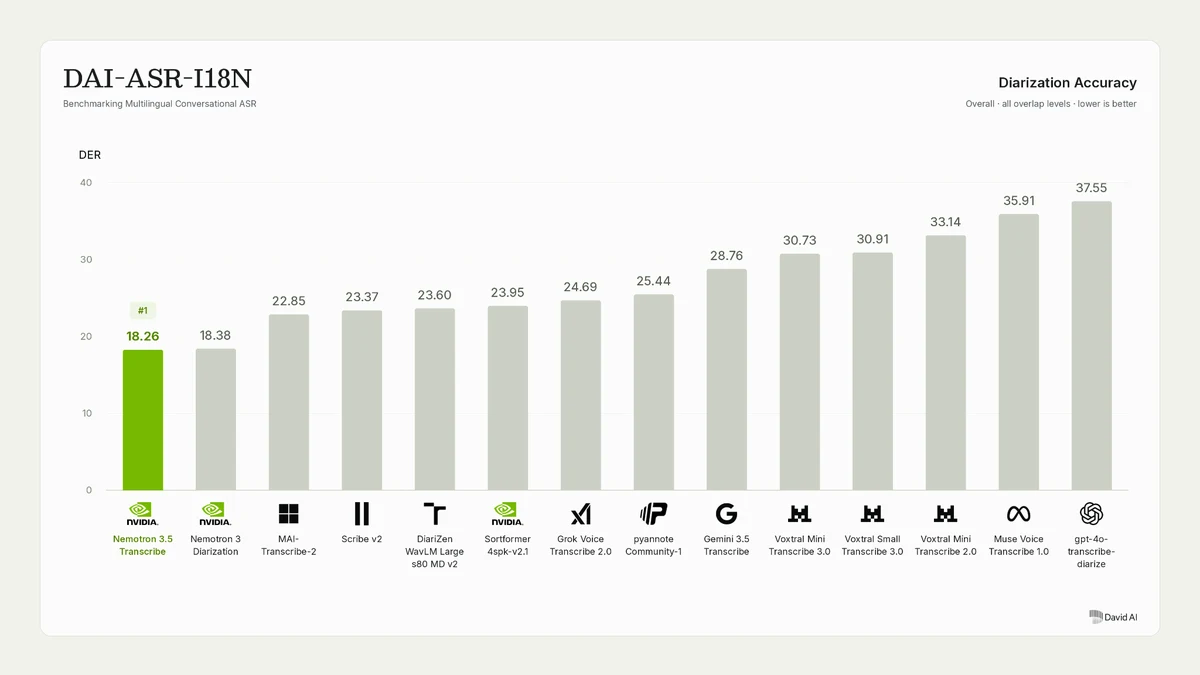
For speaker attribution, Transcribe posts the lowest diarization error rate, 18.26%, across 21 languages on David AI’s leaderboard, and ranks first in VoiceArena’s 14-system comparison of diarization plus transcription.
Granary v2: The Data Behind the Model
Alongside the model, NVIDIA released version 2 of Granary, its open speech dataset and curation pipeline. The public manifest covers 463,062 hours across 48 languages and 16 source corpora, up from 25 languages in Granary v1. The pipeline produces three transcript forms for each recording, plus audio captions, code-switching restoration, speech-grounded question answering pairs and translations with quality scores.
Developers can run the pipeline on their own recordings, and NVIDIA’s NeMo Speech fine-tuning tools extend prompt-level control into training. In a medical case study on recordings from Indian doctors and medical students, fine-tuning cut word error rate on held-out speakers by 45.8% relative to the best prompt.
Availability and Limits
The model is available now on Hugging Face and ModelScope under the OpenMDW-1.1 license, for commercial or non-commercial use, with hosted endpoints from Baseten, DeepInfra and Simplismart and an interactive demo on Hugging Face Spaces. In benchmarking, one RTX PRO 6000 Blackwell Server Edition GPU processed 100 hours of audio in under three minutes using the forthcoming NVFP4 quantized version, measured on 30-second clips at high concurrency.
One limit matters for buyers: Transcribe is built for recorded audio, not live streaming. If the use case needs real-time captions, this is not the tool. Quantized versions for local deployment on RTX Spark, DGX Spark and Jetson AGX Thor are coming soon.
Why It Matters
Speech is having a crowded month. Mistral shipped Voxtral 3 earlier in October, ElevenLabs launched Realtime for instant voice agents, and Salesforce released Launa-Omni. NVIDIA’s entry stands out because it is open-weight and promptable, and because it bundles the data pipeline that trained it. For teams building meeting or medical transcription, the combination of a downloadable model, a 463,000-hour open dataset and fine-tuning recipes lowers the cost of adapting speech recognition to a specific domain, from a hospital’s terminology to a call center’s product names. The benchmark claims are strong, but they are NVIDIA’s own framing of third-party leaderboards, so independent testing on real-world audio will be the real test.