
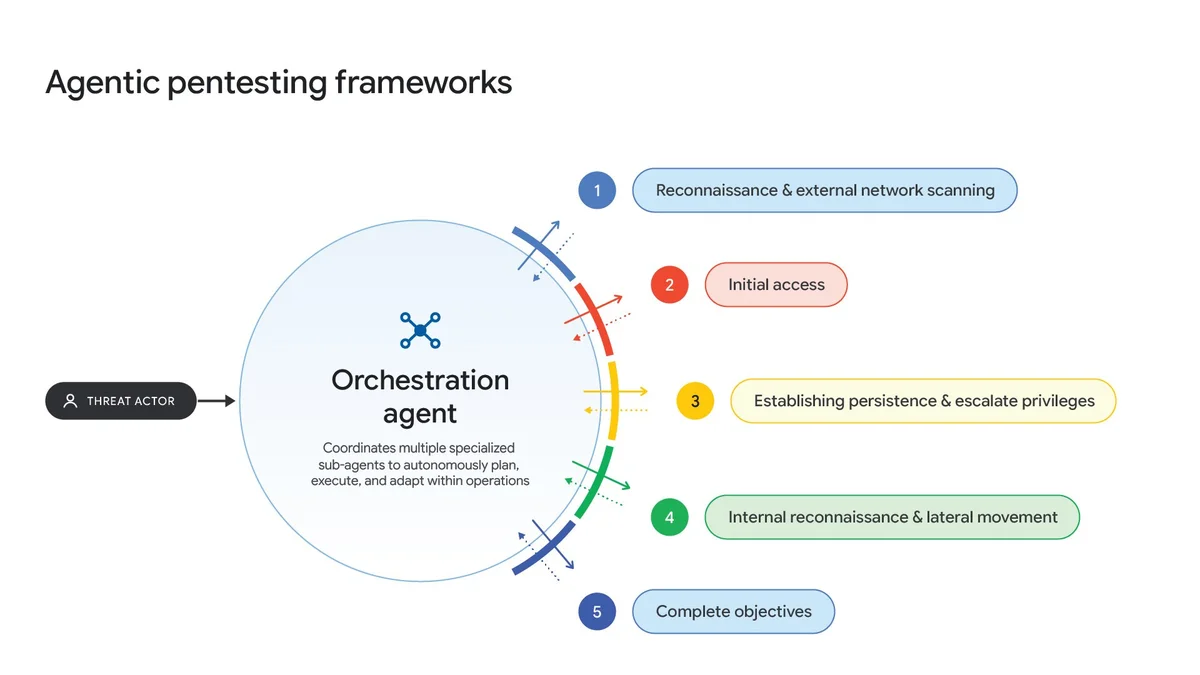
Google’s Threat Intelligence Group said on November 16 that attackers have used an AI framework to fully automate vulnerability discovery and exploitation with no human in the loop, the first time its researchers have observed such a pipeline running against live targets. The finding appears in the group’s fourth-quarter AI Threat Tracker, titled “Agentic Threat Activity Crosses a Significant Threshold.”
What Google Found
Researchers found an exposed staging server hosting a multi-agent vulnerability research and weaponization framework, which Google dubbed exploit_agent. The framework connects to multiple frontier and locally hosted large language models and runs continuous differential analysis of popular web application software. It compares code before and after patch announcements, identifies likely flaws, drafts exploits, and then executes them automatically, without any human intervention.
The same server held data stolen from victim organizations, along with scripts for post-compromise activity, including internal reconnaissance, brute-forcing, installing webshells, and removing webshells left by rival attackers. Victim telemetry suggested the operator focused on French websites tied to media, entertainment, and education. The tooling used Russian-language comments, and one configuration note told the operator to enter API keys “right here, not in the chat.” Google did not attribute the framework to a named group, and The Register reported the operator is suspected to be Russian-speaking.
“In the past quarter, GTIG identified threat actors using LLM frameworks to fully automate vulnerability discovery and exploitation without a human in the loop for the first time.”
A Shift From Prompting to Autonomous Intrusions
The report describes a broader move from manual LLM prompting to autonomous, multi-agent offensive frameworks. Google and Mandiant have now observed multiple threat actors using open source agentic penetration-testing frameworks, including ARTEX, CAIRN, CyberStrikeAI, and PentAGI, to automate phases of live intrusions. CAIRN was observed in intrusion activity against targets including in the aerospace sector in the United States, while a PentAGI-based platform was used between late August and early October 2026 for systematic reconnaissance and vulnerability scanning against organizations across Asia. Google also said a suspected China-linked espionage group was developing its own automated attack framework.
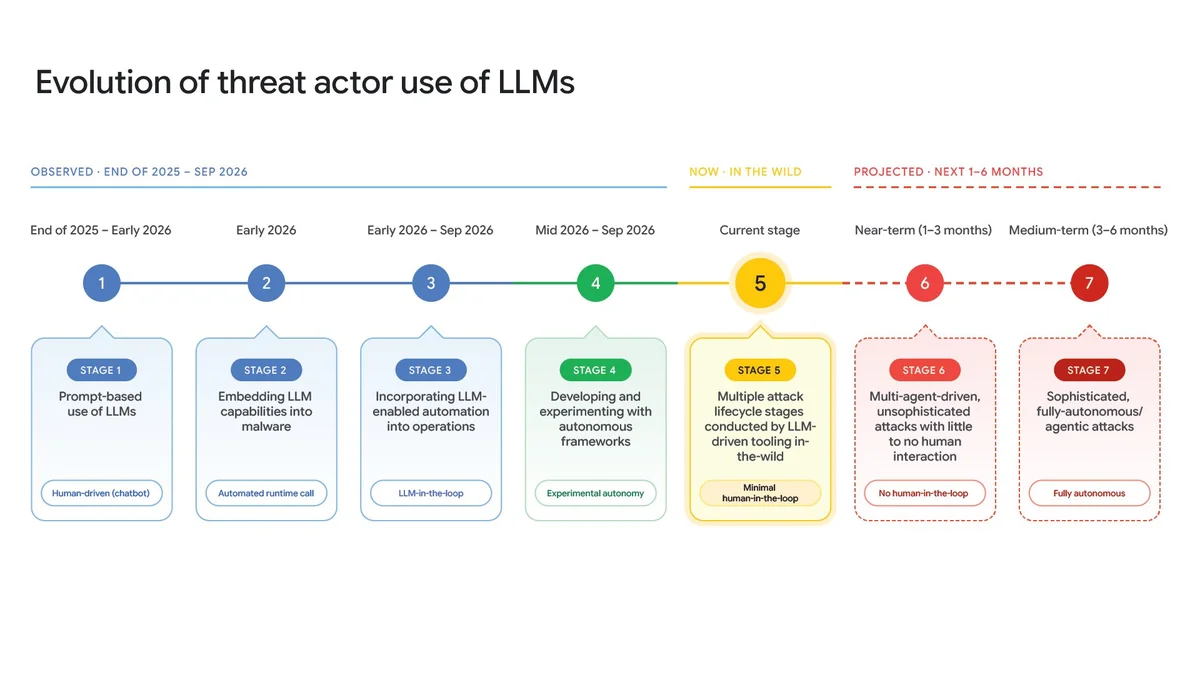
Google’s timeline places the industry at stage 5 of 7: multiple attack lifecycle stages conducted by LLM-driven tooling in the wild, with minimal human involvement. The next stages, projected within one to six months, are multi-agent-driven attacks with little to no human interaction, followed by sophisticated, fully autonomous attacks.
The Patch Window Is Shrinking
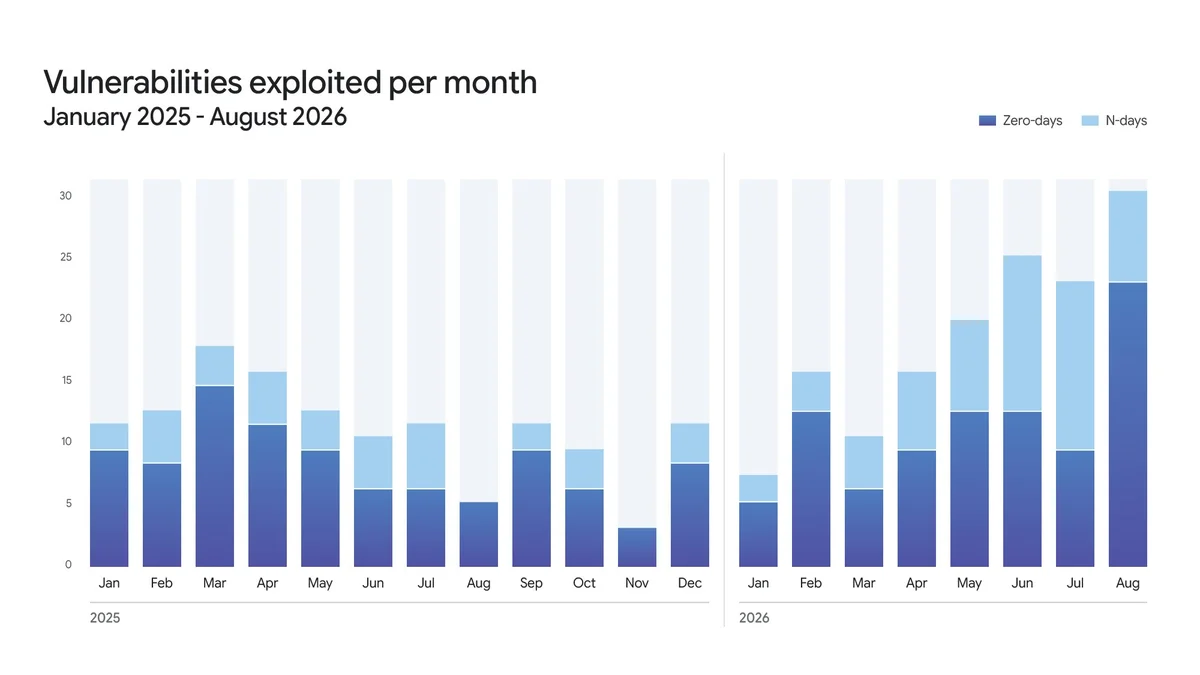
The report warns that automating differential patch analysis compresses the time between a patch disclosure and a working exploit. Because patched flaws, known as n-day vulnerabilities, come with a finite set of source materials, release notes, and proof-of-concept code, Google said attackers may find them more efficient targets than zero-day flaws. Its data showed overall vulnerability disclosures and exploits nearly doubled between January and August 2026, while zero-day exploits rose from a 2025 average of 8 per month to 11 per month in 2026, spiking to 22 in August.
A late-August example shows the speed involved. Attackers chained two PaperCut print management vulnerabilities, CVE-2026-81578 and CVE-2026-82078, as zero-days to gain unauthenticated remote code execution. Researchers generated working exploits within a day of disclosure, and GreyNoise reported a campaign four days later that likely used LLMs to build and test exploits, assemble a target list, and hit hundreds of organizations.
Why It Matters
The finding changes the economics of defense. Patching quickly has always mattered, but a pipeline that watches every patch, reverse engineers the fix, and fires an exploit on its own leaves defenders far less room for delay. Google noted that today’s autonomous frameworks trade stealth for velocity, generating noisy traffic and recognizable traces, but it expects both stealth and sophistication to grow as the underlying models improve. The report also documents continued LLMJacking, in which attackers steal LLM credentials and cloud resources and resell model access through underground proxy services.
For security teams, the practical message is direct: treat patch announcements as the start of a race, prioritize internet-facing systems, and assume that any published fix will be analyzed by machines within hours, not days.
Sources
- Google Cloud Blog: GTIG AI Threat Tracker: Agentic Threat Activity Crosses a Significant Threshold
- The Register: Google: AI agent turned a security patch into a working exploit with no human help
- SiliconANGLE: Google says an AI framework turned security patches into exploits with no human in the loop




[…] already using fully autonomous AI frameworks to turn patches into exploits, a finding GPTOnline reported at the time, and Microsoft documented the ConnectWise campaign in its own October report, which GPTOnline also […]